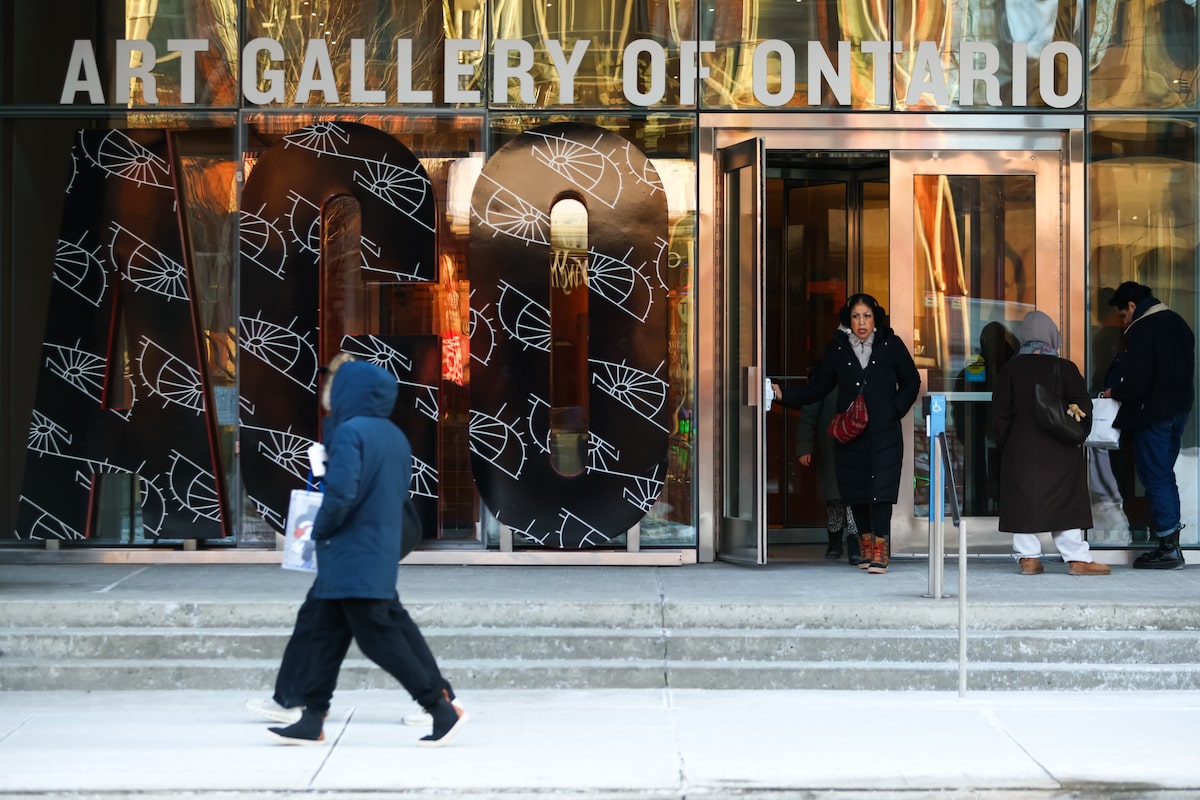
The AGO’s modern and contemporary collections committee voted 11-9 against acquiring a work by artist Nan Goldin.Cole Burston/The Globe and Mail
Jewish-American photographer Nan Goldin has joined numerous progressive Canadian Jewish groups in pressing Art Gallery of Ontario trustee Judy Schulich to step down from its board after documentation showed Ms. Schulich acted to prevent the gallery from acquiring one of Ms. Goldin’s works.
The saga, Ms. Goldin said in an e-mail to The Globe and Mail, “cracks open the door so we can see how the board uses its wealth and power to protect their own interests and to try to control curatorial decisions.” She added in an interview that the gallery “has been disgraced. They should be doing everything they can to win back the public’s confidence.”
The Globe first reported last week that the AGO declined to acquire Ms. Goldin’s video work, Stendhal Syndrome, after its modern and contemporary collections committee voted 11-9 against it. The work was to be co-acquired with the Vancouver Art Gallery and Minneapolis’s Walker Art Center; those galleries later acquired it.
AGO rocked by resignations after failed Nan Goldin acquisition
A memo by AGO director and chief executive Stephan Jost, which was obtained by The Globe, showed that some committee members alleged in a meeting in May 2025 that Ms. Goldin’s views on Israel were “offensive” and “antisemitic.” Ms. Schulich, further documentation showed, prompted the heated discussion that led to the vote against acquiring the work.
The gallery’s modern-and-contemporary curator John Zeppetelli, who had advocated for the acquisition of Stendhal Syndrome, resigned from his full-time position following the vote, as did three volunteer members of the committee who were dismayed with how the events unfolded, the Globe reported last week. “It shows a great deal of courage and adherence to their beliefs,” Ms. Goldin said of their resignations. “I’m grateful to them.”
The photographer, 72, has had a career coloured by activism – including during the AIDS crisis, and later the opioid crisis. In a 2024 speech at Berlin’s Neue Nationalgalerie, she shared her “moral outrage at the genocide in Gaza and Lebanon.” She levelled criticism at Israel for the tens of thousands of deaths reported since it launched its war on Hamas in 2023, after the group’s Oct. 7 attacks, which left 1,200 dead in Israel and 251 others taken as hostages.
“The false conflation of antisemitism and anti-zionism is being used as a weapon to silence voices speaking out in support of Palestine,” Ms. Goldin told The Globe. “It’s a tool used by Israeli propagandists and I find it alarming that it still has credibility. It’s become the great exception to free speech.”
Gallery governance experts have warned there can be dangerous consequences when political viewpoints are brought into acquisitions discussions at public galleries. The AGO has acknowledged in statements to The Globe that the May, 2025, discussion, which included allegations of antisemitism against Ms. Goldin, prompted a governance review and subsequent “reset” of its processes.
“Our reset is to ensure that conversations remain focused on an artwork’s alignment to the AGO’s acquisition criteria, are healthy and productive, and welcome multiple perspectives,” AGO spokeswoman Laura Quinn told The Globe last week.
Ms. Schulich is an executive with the Schulich Foundation, which bills itself as one of Canada’s largest private foundations, and which was seeded by her father, the billionaire entrepreneur Seymour Schulich. She has a keen interest in art, having studied the market at Christie’s in New York, and has sat on numerous gallery boards.
Ms. Schulich has not responded to numerous requests for comment over the past week, including for this story.
“I would think, after this exposure and the outcry, that she would resign from the board or that the gallery would pressure her to,” Ms. Goldin said. “I understand that the museum is in danger of losing its credibility.”
The photographer credited her friend David Wojnarowicz, who died of AIDS-related illness in 1992, for imbuing her with a skepticism of gallery and museum boards. In that era, she said, they were censoring work by queer artists and artists whose work embraced racial justice. In the 2010s, she became a leading name in the pushback against the influence of the Sackler family, owners of OxyContin maker Purdue Pharma LP, in the institutional art world.
More recently, she said, she’s noticed a chill in the institutional art world around artists such as herself who openly signed a letter through the magazine Artforum supporting “Palestinian liberation and call for an end to the killing and harming of all civilians,” as well as a ceasefire and other demands.
Because of these past experiences, “I was never surprised by this,” she said of the AGO’s Stendhal Syndrome decision. “It’s important to be reminded of how many people, including artists and writers, have experienced this kind of censorship without it being reported on.”
AGO trustee, major donor Judy Schulich led internal push to prevent Nan Goldin acquisition
Documentation from the May, 2025 meeting shows that an unnamed person likened Ms. Goldin to Leni Riefenstahl, the controversial Second World War-era German filmmaker who was a major contributor to Nazi propaganda.
Ms. Goldin found this allegation particularly striking because she had once refused one of Germany’s most valuable art prizes after learning the gallery that awarded it had exhibited some of Riefenstahl’s work. She shared correspondence confirming she had declined the award; she eventually accepted it after learning the gallery ended its relationship with the propagandist’s work.
Meanwhile, an open letter titled “Not in Our Name: Jewish Groups Reject Donor Censorship and the Weaponization of Antisemitism,” led by five Jewish organizations, has been circulating this week. It has garnered nearly 200 signatures, many from Canadian artistic communities – as well as Ms. Goldin.
“Weaponizing antisemitism to silence political speech and artistic expression does not protect Jewish communities; it endangers them,” the open letter says. “It hollows out the meaning of antisemitism itself and makes real instances of hatred harder to name and confront.”
Five organizations led the letter’s creation: United Jewish People’s Order Canada, Jews Say No To Genocide, IfNotNow Toronto, Independent Jewish Voices Toronto and the Jewish Faculty Network.
The groups are also asking AGO leadership to “recommit to curatorial independence,” including by “removing donor influence from curatorial and/or collections decisions,” while pushing it to “commit to upholding a clear distinction between legitimate criticism of state violence and real antisemitism.”
In an e-mailed statement, gallery director Mr. Jost acknowledged the pressure campaign. ”That the supporters of the AGO have a range of opinions should not surprise anyone who has spent any time in Toronto recently,” he said. “We are a public museum and pluralism is a reality. Today’s geopolitical climate has created challenges around the world for cultural organizations like ours as we are being asked to mediate conflicts beyond our control.”