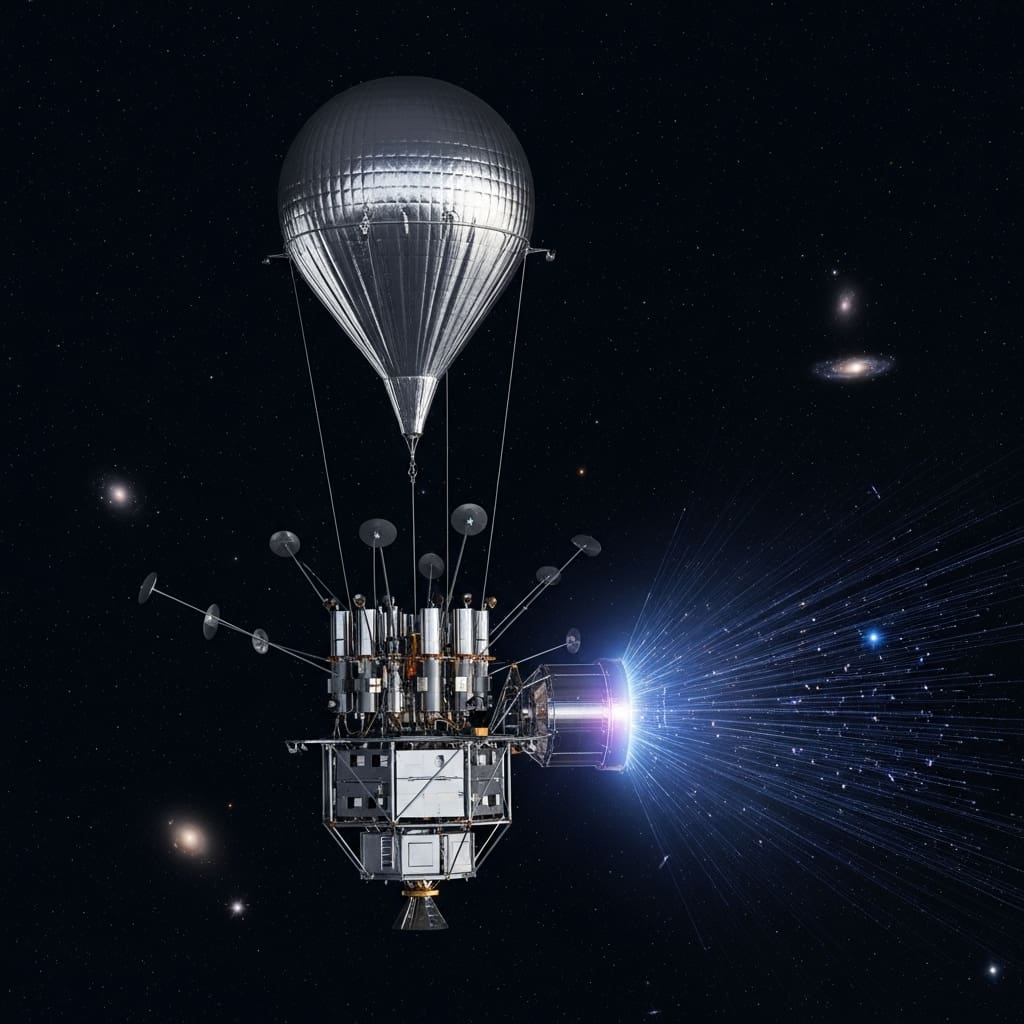
Scientists are striving to unravel the mysteries surrounding Ultra-High-Energy Cosmic Rays (UHECRs) and their origins, a challenge highlighted in recent assessments of the field. To address this, J. Adams, J. Alfaro, and D. Allard, along with their colleagues, have developed the POEMMA-Balloon with Radio (PBR), a novel balloon-borne payload designed to observe these elusive particles. This mission, planned for a long-duration flight from Wanaka, New Zealand, represents a crucial step towards validating the technology for future space-based observatories like POEMMA, and will uniquely combine optical and radio detection methods. By simultaneously measuring extensive air showers, PBR promises to improve our understanding of the UHECR energy spectrum, composition, and potentially detect high-energy neutrinos, furthering multi-messenger astronomy at the extreme energy frontier.
This innovative project addresses critical gaps in our understanding of the most energetic particles in the universe, requiring both high-accuracy instruments and detectors capable of maximizing exposure at the highest energies. PBR represents a compact, balloon-borne prototype of the larger, proposed POEMMA dual-satellite observatory, designed for a Super-Pressure Balloon flight exceeding 20 days from Wanaka, New Zealand. The PBR mission uniquely combines a wide field-of-view Schmidt telescope with a hybrid optical focal surface and a dedicated radio instrument, enabling simultaneous and complementary measurements of extensive air showers.
By observing UHECR-induced fluorescence light from suborbital altitudes, the team aims to validate fluorescence detection strategies crucial for future space-based missions like POEMMA and significantly enhance technology readiness. This approach will allow scientists to capture the first simultaneous optical Cherenkov and radio observations of high-altitude horizontal air showers above the cosmic-ray knee, specifically at energies exceeding 3 PeV, unlocking the potential for detailed energy-spectrum and composition studies at the PeV scale. Furthermore, PBR is equipped to perform follow-up observations of multi-messenger alerts, actively searching for very-high-energy neutrinos via upward-going air showers, bridging the gap between cosmic ray and neutrino astronomy.
Balloon-borne Observatory for UHECR Air Shower Studies
Scientists initiated the Probe Of Extreme Multi-Messenger Astrophysics, Balloon (PBR) project to validate fluorescence detection strategies and advance technology readiness for future UHECR observatories. PBR integrates a Schmidt telescope and a hybrid optical focal surface with a dedicated radio instrument, simultaneously capturing complementary measurements of extensive air showers. This configuration allows for the observation of UHECR-induced fluorescence light from suborbital altitudes, achieving the first concurrent optical Cherenkov and radio observations of high-altitude horizontal air showers above the cosmic-ray knee, specifically at energies exceeding 3 PeV.
Researchers harnessed simulations with CORSIKA to model early longitudinal development of horizontal air showers, induced by both 3 PeV protons and iron primaries. These simulations revealed that Cherenkov intensity is highly sensitive to primary composition, with iron primaries producing brighter showers exhibiting smaller variations. The team then utilized Reverse Monte Carlo and Energy Unfolding machine learning algorithms to correlate observed cosmic ray rates with energy, providing an accurate method for determining cosmic ray energies and enabling a measurement of nuclear composition with peak sensitivity around 2 PeV. This innovative approach pioneers a new experimental methodology to address the composition and shape of the cosmic-ray knee.
The study further investigated radio emission generated by secondary electrons and positrons in HAHA-type air showers, leveraging the geomagnetic effect. Above 30km, the interaction length of electrons becomes comparable to the gyroradius, facilitating charge separation and radio emission production. Scientists anticipate observing a transition between dipole-like and synchrotron-like radio emission, dependent on zenith angle and shower altitude. Simulations, mirroring those conducted for ANITA-IV and PUEO, estimate PBR’s energy threshold for near-horizon events to be significantly lower, around 100 PeV, due to the externally triggered readout of radio antennas by the air-Cherenkov instrument.
Additionally, the research team considered X- and gamma-ray emission resulting from the gyration of relativistic electrons and positrons, predicting observable signals above 1 PeV. These high-energy photons, detected by PBR, will probe the early stages of shower development and refine reconstruction of primary energy and composition. Finally, PBR will uniquely measure longitudinal profiles using the fluorescence calorimeter for tilt-mode showers, providing an alternative approach to evaluate hadronic interaction models, given the altered shower development in rarefied atmospheres.
Subtle spot size and throughput optimisation achieved significant
Scientists achieved a root-mean-square spot size diameter of less than 1.5mm, as demonstrated through ray tracing simulations using Zemax OpticStudio for photons at 337nm, 357nm, and 391nm. These simulations modeled the optical system with equal proportions of each wavelength, revealing that encircled energy within one pixel exceeds 80% across expected incidence angles. Measurements confirm a throughput above 65% for the Fluorescence Camera and above 55% for the Cherenkov Camera, with the latter’s lower throughput attributed to losses within the Optical Accordion. Experiments revealed the design of a PMMA Optical Accordion that, when positioned 30mm before the Cherenkov Camera, generates two image spots on its focal plane.
This arrangement requires time-coincident detection of both spots, effectively suppressing noise triggers caused by direct cosmic-ray impacts on the camera. Zemax simulations of the Optical Accordion show a desired 6mm separation between the spots, with most energy concentrated within a single pixel for various wavelengths. The team measured a spot separation of approximately two pixels, ensuring effective noise reduction. Researchers designed a telescope mechanical structure supporting the optical design while maintaining image quality throughout the pointing range and under extreme stratospheric conditions.
The modular design comprises a mirror assembly, telescope frame, aperture assembly, camera shelf, and dark-box shell. Nine Kovar pads were epoxied to each of the ten trapezoidal borosilicate mirror segments, attaching them to an aluminum structure via flexures and a Whipple-tree distribution to equalize loads and accommodate thermal contraction. Tests prove the radio antenna is positioned 0.5m below the optical telescope, providing clearance from the gondola and preventing interference with the antenna’s 60◦×60◦field of view. The mast and frame maintain antenna orientation within 1◦ of the telescope optical axis across the full rotation range, utilizing glass-fiber-reinforced vinyl for its non-conductive and radio-transparent properties. The PBR focal surface hosts approximately 10% of the channels proposed for a POEMMA satellite, integrating a Cherenkov Camera with SiPMs and a Fluorescence Camera with Multi-Anode Photomultiplier Tubes. The Cherenkov Camera consists of four rows of eight 8×8 SiPM arrays, each pixel measuring 3×3 mm2, totaling 2048 pixels.
PBR Validates UHECR Detection Techniques Balloonborne experiments demonstrate
Scientists are developing the POEMMA-Balloon with Radio (PBR) payload, a compact balloon-borne observatory designed to advance the study of ultra-high-energy cosmic rays (UHECRs). This mission builds upon previous balloon flights and the broader POEMMA concept, aiming to validate key detection techniques and increase technology readiness for future space-based observatories. PBR integrates a Schmidt telescope, a hybrid optical focal surface, a radio instrument, and a gamma/X-ray detector to simultaneously measure extensive air showers. The PBR payload is expected to observe UHECR-induced fluorescence, study high-altitude horizontal air showers, and search for neutrinos originating from multi-messenger alerts.
By observing from a suborbital altitude, PBR will validate the fluorescence detection strategy crucial for the planned POEMMA mission. The simultaneous optical and radio measurements will enable energy spectrum and composition studies at the PeV scale, providing valuable data for understanding the origins of these high-energy particles. Acknowledging limitations inherent in balloon-borne experiments, the authors note the restricted flight duration and potential atmospheric conditions impacting data collection. Future research will focus on analysing the data gathered during the flight campaign, refining the detection algorithms, and informing the design of the full-scale POEMMA observatory. This work represents a significant step towards resolving open questions regarding the sources and acceleration mechanisms of UHECRs, and towards establishing a more comprehensive understanding of the extreme universe.