About five years ago, Caelan Doris arrived at a blind crossroads. He believed he knew the way he had come and where he was headed, but he didn’t know the guts of it yet, or the truth of it.
A series of concussions had led Doris to a specialist in the UK. He had been experiencing issues with cognitive functions: concentration, short-term memory, speech. The impairments were not so intrusive that anybody else would notice, but for a 22-year-old professional rugby player in the foothills of his career, it was troubling.
Throughout his young life, Doris had a cold relationship with worry. He didn’t exhibit it or give in to it. But he also didn’t have a fuse box or a trip switch or an earth wire to manage it. Worry circulated on a closed circuit.
“Growing up, I would have been quite blocked, emotionally,” he says. “My spectrum of emotion, we’ll say, was quite confined. Some of that was through repressed emotion – subconsciously not even being able to feel them [the emotions].
“I would have been known by family and friends as being quite calm and taking things in my stride, and I probably liked that perception. If I was feeling anxious or nervous about something, or sad about something, [my attitude was], ‘It’ll be grand, they don’t need to know. It’s fine. It’ll be fine.’
“That came to a head with the worry around the concussions in 2021. It felt like the level of worry and anxiety around the concussions was too big for that coping mechanism. It overwhelmed that way of dealing with things which was just, ‘Push down. Push down.’ And my body started speaking to me and being like, ‘There’s something not right here. It needs addressing.’”
The cognitive issues were managed, and it is nearly three years since he last suffered a concussion. “It’s an ongoing process,” he says. “I get checked up quite regularly and I feel like I’m in good hands around it, so it weighs on my mind so much less.”
But around the time when he suffered the concussions in 2021 he started sweating profusely in “quite normal, mundane” situations. He thought at first it was a side effect of the concussions and that it could be fixed with a simple intervention, something skin deep and transactional: a diagnosis, a cure.
That was a misunderstanding. The issues were out of sight. The sweating was a portal into parts of him that he had never explored or acknowledged.
 Caelan Doris in action for Ireland against Japan at the Aviva Stadium in November. Photograph: Gary Carr/Inpho
“I like the quote: ‘The parts of ourselves that we don’t fully understand or know use our body as a way to express themselves.’ I think that is what was happening with me through the sweating. On the outside I would have looked calm and looked fine, even if internally there was stuff going on – and even if I couldn’t feel what was going on in the inside.
“So, that led me to therapy. It was a bit of a world change for me. It was opening a can of worms in a way. I didn’t know what I was going to find, or what was in there at that stage. But it [the sweating] was my body talking to me in a way I had to address.”
Doris has recently joined the Tackle Your Feelings programme as one of its ambassadors. Designed to address mental health wellbeing among young people, the campaign is being run by Rugby Players Ireland and will be rolled out in schools all over the country.
In a short video for the programme, and in his own words, Doris paints a vivid self-portrait: it is tender and authentic and uplifting. The two overriding themes are vulnerability and openness. In his own life, he has embraced them both.
“Over time I’ve realised I couldn’t just fight my own way out,” he says in the video. “I had to start talking. Now, I use therapy weekly, meditate daily and lean on the people I trust. When hard emotions hit, I don’t ignore them any more. I feel them, process them and let them move through.”
Doris studied psychology in UCD and both of his parents, Chris and Rachel, are psychotherapists; Chris is also a renowned artist. When Doris was a child, they must have noticed something or suspected something, or not always believed that everything was “fine” when Doris said so?
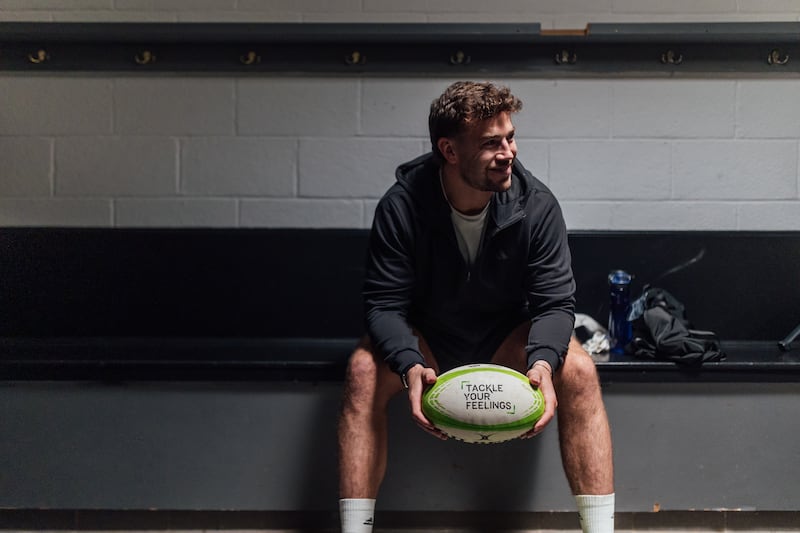 Caelan Doris is an ambassador for Tackle Your Feelings, a mental health campaign for young people run by Rugby Players Ireland in partnership with Zurich Ireland.
Looking back, he reckons his mother was “probably aware that there was stuff I wasn’t feeling”, but it wasn’t something they confronted or teased out. That door was closed from the inside.
“Like, I’m going to say I was fine – which is what I always said – but I was. I was doing OK in school, I had friends, I was doing well in rugby. I was enjoying myself to a certain extent, but there was just … the range of emotion that I was able to feel was a lot narrower.
“I don’t think as a kid or a teenager I would have been massively aware of it. I remember my brother saying to me when I was very young that I don’t laugh at TV shows that much and that sticks with me, that memory. But it was only through the psychotherapy [in recent years] that I realised there was a lot of stuff that had been pushed down and kept down.”
His parents explored their own inner hemispheres and made themselves at home there. Chris and Rachel practised a specific kind of meditation called Heartfulness which led them to ashrams in India for retreats. Doris and his siblings would go along for the ride. The journey to Chennai in southern India was along “crazy, lawless roads”, but it was an adventure too. Doris was first taken there as a baby and was still in primary school the last time he went.
“I remember being in the playground, playing with Indian kids for hours while my parents would have been sitting in these massive meditation halls with hundreds if not thousands of people doing group sittings. It was a pretty cool experience.”
The family lived in Lacken, in north Mayo, a small townland of about 500 people, 10 minutes from the nearest village, 20 minutes from Ballina, and a stone’s throw from the sea. The local primary school was within walking distance and in his time, it had a roll call of just 35 pupils; Doris had only one classmate.
I remember, when I was 12, describing it as a six-year sleepover. Getting away from the parents was a big thing at the time
— Caelan Doris
A few years ago, he was rooting through some old stuff at home when he came across a booklet he had created for his First Holy Communion. One page was devoted to future ambitions and on it he had written: “I want to be a rugby player or a football player.” He also declared his desire to own a house in “Mayo, London and New York.” On that front, nothing has been settled yet.
But even as a boy he was looking at the horizon. After primary school he wanted to go to Blackrock College in Dublin, as a boarder. His older brother Rhian had attended another boarding school in Dublin for a couple of years but didn’t like it. Doris’s heart, though, was set on Blackrock.
For all of them that was complicated.
In the early 1970s Chris had been abused in Willow Park, the junior school for Blackrock College. Over a four-year period, he suffered at the hands of two priests and a religious brother. Chris spoke about it briefly in a Would You Believe documentary broadcast on RTÉ in 1992, and in greater depth in an interview with Patsy McGarry in The Irish Times 30 years later.
“The abuse stopped when he was 13,” wrote McGarry, “but Doris was by then ‘in bits’ he says. He was captain of the school’s under-13s rugby team, top of the class, ‘but the strain was showing’, and he showed signs of post-traumatic stress syndrome.
“Just before his summer exams at the end of his time in Willow Park, his brother, who was six years older, died by suicide in the Netherlands on the eve of his 19th birthday, which their sister is now convinced was a result of abuse at that school too.”
 Caelan Doris. Photograph: Nick Bradshaw
Chris was 60 when he spoke to McGarry about his experiences. By then, he reckoned, he had been through 800 sessions of therapy to reach a point where he considered himself, “self-healed and pretty free of it”.
“I’ve had to be absent from a lot of things in my life at various times because of this,” Chris said. “I’ve missed weddings and funerals. I just feel like saying ‘sorry’ to all the people who I love, for not being there consistently as I would have wished to be and say that, ‘I’m back, I’m back … ”
As a child, Doris knew about his father’s experiences. Not deeply, of course, and not with any understanding of how it might impact his life.
“It was never a big family secret,” Caelan says. “My parents were always open about it. It was part of the discussion around us going to secondary school. There was never any kind of shame or embarrassment or secretiveness. So, I think the way my parents dealt with it was great. There was nothing to hide.
“I wanted to go to Blackrock with the rugby side of things so my dad spoke to relevant people or did a bit of due diligence on the school, on the figures who were there when he was there versus who was there now. So, obviously it was a very different experience for me.”
Over the years in his work as a psychotherapist, Chris often shared a book called The Body Keeps the Score by Bessel von der Kolk which, McGarry wrote, “shows how trauma devastates the victim, but also their partners and future generations”.
Until the past couple of years, Doris had not considered that possibility.
It’s a cool journey that brings up a lot of stuff that I mightn’t have faced had I been doing something easier, or less in the spotlight or with less demands
— Caelan Doris
“I wasn’t aware that it affected me. I avoided it, basically. I think, subconsciously, it was just too big a thing. So, I pushed it to the side and it’s only coming up now,” he says.
“I do remember sharing [my dad’s experience] with some of the boarders when I was in first year. It wasn’t that I never thought about it or wasn’t aware of it, but, as my dad encouraged, [the school] was a very different place when I was there versus when he was there, and to make my own memories and make up my own mind about the place.
“But the intergenerational stuff around what happened with my dad is stuff that I’m working through at the minute, and you can probably see…” he pauses, “I feel a little bit emotional talking about it because … it’s hard stuff.”
Doris flourished in Blackrock. Part of that was a desire for independence. In his first year there were 12 boarders, all of whom slept in the same dorm. You would think it must have been daunting, coming from a small place and a tiny school on the north Mayo coast, to this rarefied bastion of private education in the heart of Dublin’s southside, but that was not how he felt.
“I actually loved it. Within my family, I felt quite constricted. I felt like I had more of a personality or I was able to be freer in myself [in Blackrock]. It was an opportunity to express myself more, find out who I am and get away from my parents and my family. I remember, when I was 12, describing it as a six-year sleepover. Getting away from the parents was a big thing at the time.
“I also felt freer and more expressive on the pitch [playing rugby]. As boarders we always had a ball in our hands, just throwing it around, playing tip in the evenings. But when you’re asking me, ‘Did I feel differently playing rugby?’ I wasn’t aware of not feeling normal outside of rugby. It was just the way things were, and things were good, generally. I want to emphasise that it’s not as if I was massively struggling or it was like rugby was my escape, because that doesn’t feel true or genuine. It was just that things were a little pushed down.”
 Caelan Doris and Andy Farrell with the Six Nations trophy at the tournament’s media launch in Edinburgh on Monday. Photograph: Lesley Martin/AFP/Getty
Players like Doris are drawn to captaincy, whether they like it or not. Picking him would always have been safe and obvious and smart. When it came to his final year in Blackrock, he was selected to captain the senior cup team. A couple of years after that he captained Ireland’s under-20s at the Junior World Championship.
Bigger roles were bound to follow. Within the space of a few weeks in the autumn of 2024, Doris was made captain of both Leinster and Ireland, the two most successful and scrutinised entities in Irish rugby. Doris was no longer just one of the best players, he was a member of middle management.
He said at the time that he felt “impostor syndrome” and that he was hectored by “self-doubt.” Over a period of time, people like the former Leinster coach Stuart Lancaster and the current Ireland coach Andy Farrell convinced him of his aptitude to be a leader, or at least made him see what they could see.
“It was a very uncomfortable step, even though deep down I knew it was something that I wanted to do, and something that I could do, and something that would benefit me, and that I would grow into. I see it as a vehicle for personal growth, and continually expanding my comfort zone. It’s a cool journey that brings up a lot of stuff that I mightn’t have faced had I been doing something easier, or less in the spotlight or with less demands.
[ Caelan Doris brings a presence to captaincy which makes Ireland prosperOpens in new window ]
“But the self-doubt is still there, definitely. The funny thing is that a lot of people who are high achievers, or who succeed at things, a big driver can be self-doubt. Or the feeling of not being enough and needing to have accomplishments in order to feel complete. I would say that’s quite a common thing.”
Was that his experience?
“Yeah, yeah. And I probably wouldn’t have been aware of it again until this kind of – I don’t like calling it a journey – but this delving a little deeper and getting to the core of these things.”
The upcoming Six Nations that starts on Thursday will be his second as captain. When Doris won his first cap for Ireland six years ago, Johnny Sexton had just taken over that role, and when Sexton retired, the honour passed to Peter O’Mahony. They were different personalities, who commanded the dressingroom in different ways. O’Mahony was still in the squad when Doris was made captain 18 months ago, and Sexton has since returned as part of the coaching team. He has leant on them both.
“Johnny’s will to win is incredible and I think I’ve got some of that – probably in a more muted version. It probably manifests itself in different ways at times. We’ve had some good conversations [about captaincy]. And then Pete,he connected with everyone and he was just such a good person to have around. He was a good sounding board and he was by my side through the transition.
“I try and build connections with team-mates as much as possible on a deeper level as well. But ultimately, I’m growing in the role. I’m far from the finished article with how I would like to be as a leader, but I think I’m on the right path.”
At the beginning of last year, Doris was one of the leading contenders to captain the British and Irish Lions until a shoulder injury he sustained in Leinster’s Champions Cup semi-final defeat to Northampton ruled him out of the summer tour. That setback was a field test of the mentality he was trying to build.
“I was able to feel a little bit of the progress in the [therapy] work I’ve been doing, based off how I processed that,” he says. “I was with my friend in the car on the way back from the scan when I got the news around how bad the shoulder actually was, and I just allowed myself to cry and feel the sadness and feel the loss or grief of what I’d hoped [would] be a very different summer.
“But I saw it as an opportunity to dive deeper into some of the psychological work, into the roots behind the things like self-doubt and some of the anxiety and the harder emotions. I also met my girlfriend at the start of that period, so there were lots of positives. I would definitely frame it now as I made the best of what happened.”
 Caelan Doris with teammates after defeating Scotland during the Guinness Six Nations 2025. Photograph: David Rogers/Getty Images
It sometimes feels foolish to ask someone if they’re happy, because it exists in such a state of flux with such an endless spectrum. Being good at pursuing happiness, though, is a different thing. More manageable maybe. You wonder if the journey into himself has made any difference to that? If he is somehow happier now that he has asked difficult questions and been accepting of uncomfortable answers?
“It’s a funny question for me at the minute, because it’s a bit of a challenging period [working through] what happened to my dad, but I’ve felt a lot truer and more present and more connected to my core self. There’s been a lot of challenging emotions that I wouldn’t have felt for years, or maybe ever. But I can feel the spectrum of emotion widening.”
He mentions a retreat he did over the summer, and a quote that has stayed with him from it – “Joy is the matriarch of all emotions, and until you welcome her children – fear, sadness, anger – she won’t come visit.”
[ Why we strive for happiness but then often ignore it when it arrivesOpens in new window ]
“I think my mom is a very good example of that; she’s probably one of the happiest people I’ve come across and finds joy in the smallest, most mundane things.”
Chris and Rachel are in Costa Rica at the moment, where Rhian is based now. He moved from LA where had been living for the past seven or eight years. Doris says his brother is tapping into “a spiritual vibe, as well as doing more inner work”.
Would he describe himself as spiritual now?
“I would say I don’t have a full grasp of it yet, but I do think I’m moving towards that way. One definition of spirituality that I heard recently is ‘Sensitivity to reality’. I think I’m certainly becoming more sensitive to my reality anyway.”
That is the road less travelled.
Tackle Your Feelings is a mental wellbeing campaign by Rugby Players Ireland in partnership with Zurich Ireland and the Z Zurich Foundation.