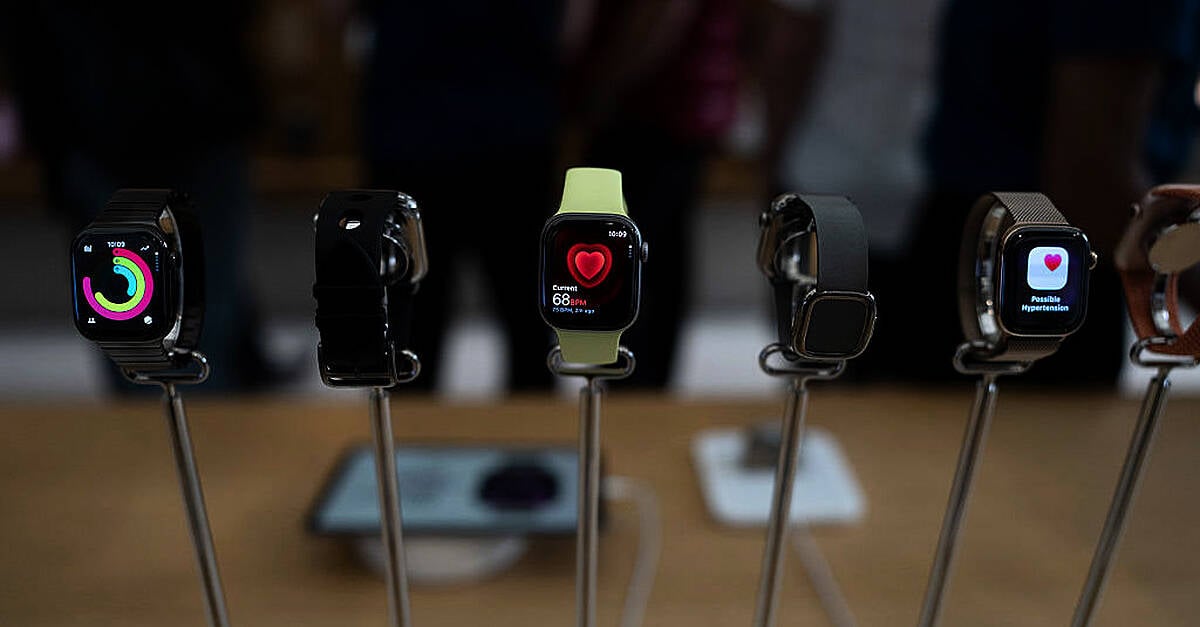
Tipperary car sales manager Michael Byrne started seeing odd readings on his Apple Watch. It was notifying him that his heart rate was dropping low. He hadn’t noticed anything strange and was seemingly fit and healthy, running four 5km runs a week.
But the alerts raised concerns.
Byrne went to the doctor, who carried out an ECG. He was then sent straight to hospital.
He was diagnosed with ectopic heartbeats and premature ventricular contractions, a condition where the heart experiences extra beats that fall out of rhythm with normal heart activity.
After being seen at Clonmel University Hospital, he had his first surgery to remap the signals in his heart.
“While the first surgery was a success, it didn’t drop the ectopic beats enough, and a second operation was done,” he said.
“Currently, I’m all good and getting constant reviews. I was told that had it not been for the watch highlighting it, I could have had sudden death syndrome.
“I was asymptomatic all along, so I felt nothing. I was running four 5km runs a week until the day I got sent to hospital.
“I was told that had it not been for the watch highlighting it, I could have had sudden death syndrome.”
Despite stories like Byrne’s, smartwatches and health trackers faced criticism over their accuracy. Experts also warn that a bigger issue is how the data is used – and who controls it.
Dr Cailbhe Doherty, a wearables expert at University College Dublin, told BreakingNews.ie that historically, wearables were more accurate for certain demographics.
He said there have been studies where certain metrics – including blood pulse oximeters, which measure blood oxygen saturation – were not accurate for darker-skinned people.
However, more recently, there has been a push to include a more diverse sample of participants in the development of smartwatch algorithms. Researchers now try to include people all across the spectrum of the Fitzpatrick Skin Scale – a measure of the colour of people’s skin.
“The samples that they recruit are very diverse, and they’re typically 50 per cent male and 50 per cent female. At the end of the day, these samples are somewhere between 5,000 and 10,000 people.
“The sample is supposed to be representative of the wider population. And getting that many people to develop an algorithm is really, really good.
“But ultimately, you’re not going to capture the full diversity of people… when there are 8 billion people in the world. But they do as good a job as they realistically could, in my opinion.
“And things are improving. The trend of there being a bias in the algorithm is disappearing. It’s still probably there in specific ways, but it is improving.”
Dr Doherty also said that there is an element of gender bias in wearables. “The current crop of consumer wearable devices are only now getting to grips with the trends and the premise that a female’s heart rate variability will vary throughout the menstrual cycle in quite a pronounced way.
“Similarly, these devices don’t work particularly well for pregnant women.”
What about my data?
Dr Doherty also expressed concern about the collection of health and biometric data by large, multinational companies.
“One of the biggest worries that I think is being overlooked in the wearable space is just how powerful this data can be.”
[Wearables] could also be used as a penalty system for people who don’t engage in healthy behaviours – Dr Cailbhe Doherty
He used the example of VO2 max, which is the measure of how well one’s heart, lungs and muscles use oxygen.
“Not only is it a really good measure of athletic performance… but it’s also a really powerful measure of mortality risk. So we know that people with low VO2 maxes are at a higher risk of dying.”
“These devices can measure things that could be used to improve public health, could be used for physical activity or for public health initiatives, could be used to predict disease,” he said.
“If I can see, for example, that my VO2 max is decreasing steadily over the course of a year or two years, that could be the trigger to get in contact with my GP to investigate the source of that decrease. But in the wrong hands, that data can be used against us.
“For wearable device users today who have owned their devices for [several] years, what could that
data be used for over the next [few] decades? They could be used for a lot of good, could be used to revolutionise the model of healthcare… But it could also be used as a penalty system for people who don’t engage in healthy behaviours.”
“There are some companies which are… playing fast and loose with your data, and others are very good.”
How can I protect my data?
Dr Doherty recommended that smartwatch users read through the terms and conditions and read about how the companies are using their data.
He also recommended reading a paper which compares and contrasts the accuracy of different smart watches, which is updated every year.
Health Wellness
Can your smartwatch really track your health accurately?
“A very simple proxy for how good a company is can often be the length of the privacy policy,” he said.
“My vision for wearables is that everyone has one and you have complete security and privacy over your data.
“We flag early signs of disease risk and implement prophylactic measures, implement physical activity incentivisation and public health programs across entire populations.
“If that’s ever going to be realised, the data needs to be safe and secure and not leveraged against you in any way.”