When you buy through links on our articles, Future and its syndication partners may earn a commission.
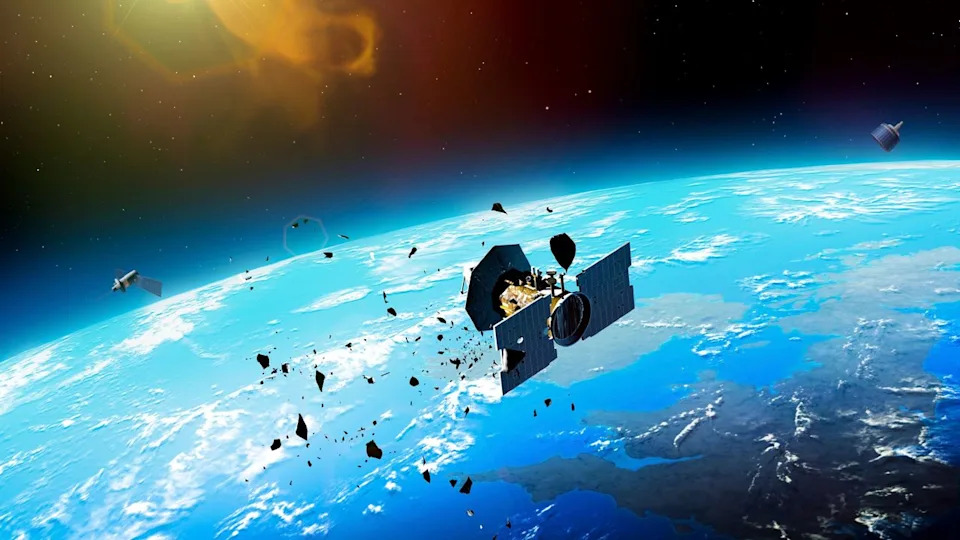
An illustration of satellites breaking up in Earth orbit. | Credit: Mark Garlick/Science Photo Library/Getty Images
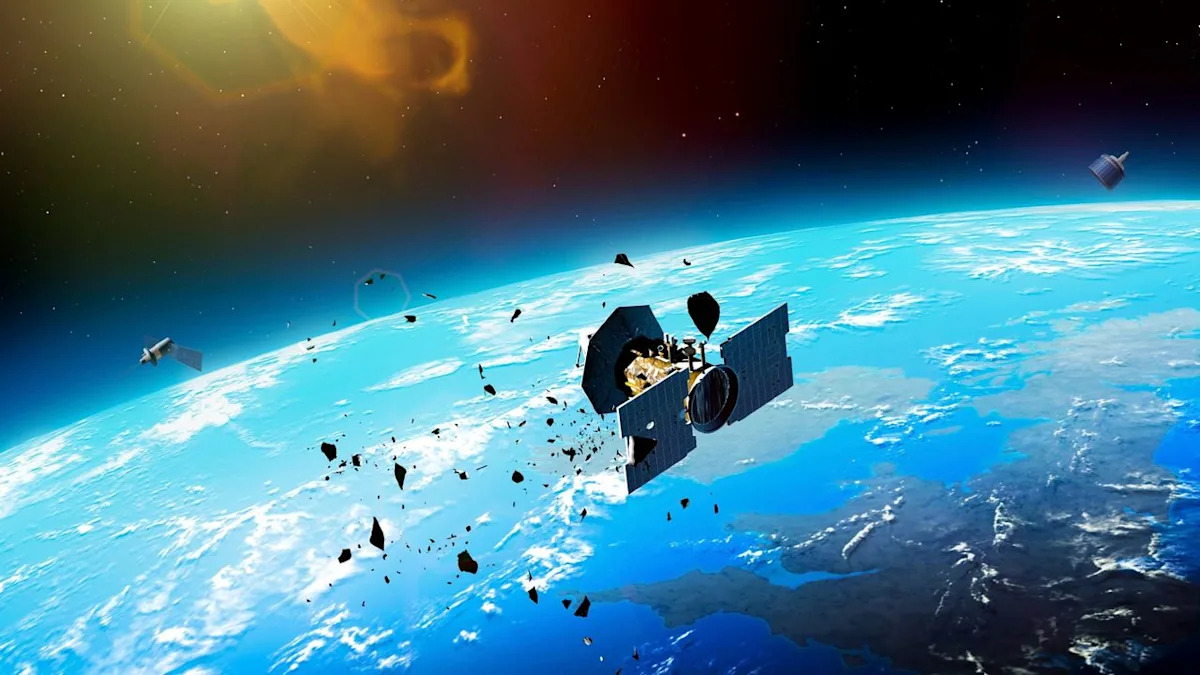
A Russian satellite once used to inspect other spacecraft appears to have disintegrated in a graveyard orbit high above the Earth, according to ground-based imagery.
The Luch/Olymp satellite, launched in 2014, is one of two secretive military Russian satellites that have been used to stalk spacecraft from the US and others in the geostationary belt (GEO), around 22,236 miles (35,786 kilometers) above the equator. Luch/Olymp (NORAD catalog number 40258) had recently been decommissioned and sent into a graveyard orbit a few hundred miles above GEO in October 2025.
Now, however, optical ground-based imagery from Swiss space situational awareness company s2A systems shows what appears to be a fragmentation event as the satellite disintegrates and begins to tumble. Additional objects have been spotted around the satellite following the fragmentation event at 06:09 GMT on Jan. 30, according to a post on social media platform X.
Astrophysicist and satellite tracker Jonathan McDowell told Space.com that the fragmentation of Luch/Olymp may have been caused by an external debris impact, which may be a worrying event.
McDowell says the disintegration may possibly be due to a debris hit, since internal energy sources, such as fuel and batteries, should have been vented when it was retired.
While a failure to properly passivate the spacecraft could not be ruled out, McDowell notes that a possible debris impact could suggest that the space debris environment in GEO, and the graveyard orbit above it, is worse than previously believed.
While the first Luch/Olymp satellite is now out of action, Russia has another such asset, having launched a second Luch/Olymp inspector satellite in 2023. Russia, the U.S. and China have in recent years used satellites around geostationary orbit to get close to and inspect other countries’ satellites.