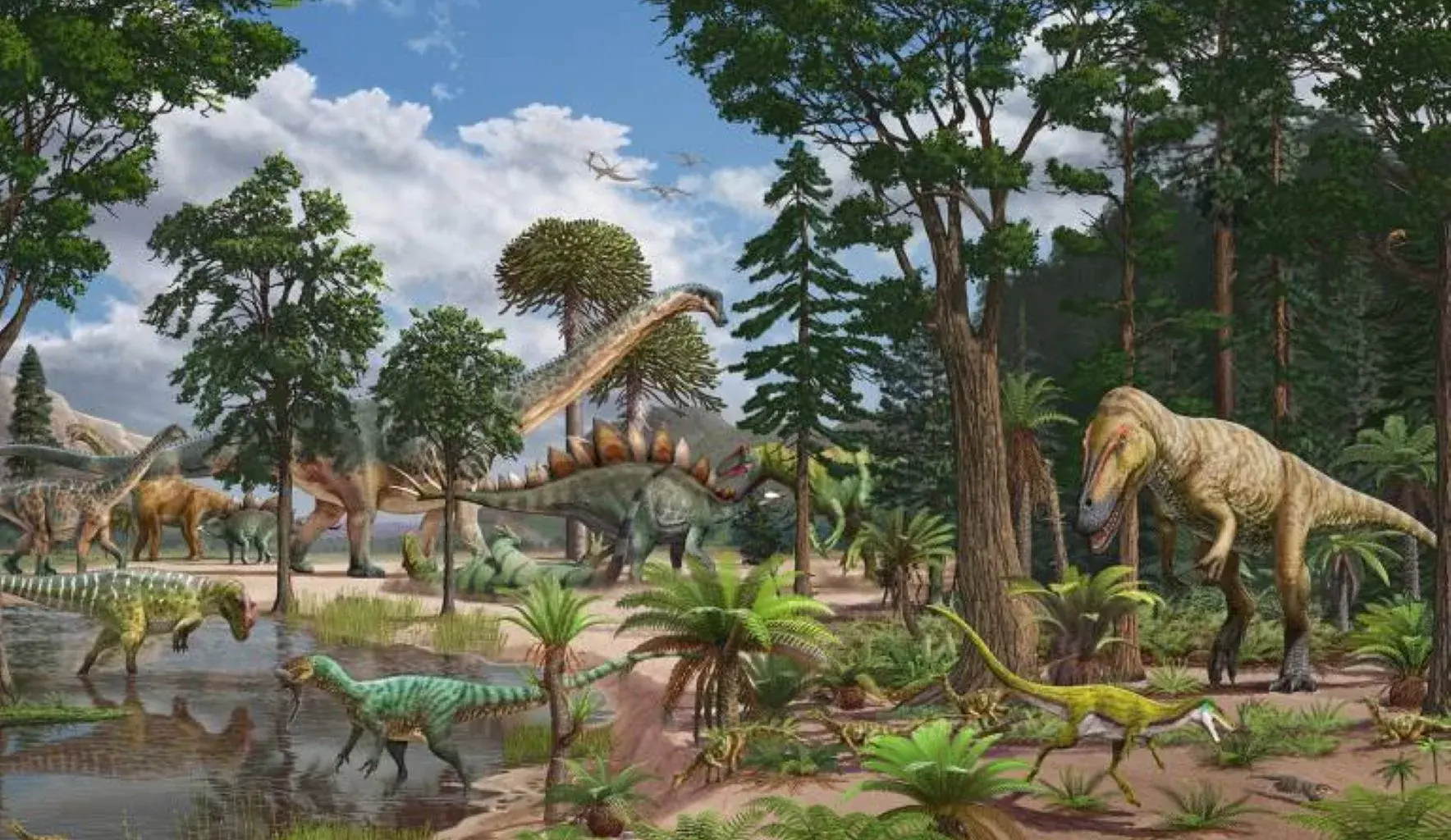
The Morrison Formation is a notable rock layer from the Upper Jurassic period, recognized for its variety of land animals. Despite over a hundred years of research, we still don’t fully understand how these organisms interact with each other.
Understanding its food webs is important, as the Morrison hosts one of the most unique and diverse fossil records. Yet, reconstructing these ancient ecological interactions remains understudied.
A new study reconstructs the trophic links and food web of the Dry Mesa Dinosaur Quarry, a well-preserved ecosystem within the Morrison Formation.
Using the R package cheddar, designed for food web analysis, researchers mapped interactions within the Morrison Formation ecosystem, including at least six species of sauropods (among them Diplodocus, Brachiosaurus, and Apatosaurus).
Their results reveal a highly complex network with more than 12,000 unique food chains.
Thanks to this reconstructed food web, scientists discovered that baby and very young sauropods were a key food source for many predators. Sauropods, long-necked, long-tailed plant-eaters, grew into the largest land animals in history.
But their sheer size made it difficult to protect their eggs without crushing them. Evidence suggests that, like baby turtles today, young sauropods were left on their own, receiving no parental care.
A new sauropod dinosaur from the Cretaceous discovered in the Iberian Peninsula
Lead author Dr Cassius Morrison, based at UCL Earth Sciences, said: “Life was cheap in this ecosystem and the lives of predators such as the Allosaurus were likely fuelled by the consumption of these baby sauropods.”
The ability to study ecosystem dynamics helps us better understand how ecosystems evolved and became vulnerable during the Mesozoic, including shifts in ecological niches and food web interactions, as well as the role of keystone species.
To explore this, researchers analyzed fossils from the Morrison Formation, deposited about 150 million years ago. These fossils allowed them to reconstruct a vast “food web” showing who ate what. This approach is highly novel; the study is the first to apply trophic analysis to investigate ecological interactions within the Morrison Formation.
To figure out who ate what, researchers drew on several lines of evidence: dinosaur body size, tooth wear patterns, isotope signatures in fossil remains, and, in rare cases, stomach contents preserved with the animal’s last meal.
Researchers then applied a cenogram to the ecosystem, a method usually used in mammalian paleoecology but rarely in Mesozoic studies. A cenogram is a graph showing the distribution of body sizes within a community. While typically applied to modern ecosystems, using it here offers a novel way to analyze ancient ecological patterns.
The team found that sauropods played a central role in the ecosystem, with far more connections to both plants and animals than the other major plant-eating dinosaurs, the ornithischians. Ornithischians, such as the armoured Stegosaurus, were tougher and more dangerous prey, making them less frequently targeted.
Dr Morrison explained: “Sauropods had a dramatic impact on their ecosystem. Our study allows us to measure and quantify the role they had for the first time.”
Researchers found that 70 million years after the sauropods declined, Tyrannosaurus rex had to adapt. With fewer easy prey, it evolved stronger jaws, a bigger body, and sharper vision. These changes helped T. rex hunt tougher animals like Triceratops, protected by three large horns.
William Hart, one of the co-authors from Hofstra University in the United States, said: “The apex predators of the Late Jurassic, such as the Allosaurus or the Torvosaurus, may have had an easier time acquiring food compared to the T. Rex millions of years later.”
“Some Allosaurus fossils show signs of quite horrific injuries, for instance, caused by the spiked tail of a Stegosaurus, that had healed, and some that hadn’t. But an abundance of easy prey in the form of young sauropods may have allowed injured allosaurs to survive.”
Journal Reference:
- Morrison, Cassius & Hart, William & O’Callaghan, Ezekiel & Boisvert, Colin & van der Linden, Tom & Goodchild, Owen & Boeye, Adrian & Scherer, Charlie & Jones, Harry & Moran, Tristan & Lewis, Zak & Rayburn, Kenneth & Layton, Collin & Wasserlauf, Joshua & Bohus, Caleb & Danison, Andy & Lopez-Vaca, Alejandro & Durrant, Leroy & Guest, Chance & Allain, Steven. (2026). “HERE, SIZE IS NO ACCIDENT”: A NOVEL FOOD WEB ANALYSIS OF THE DRY MESA DINOSAUR QUARRY AND ECOLOGICAL IMPACT OF MORRISON FORMATION SAUROPOD FAUNA. New Mexico Museum of Natural History and Science Bulletin.