“I’ve refused scores of requests from some mightily talented people to turn M’bird into everything from a Broadway play to an opera,” Harper Lee wrote to Gregory Peck in the late 1980s.
“M’bird” was To Kill a Mockingbird, and Peck’s Academy Award-winning performance as the principled lawyer Atticus Finch in the 1962 adaptation of Lee’s novel had helped to secure its status as an American classic. For Lee, in Peck’s performance “the man and the part met”. “As far as I’m concerned,” she confirmed in a rare interview, “that part is Greg’s for life”.
Lee was a formidable defender of both her literary reputation and her work. Her father was a well-known defence lawyer; she was expected to follow in his footsteps, but she had ambitions from an early age to become “the Jane Austen of south Alabama”.
She dropped out of law school in the late 1940s to move to New York, publishing short stories in various magazines and journals; these were collected in book form for the first time in 2025, in the posthumous collection The Land of Sweet Forever.
To Kill a Mockingbird was published in 1960, and it was the work on which Lee’s status as literary legend rested. Indeed, she would not publish another novel until shortly before her death, and that book, Go Set a Watchman, was mired in controversy.
Some believed that Lee had been coerced into releasing it during a period of rapidly declining health; there was disquiet, too, about the work itself. Marketed as a sequel to To Kill a Mockingbird, Go Set a Watchman was in fact a very baggy first draft, the manuscript that Lee submitted to Tay Hohoff, a high-profile literary editor with JB Lippincott.
It took two years of intense editorial work for the To Kill a Mockingbird that readers instantly adored to emerge. Set 20 years after the action of that book, To Get a Watchman also revealed Lee as a writer with less control over both her prose style and her thematic intention.
To Kill a Mockingbird is set in the early 1930s, in the aftermath of the Great Depression, and it is an atmospheric and tightly plotted bildungsroman, a coming-of-age tale in which a young tomboy, Scout Finch, comes to understand the racial segregation of the society she lives in as her lawyer father defends a black man who has been accused of raping a white woman.
Go Set a Watchman is narrated by the grown-up Scout, who is returning to her home from New York for her annual holiday, and being confronted with the continuing racist beliefs of her community, as well as her father.
Most unforgivably for many readers, Go Set a Watchman cast doubt on Atticus’s moral rectitude, which had become shorthand for the progressive American morality that was coming into its own when To Kill a Mockingbird first appeared.
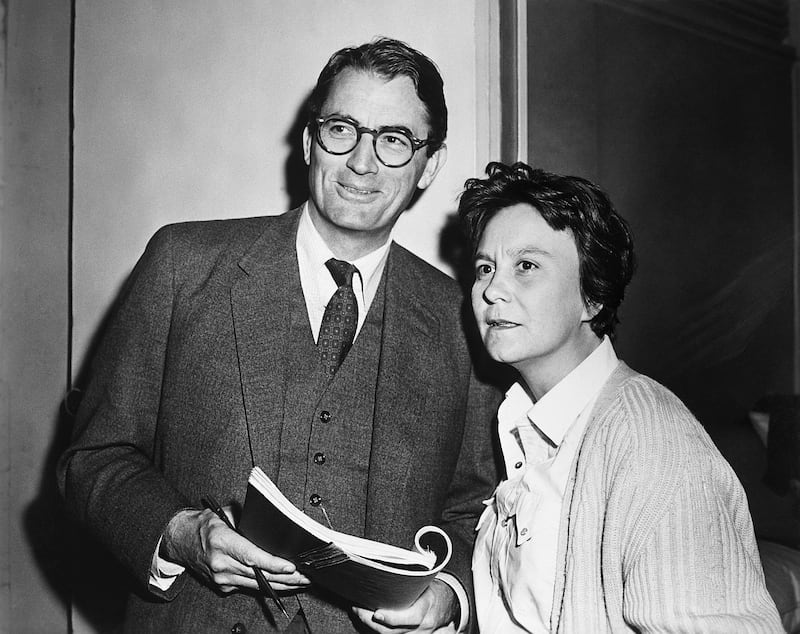 Actor Gregory Peck and novelist Harper Lee on the set of To Kill A Mockingbird. Photograph: Bettmann Archive
 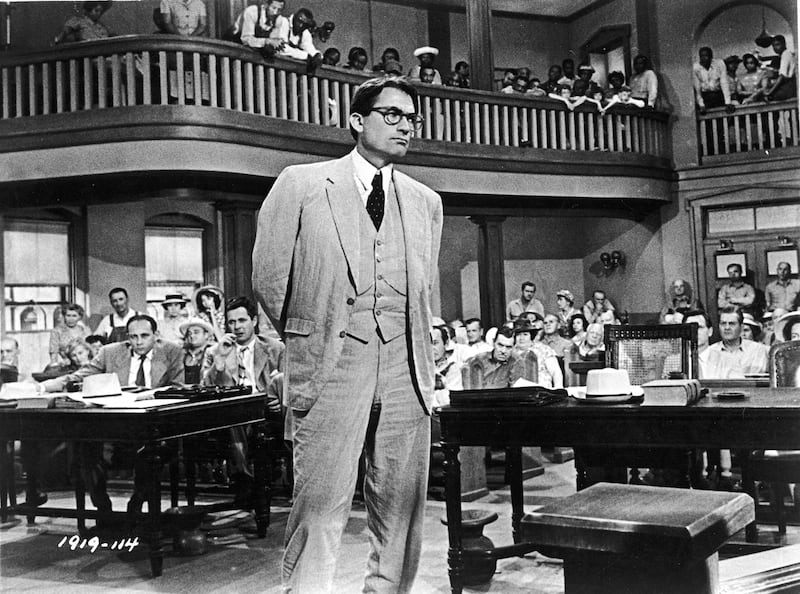 American actor Gregory Peck, as Atticus Finch, stands in a courtroom in a scene from director Robert Mulligan’s film adaptation of To Kill A Mockingbird, 1962. Photograph: Universal Studios/Courtesy of Getty Images
If, in that first book, the child narrator’s idealism inspires hope, despite the inevitable outcome of the trial, in Go Set a Watchman we meet a cynical Scout embittered by the limitations of liberalism, and her father.
As a result, it presents a far less flattering portrayal of Atticus, that long-standing American hero. As one commentator observed, Go Set a Watchman “wasn’t only bad storytelling; it was the sort of story that editors didn’t want to tell”.
It was in this context of cultural controversy and literary disappointment that a high-profile stage adaptation of To Kill a Mockingbird by the Oscar-winning screenwriter Aaron Sorkin was first mooted.
The producer Scott Rudin had acquired the rights just before Lee’s death, in 2017; Sorkin was announced as playwright for the project soon after. Starting out, Sorkin admits, he had reservations: “I thought it was an absolute suicide mission.”
Unfortunately, he wasn’t wrong to have doubts. Apart from the challenge of meeting cultural expectations – “It’s a beloved book that had been adapted into a beloved movie, and what could I possibly do but make it less than it was before?” – Sorkin had the Lee estate to contend with.
[ Harper Lee: New details of lost true crime book revealedOpens in new window ]
Before the play even opened, it sued Rudin for presenting a version of the work that deviated from the spirit of the novel. In Sorkin’s script, Atticus is the central character rather than Scout, and the estate was right to think that the dissolution of the child’s-eye view – just as it did in Go Set a Watchman – presented a more compromised portrayal of liberal idealism than Lee’s original novel did.
The dispute was settled in time for the Broadway premiere, in 2018, however, and Sorkin’s instincts to update the racial narrative proved to be the play’s greatest strength.
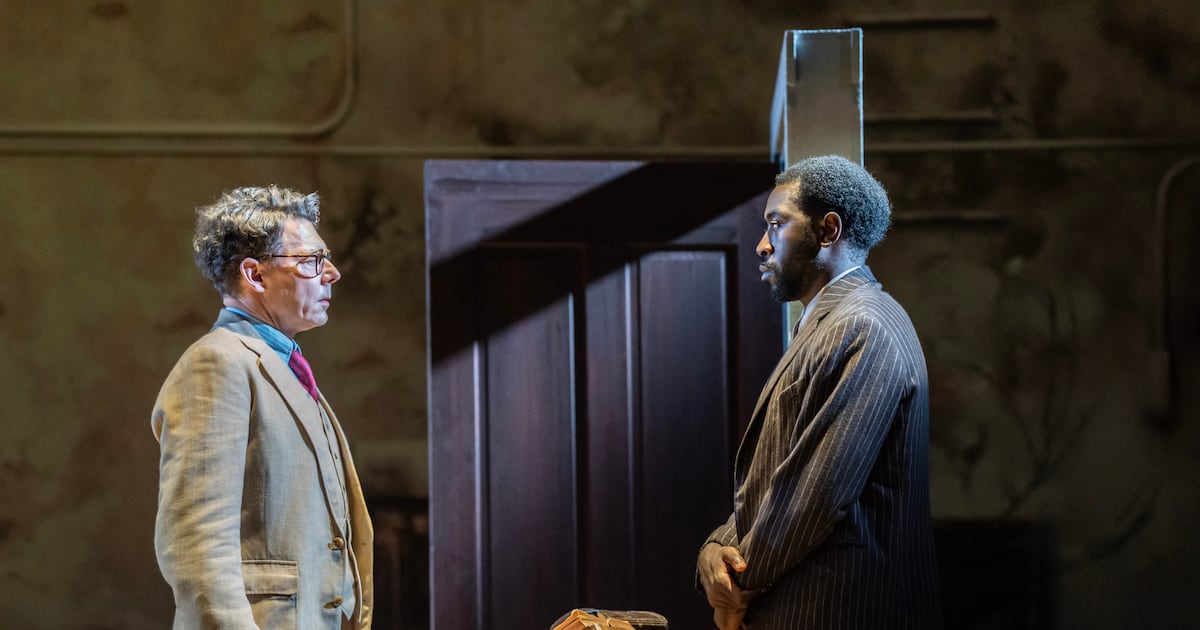
With Jeff Daniels in the starring role, the Broadway production broke box-office records. It transferred to the West End in 2023, with Rafe Spall taking on the title role.
A new touring production is about to visit Dublin and Belfast. While still maintaining its historical setting, the play feels urgently engaged with the contemporary United States, as well as with Europe, where cultural differences have become an ever-increasing point of social and political tension.
In Lee’s novel, the trial of Tom Robinson is the narrative climax of the book. Sorkin’s adaptation takes the court case as the dramatic starting point; from the beginning the stage is set, by designer Miriam Buether, for a courtroom drama, a context that Sorkin has used to great effect in his films A Few Good Men and The Trial of the Chicago 7.
Visually, the setting quickly establishes the segregated world of the Jim Crow South, with only Atticus and the children – Scout, her brother, Jem, and best friend, Dill – crossing the colour line of the courtroom.
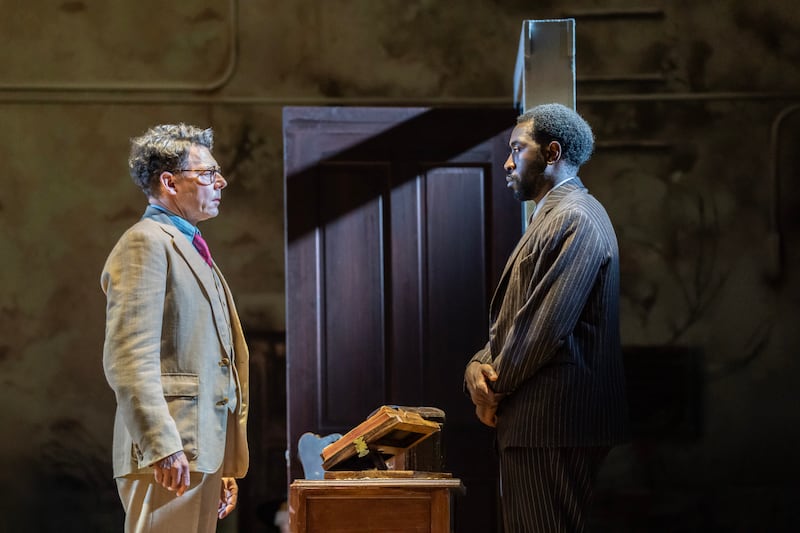 Richard Coyle as Atticus Finch and Aaron Shosanya as Tom Robinson in Aaron Sorkin’s adaptation of Harper Lee’s American classic. Photograph: Johan Persson
 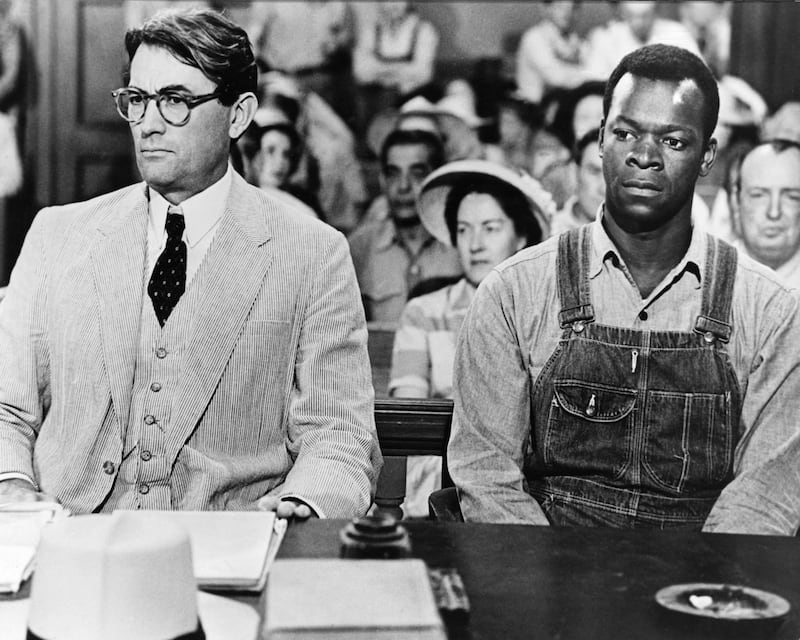 Gregory Peck as Atticus Finch and Brock Peters as Tom Robinson in To Kill a Mockingbird, 1962. Photograph: Silver Screen Collection/Getty Images
Although Scout remains a key narrative voice, there is a shift in focus in Sorkin’s version, and Atticus becomes the protagonist, his idealistic humanism challenged both by the outcome of the trial and the way in which the black people he claims to love (his housekeeper, Calpurnia) and defend (Tom Robinson) call him to account.
By giving voice to two key characters who barely speak in Lee’s original book, Sorkin lifts Mockingbird above the white-saviour narrative for which it has been criticised at various points in history. As Sorkin conceded at the time, “I couldn’t pretend I was writing this in 1960. I had to be writing it now.”
He has a surly Calpurnia question Atticus’s insistence on seeing the good even in those who are committing clear crimes of hatred, as well as Atticus’s assumption that she should be grateful that he is defending a member of her community in court.
The most startling moment comes when a lynch mob gathers outside the courthouse and Atticus tries to quell the disquiet by insisting that there is “goodness in everyone”. The similarity of this phrase to those Donald Trump has made in public reactions to civil unrest in the US is not accidental. Of course, Atticus is no authoritarian, and by the end of Sorkin’s drama he has learned that empathy is not a cure-all for hatred.
It is fitting that Bartlett Sher, the production’s director, has chosen to leave the jury box empty in his gripping production of the play. In effect, it casts the audience as the community of court witnesses. We know – as everyone in Maycomb County does – that Tom Robinson is an innocent man.
But can we claim as much for those who uphold the system of injustice that ensures he will die anyway?
To Kill a Mockingbird is at the Bord Gáis Energy Theatre, Dublin, from Tuesday, February 10th, until Saturday, February 21st, and at the Grand Opera House, Belfast, from Tuesday, February 24th, until Saturday, March 7th