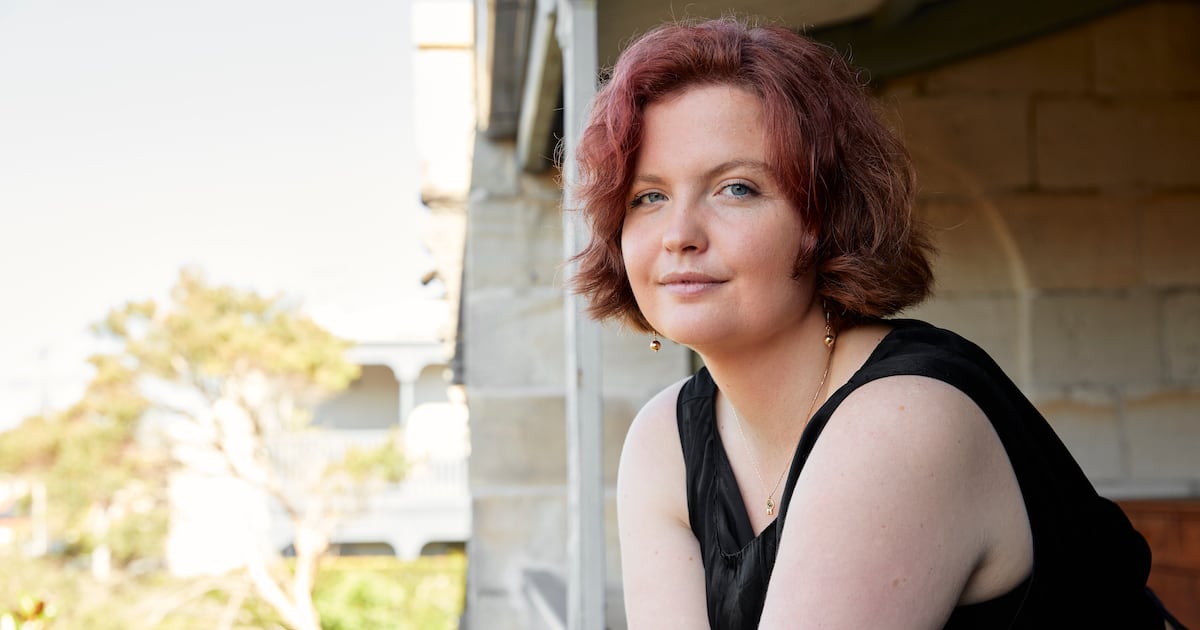
With success can come unintended consequences. When Madeleine Gray’s debut novel, Green Dot, was published, in early 2024, the Sydney author started receiving emails from women who related strongly to the book’s main character, a 24-year-old content moderator named Hera, who finds herself caught up in an affair with an older married man, a colleague in her soulless office.
Most were “gorgeous messages”, Gray says over video. But some caught her by surprise. They were missives from male readers who said Green Dot had finally made them understand how their mistress might feel about being the other woman. “They were thanking me,” she says, laughing in astonishment. “Wow. Like, the fact that it took a whole novel about a mistress being disenfranchised for you to have empathy for your partner is wild. But also: thank you for reading the book, and I’m glad that you have empathy.”
As literary conundrums go, Gray, who is 31, knew it was a better class of problem than most. Before publishing her hit novel, the author had worked in a Sydney bookshop, taking up a retail-assistant role to stave off the loneliness she felt sitting in her family home studying for her PhD in women’s autobiographical literary theory.
She had seen the tables full of books that didn’t sell. She had served as a cheerleader to try to get authors to generate buzz about themselves. “I’d take their photos for social media. And make them pretend to be lions, like in Zoolander.” Her quiet hope was that her own debut might last on the shelves a few weeks before being remaindered.
But Green Dot beat the odds, catching fire with readers, drawing accolades from Caitlin Moran (“every sentence sparkles”) and Nigella Lawson (“a major talent”) and placing Gray in a pantheon of zeitgeisty writers that includes Sally Rooney; the Sorrow and Bliss author, Meg Mason; and Naoise Dolan, who focus heavily on character interiority while surfing the uneasy waves of online culture, modern relationships and evolving societal structures. The novel was nominated for debut fiction book of the year at the British Book Awards, and a screen version is in development with the production company behind David Nicholls’ One Day.
Impostor syndrome loomed large when Gray returned to her safe haven writing space: King’s Cross Library in Sydney. Was it a fluke? She didn’t know. “The pressure came. I was, like, I don’t know if I can write another book: I can only write this book,” she says. Over a grainy-screened Google Meet, as she sits in the home she shares in Sydney with her wife and five-year-old son, you see the relief etched on her face that her sophomore outing is here in the world.
A coming-of-age novel, Chosen Family propels us into the world of Eve Bowman and Nell Argall, charting their on-again, off-again friendship over two decades and documenting their experiences as artistic people floundering in a world that never seems well-made for them.
The novel begins with the revelation that something terrible has happened and adult Nell is no longer in Eve’s life. As the narrative unfolds, through flashbacks and flash-forwards, you gradually find out why Nell has made her exit.
A loose-limbed, poignant, athletically written and acid-smart story of finding your tribe amid societal repression and deep personal uncertainty, Chosen Family is particularly acute on the subject of queer teenage identity.
I really wanted her to have good sex, because I have read so many versions of women who are interested in women or non-cis men having terrible first experiences
Shame and unease pervade Eve’s high-school experience. One of the most troubling scenes is when Eve treks out to the Grove, a patch of grass by a small beach where teens congregate, to find a boy to make out with, so she can pretend to her classmates that she is heterosexual.
After giving a boy a handjob while older kids look on laughing, Eve is teased at school “for being a slut, but this is better than being teased for being a lesbian.” Memories of that night haunt both Eve and Nell, who was an anxious bystander that fateful evening, horrified at having walked her friend into a desperate act of self-violation.
The novel has some parallels with Gray’s own experiences growing up. As with Eve, who is the daughter of single mom Emerald and has never known her father, Gray knows what it’s like to experience familial division. Her parents separated when she was young, her father remarried, and she didn’t cope well. Her stepmother, Helen, with whom she is now close, bore the brunt of her pain and disorientation. “When I was a kid I was a real b**ch to her: really rude. Not because I didn’t like her but because I didn’t like the role she was in – ie, marrying my father.”
Gray was bullied for her sexuality at her Catholic school in Sydney, despite only identifying at that time, she says wryly, as a “nerd”. “The feeling of being ‘other’ is very real to me, and my last name is ‘Gray’, which is very easy to turn into ‘gay’,” she says. “I was ‘Mattie Gay’ for all of high school despite not even knowing if I was gay or not. Eve’s journey definitely has resonances to my own.”
It was important to Gray to show that Eve could survive and thrive as a queer girl in Sydney. Eve forges her own bonds in life, making friends with Nell at 12, then hitting her stride at college with the help of her gregarious gay pals Marcus and Tae. Before long she’s partying, flirting and staking out hot property on the queer scene.
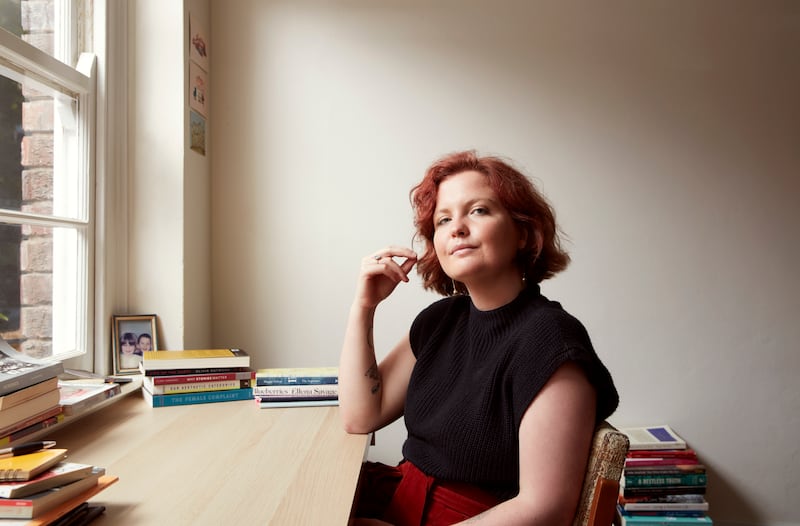 Madeleine Gray: ‘I’m scared. My child is half-Turkish. And the climate of racism in Australia and around the world and on social media is terrifying’
And – hold her beer, Heated Rivalry – as the teenage Eve discovers who she is sexually, there are plenty of bedroom scenes that would rival anything from the steamy TV phenomenon. This was a deliberate move.
“I really wanted her to have good sex, because I have read so many versions of women who are interested in women or non-cis men having terrible first experiences, or feeling awkward or not knowing what they’re doing and it all goes to hell in a handcart.
“I wanted Eve to think, ‘My body’s good, we’re making each other feel good, and that rules.’ It’s so simple, and I hadn’t seen it that much, especially in more mainstream, big-publisher books.”
Another topic that Gray explores with originality and nous in the book is the theme of what it means to be a parent. In adulthood, Nell has a personal crisis when she winds up becoming an adoring mother to a baby who, she worries, may grow up to feel that Nell is not as important as Nell wants to be in her life, because she didn’t give birth to her. “I wanted to look at how maternal roles can exist on a spectrum,” Gray says. “Being the nonbiological parent is really tricky.”
The author married her partner, the artist and musician Bertie Blackman, in 2025, and became stepmother officially to their five-year-old. “My son, who is gorgeous, I didn’t birth him,” she says. “I came into his life when he was about two. That was possibly the hardest thing I’ve ever done in my life, but also the best. It’s really tricky to become a parent when you don’t know how to become a parent; you’ve had no gestational period. There’s a lot of impostor syndrome and people assuming you don’t care as much. And I care so much.”
She’s already thinking of how he will be accepted into the world they live in now. Australia recently banned social media for children under 16, but he will still come of age in a world governed by extremes.
“I’m scared,” Gray says. “My child is half-Turkish. His donor is Turkish. He’s a brown boy. And the climate of racism in Australia and around the world and on social media is terrifying.
“All I can try to do is read him every book that sends messages of love. His favourite book at the moment is Julian Is a Mermaid, a beautiful book about a kid who sees a drag parade and wants to be a mermaid. My son is the most loving, open person. That gives me hope that, no matter what’s thrown at him, he’ll be good.”
In the version of life that Gray offers up on the page, there is always the chance to write yourself a new ending, no matter how poor the odds or how difficult the world you find yourself in is. That’s why the title Chosen Family is so important. “It’s a phrase I love,” she says. “Anyone who makes a life for themselves with the people they want, that’s what ‘chosen family’ is.”
Chosen Family is published by Weidenfeld & Nicolson