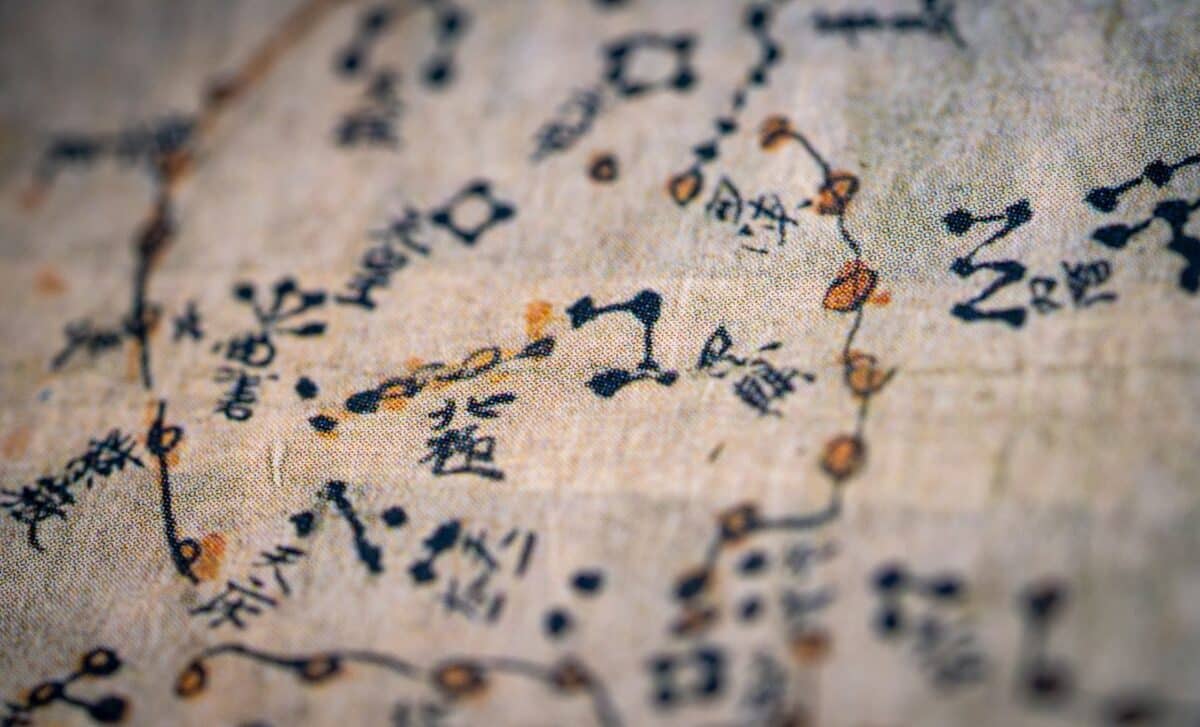
Long forgotten and hidden under layers of religious texts, the world’s earliest star catalog has just resurfaced. Scientists have managed to pull fragments of it from a 1,500-year-old manuscript by scanning erased ink with X-ray technology.
The ancient astronomer Hipparchus had mapped the stars by eye more than 2,000 years ago, but his groundbreaking work disappeared for centuries. Now, thanks to high-tech tools and a bit of luck, part of his sky chart is readable again, and it’s a striking example of just how much early astronomers got right.
An Ancient Catalog Hiding Under Six Layers Of Ink
Until recently, all that remained of Hipparchus’ work were secondhand mentions and a few symbols carved into statues, like those on the Farnese Atlas, a Roman sculpture that shows the sky etched onto a celestial globe. But actual star positions from his catalog had vanished.
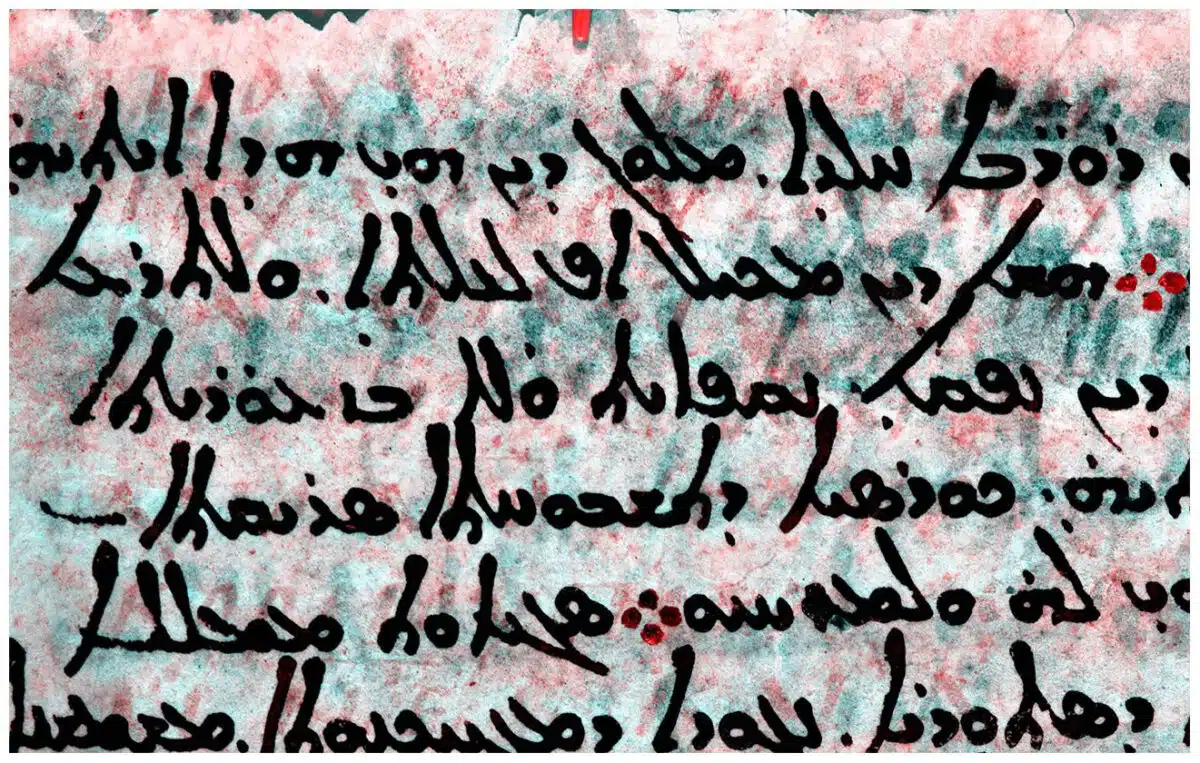 Folio 53v: erased Greek words (in red) pop out under later Syriac text, uncovered through imaging tech. Credit: Journal for the History of Astronomy
That changed when researchers spotted traces of ancient Greek writing on a palimpsest, a parchment manuscript that had been wiped clean and reused. Led by Victor Gysembergh from Sorbonne University, the team dug deeper.
The historic discovery was published in the Journal for the History of Astronomy, where researchers explained how they used X-rays from a particle accelerator at the SLAC National Accelerator Laboratory to uncover the erased text.The trick was that Hipparchus’ original ink had a different chemical makeup than the later religious writings, which made it stand out under the right scan.
Physics Helps Bring Forgotten Text Into Focus
The manuscript, now held at the Museum of the Bible in Washington, D.C., is so delicate that it had to be hand-carried in climate-controlled boxes to the lab. There, scientists scanned 11 pages with extremely short X-ray pulses, each just ten milliseconds, and focused the beam to an area no wider than a human hair.
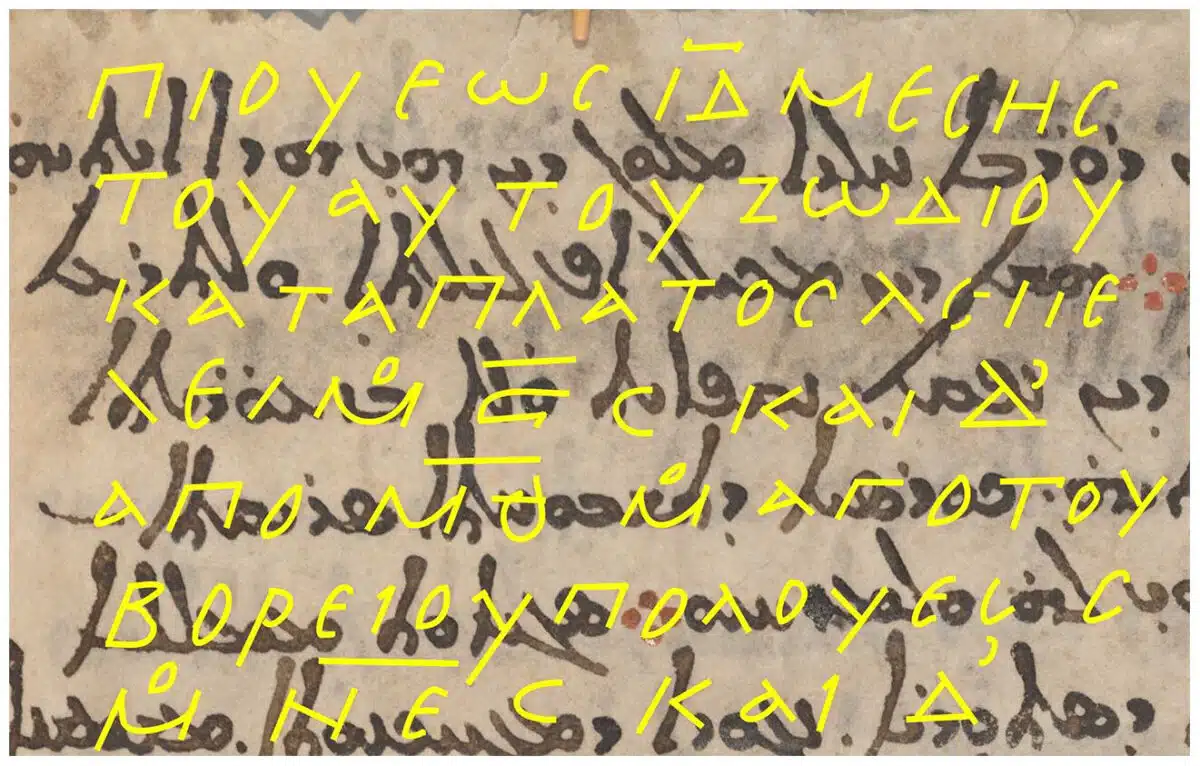 Detail from folio 53v, featuring yellow outlines based on full multispectral imaging data. Credit: Journal for the History of Astronomy
As the scans came through, characters from erased Greek text began to appear clearly on screen. According to Popular Mechanics, the ink used in Hipparchus’ original work was rich in calcium, so researchers could separate it from the later layers and recover actual star positions written over 2,000 years ago.
Sky Maps Made With No Telescope, Just Vision
Hipparchus is widely seen as the father of astronomy. Long before modern instruments existed, he figured out how the equinoxes shift, created a magnitude scale to rank star brightness, and tracked planetary motion. His rediscovered coordinates are more than just numbers, they’re a window into how ancient people made sense of the night sky.
“The goal is to recover as many of these coordinates as possible,” said Gysembergh, “And this will help us answer some of the biggest questions on the birth of science […] because the coordinates we are finding are incredibly accurate for something that is done with the naked eye.”
The Codex Climaci Rescriptus, cobbled together from ten older texts in Greek and Aramaic, was eventually rewritten in Syriac with the religious writings of Saint John Climacus. That layering almost buried Hipparchus’ legacy for good. But with the help of modern tools and some careful detective work, one of the earliest roadmaps to the stars is finally seeing daylight again.