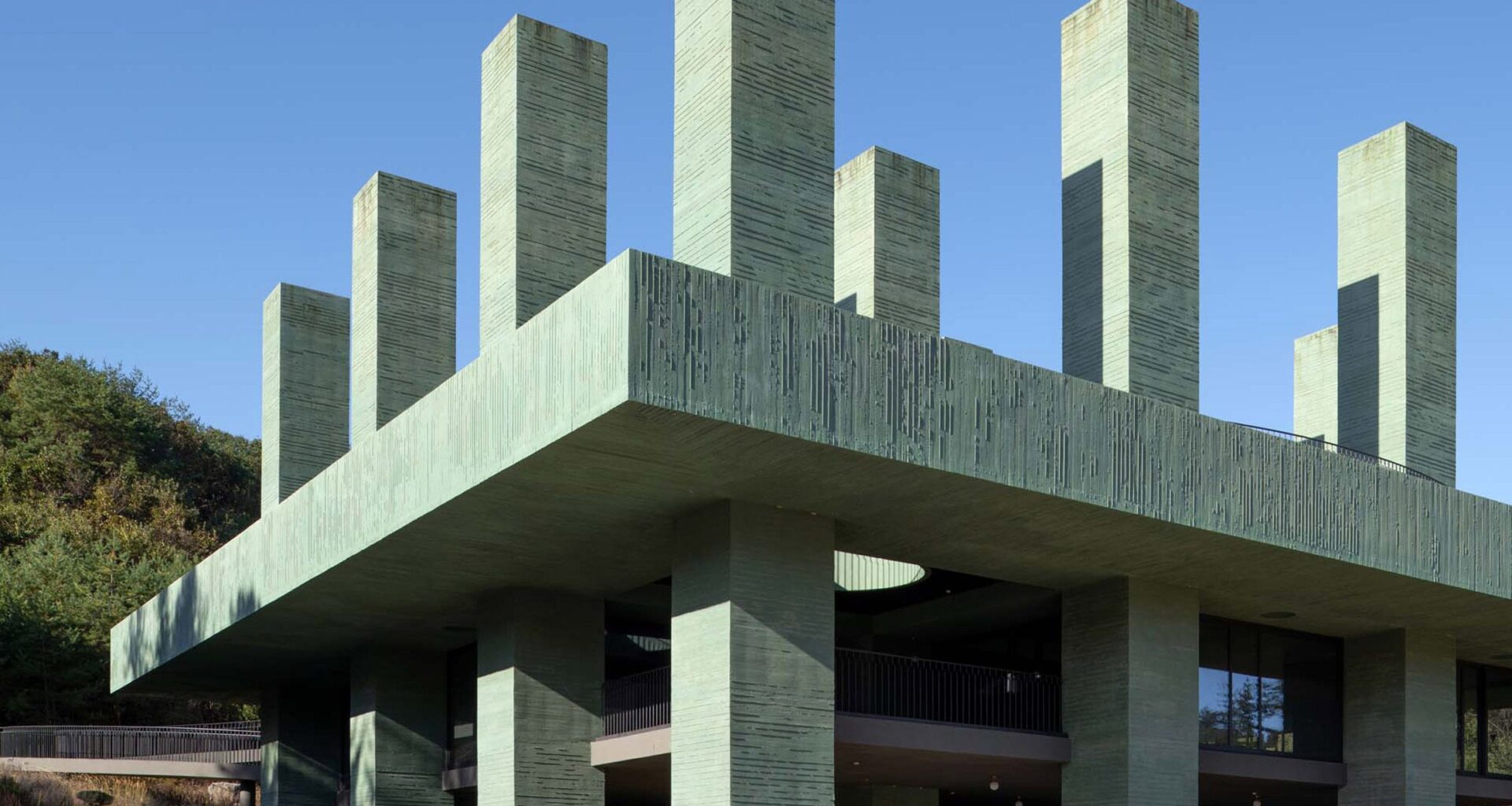
Chilean studio Pezo von Ellrichshausen has installed a restaurant at Les Jardins de Médongaule, in South Korea’s Gyeonggi Province, featuring 16 huge green concrete columns.
Providing a roof terrace as well as a restaurant, the towering structure is the latest addition to a new botanical garden complex located northeast of Seoul.
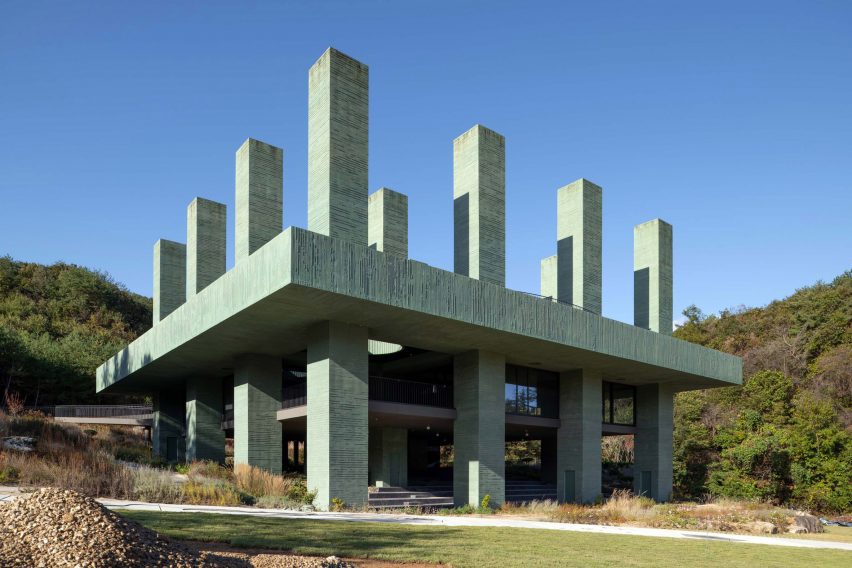 The structure comprises 16 columns and a horizontal slab suspended midway up
Its official name is Überhaus, reflecting its vantage point overlooking the gardens, but architects Mauricio Pezo and Sofia von Ellrichshausen call the building Rest, indicating its function as both a restaurant and a rest stop.
The 10-metre-high columns organise the building into a precise square grid, dissected midway up by a concrete slab of the same thickness.
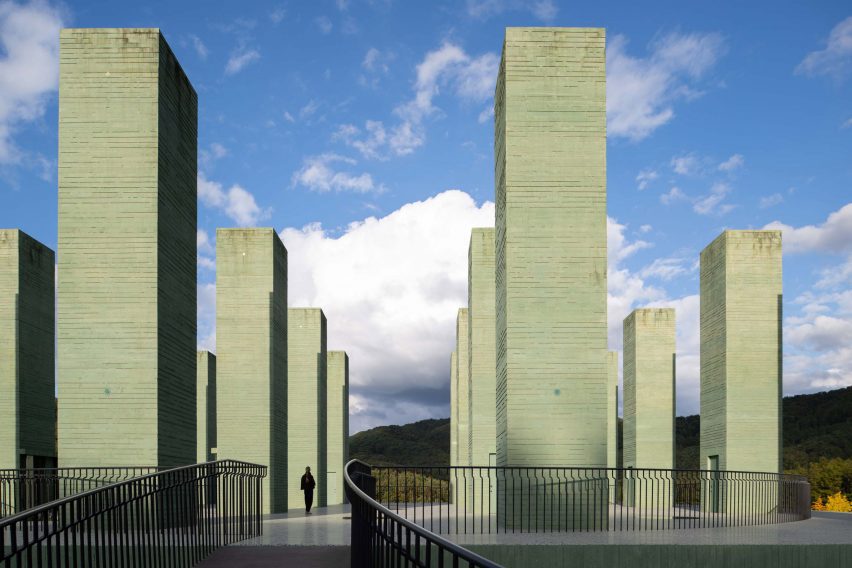 A terrace covers the building’s roof
This slab forms the floor of the vast roof terrace, where a balustrade draws a large circle to define the boundary between accessible and inaccessible space.
The restaurant’s 100-seat dining room is located underneath, with its floorplate suspended between the concrete slab and the sloping landscape. The kitchen and other facilities are buried underground, covered by a stepped plaza.
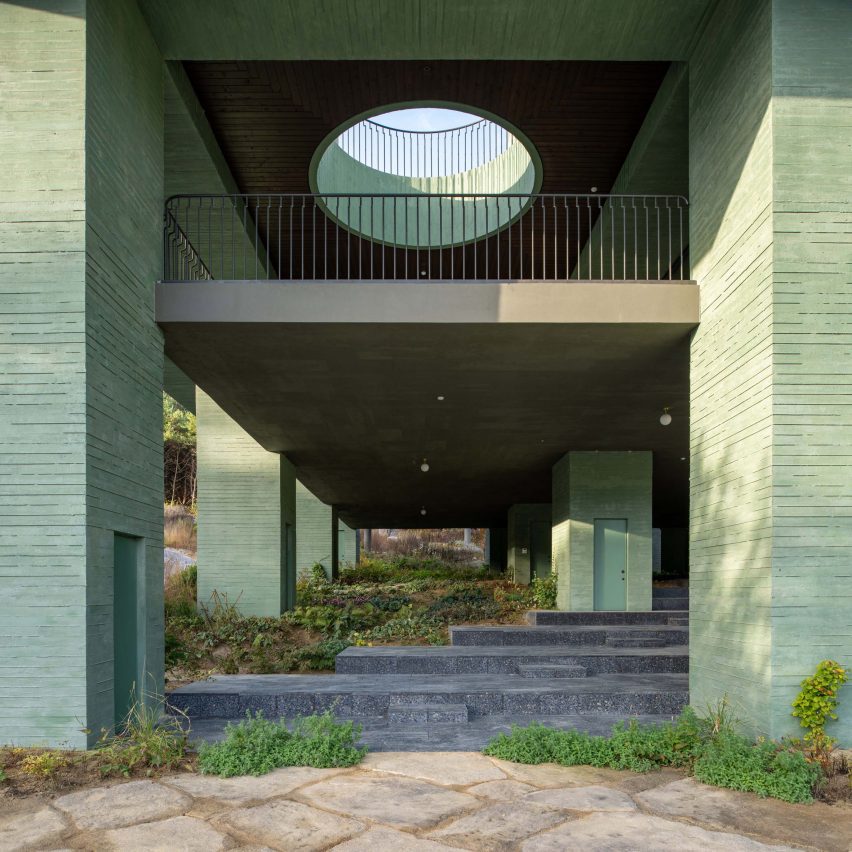 The restaurant dining room sits between the concrete slab and a stepped plaza
“The open plan is explicitly characterised into three strata,” explained Pezo and Von Ellrichshausen, who delivered the building in collaboration with local studio See Architects.
“The lower one follows the natural topography, with a covered amphitheatre funnelled towards the lower valley,” said the duo.
“The intermediate one is suspended under a thick platform, with a diagonal symmetry formed by open corner terraces at opposite ends, and the upper one is over the non-directional horizontal platform, with a panoramic view framed in multiple orientations by 10-metre-tall, obelisk-like, free-standing columns.”
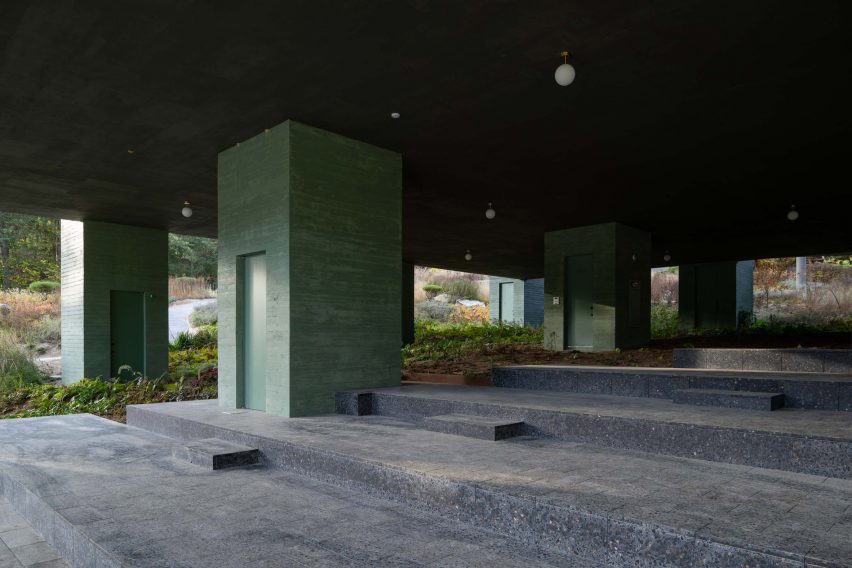 The columns contain lifts, storage spaces and toilet cubicles
Überhaus is one of several landmark buildings in the 23,000-square-metre Les Jardins de Médongaule, which opened in September 2025.
Showcasing the history and future of the Korean garden, the complex also includes the Seongok Seowon Academy, an education facility designed by Seung H-Sang of Iroje Architects & Planners, and a cloud-shaped entrance building by Ensamble Studio that is still under construction.
Pezo von Ellrichshausen organises pink concrete Lima House around pool
Überhaus borders a forest at the western edge of the complex, furthest from the entrance, serving as a destination for visitors after they have walked through the gardens.
While past Pezo von Ellrichshausen buildings feature pigmented concrete in shades of yellow and pink, the architects created a soft green shade here by adding a silicate pigment.
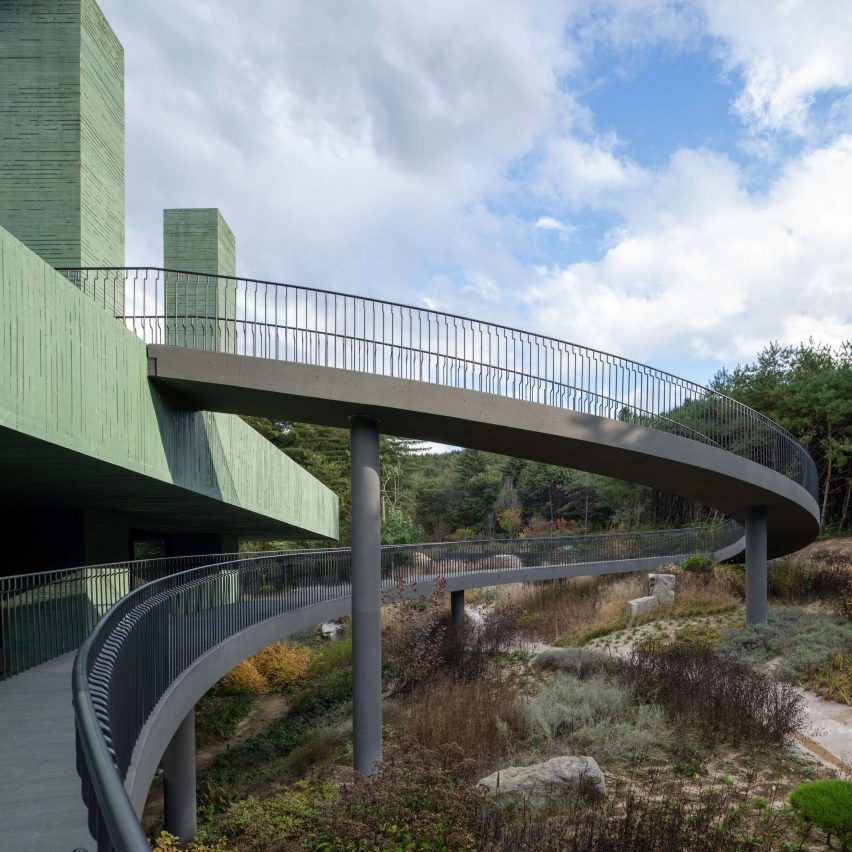 Sloping bridges spiral up from the ground to the roof terrace
The columns are square in footprint, measuring two metres in both width and depth. Four of them contain lifts, while others provide storage spaces and toilet cubicles.
Most visitors access the restaurant and roof terrace via ramped bridges that slope up from the landscape in neat circles. Another route involves a spiral staircase in the building’s west corner, which rises from the stepped terrace.
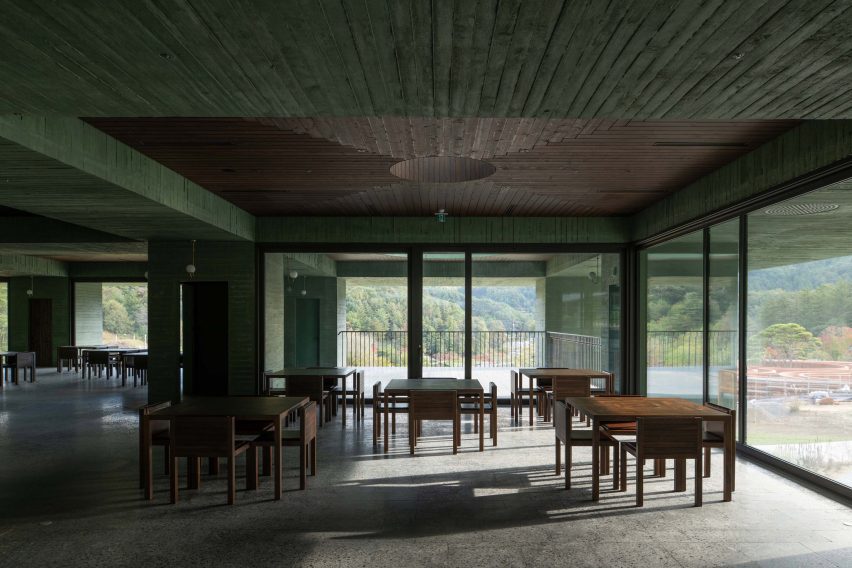 Oak clads ceilings and lines the inside of circular skylights
The design offers a continuation of the ideas behind Pezo von Ellrichshausen’s Less pavilion in Canberra, Australia, which also featured a strict grid of thin vertical elements.
The architects bring strict geometries to most of their buildings, but these are the first to explore the column as an organising system.
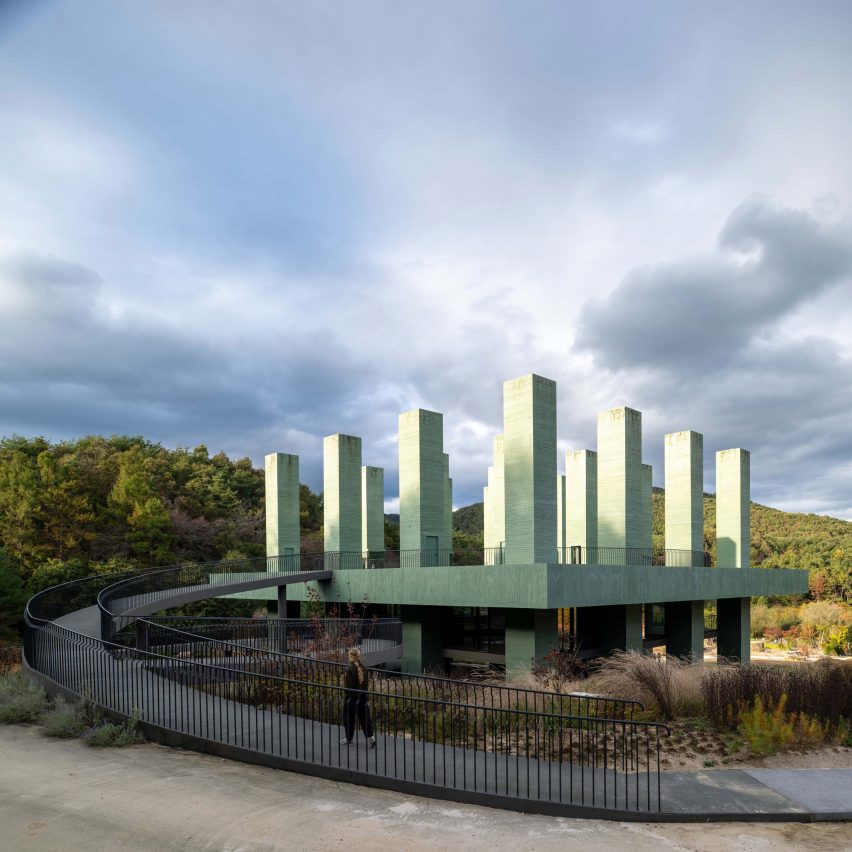 A green pigment changed the colour of the concrete
They suggest that the columns be used in different ways, “as supports for garlands, candles or canopies”.
“The massive columns and slab, in their boldness, promote a sense of enduring presence, of discreet contemplation, of arcane shadows within an opaque and transparent milieu,” said the architects.
“In as much as the columns remain inexpressive, there is a vacant space, both physical and mental, to be filled.”
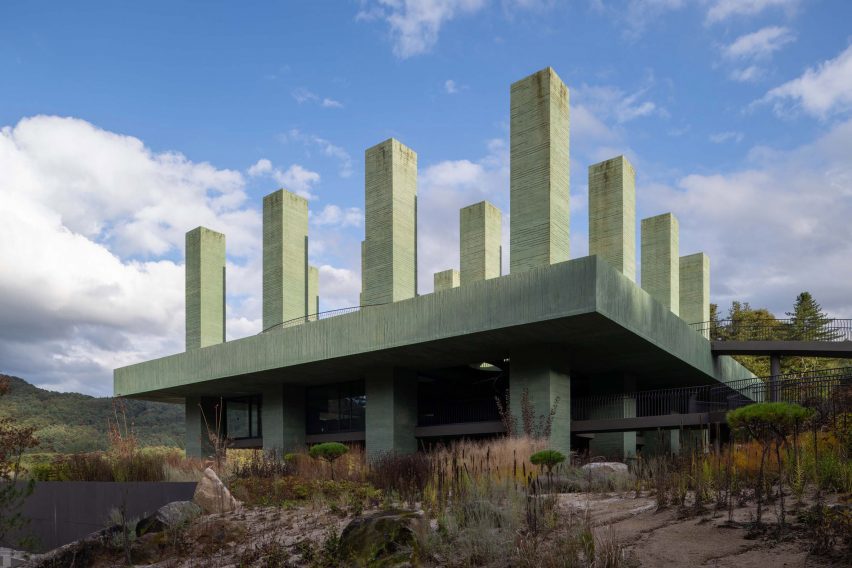 The building is located in Les Jardins de Médongaule, northeast of Seoul
Terrazzo paving provides floor surfaces both inside the building and underneath it. Oak boards clad the ceilings, lining deep circular skylights, while bronze-toned aluminium frames the glass walls.
The photography is by Pezo von Ellrichshausen.
Project credits:
Architects: Pezo von Ellrichshausen
Collaborators: Emilie Kjaer, Francesco Caminati, Masha Arnold, Manuel Heck, Beatrice Pedrotti, Lukas Vajda
Local architect: See Architects
Structure: Chang Minwoo
Construction: C&O
Consultants: Macand Mec Inkok Enc, Rainbowscape
Landscape: Jardins de Sericourt/Dongsimwon Landscape Design