Scientists are continually striving to improve the sensitivity of label-free optical microscopy, a vital tool for biological and materials science, which is typically restricted by fundamental limits imposed by photon shot noise. Pengcheng Fu, Xiao Liu, and Siming Wang, from the Zhejiang Key Laboratory of Micro-Nano Quantum Chips and Quantum Control at Zhejiang University, alongside Nan Li, Chenran Xu, and Han Cai et al., have now developed squeezing-enhanced photothermal (SEPT) microscopy to overcome this challenge. Their research introduces an imaging technique utilising twin-beam correlations to detect absorption signals with significantly improved sensitivity, achieving 3.5 dB of noise suppression and a 2.5-fold increase in imaging throughput. This advance not only enhances the detection of subtle features, such as previously undetectable subcellular structures like cytochrome c, but also offers a versatile and compatible upgrade path for existing microscopy setups, promising a new era for molecular absorption imaging across diverse scientific disciplines.
This breakthrough addresses a fundamental limitation in biological and materials science imaging, the sensitivity bottleneck imposed by photon shot noise. The research team, utilising twin-beam quantum correlations, demonstrates 3.5 dB of noise suppression beyond the standard quantum limit, representing a significant leap in imaging capability. This noise reduction translates to either a 2.5-fold increase in imaging throughput or a 31% reduction in required pump power, offering substantial advantages for high-precision analysis and minimising photodamage to sensitive samples.
The core of the innovation lies in the application of squeezing-enhanced light, generated through a four-wave-mixing process in a rubidium vapor cell, as the probe beam in photothermal microscopy. Unlike conventional methods reliant on high-peak-power nonlinear optical processes, SEPT leverages the compatibility of continuous-wave squeezing with photothermal modulation, a linear optical process. Experiments show that this approach circumvents the limitations of existing Squeezed light sources, which often struggle to simultaneously achieve high squeezing degrees and sufficient peak power. By employing balanced homodyne detection, the team measured up to 7 dB of squeezing in the intensity difference of the twin beams, effectively reducing noise and enhancing signal detection.
This enhanced sensitivity allows for the visualisation of subcellular structures, such as cytochrome c, which remain undetectable using traditional shot-noise-limited imaging techniques. Furthermore, SEPT facilitates high-precision characterisation of nanoparticles, demonstrating its versatility across diverse applications. The study establishes a new paradigm for molecular absorption imaging, combining label-free contrast with quantum-enhanced sensitivity and compatibility with existing microscopy platforms. By overcoming the limitations of conventional photothermal microscopy, which suffers from signal instability and photodamage at higher power levels, SEPT enables quantitative analysis and real-time monitoring of dynamic cellular processes.
The researchers developed SEPT microscopy based on the principle of exploiting quantum correlation of twin beams to suppress shot noise and improve sensitivity. In conventional coherent photothermal detection, shot noise arises from the inherent randomness of photon arrival times. However, in quantum-correlated balanced detection, photons in the twin beams exhibit strong temporal intensity correlations, resulting in squeezed noise in their intensity difference. Crucially, the interaction between the pump and probe lights is mediated by thermal expansion of the specimen, meaning photothermal detection does not require the high peak power of ultrafast lasers. With modulation frequencies typically below 1MHz, SEPT fully benefits from the highly squeezed continuous-wave twin beams generated via a four-wave-mixing process in a rubidium vapor cell. The team achieved consistent squeezing throughout imaging by locking the laser frequency using saturated absorption spectroscopy in a reference rubidium vapor cell.
Twin-beam generation and squeezed-light microscopy setup are now
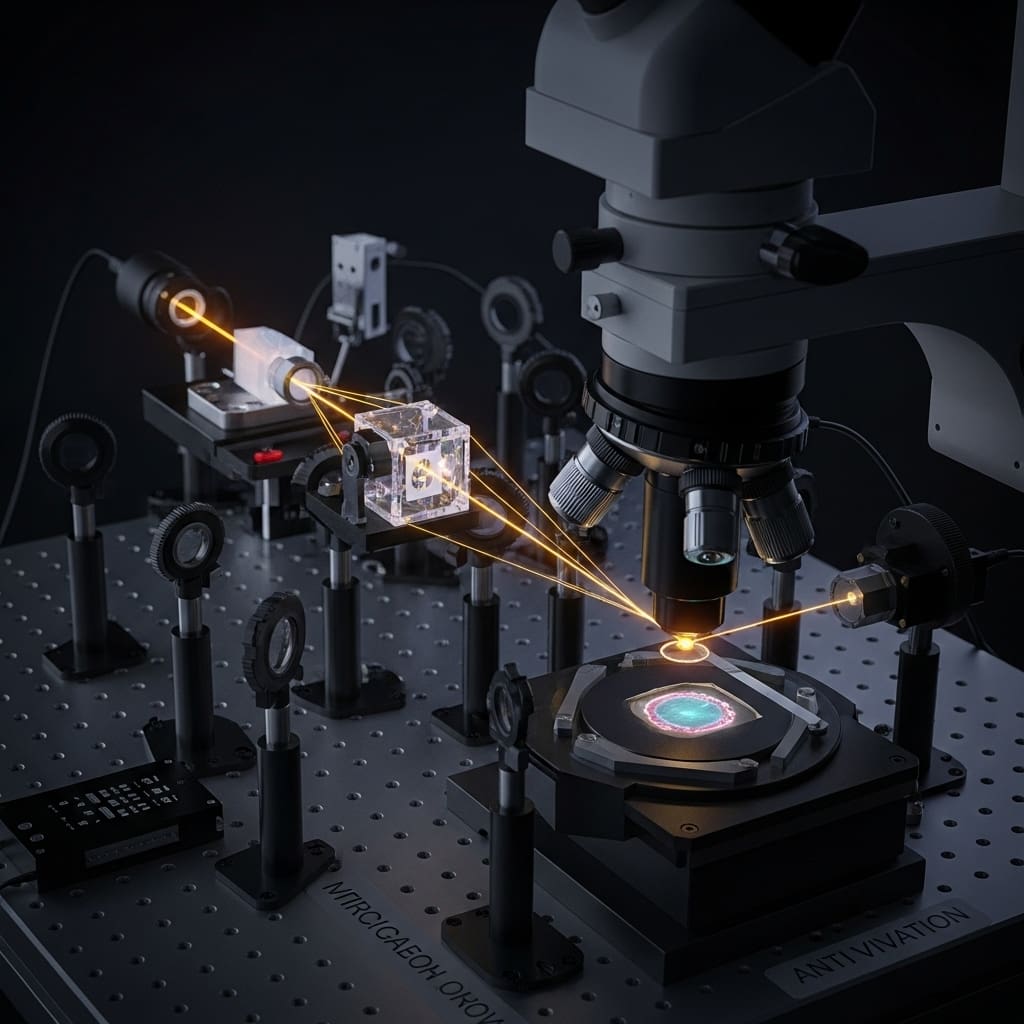
Scientists pioneered squeezing-enhanced photothermal (SEPT) microscopy, an imaging technique leveraging twin-beam correlations to detect absorption signals with unprecedented sensitivity. The team generated m-correlated twin beams through a four-wave mixing (FWM) process utilising 85Rb atoms, carefully controlling polarization with a quarter-wave plate and half-wave plate before expansion via a pair of concave mirrors. A frequency shifter and polarizing beamsplitter further refined the beam characteristics, directing it towards the sample via an acousto-optic modulator and dichroic mirror. Experiments employed a custom-built scanning microscope integrating squeezed-light balanced homodyne detection (BHD) with photothermal detection, minimising optical losses to reduce vacuum noise leakage.
The photothermal pump and probe beams were collinearly combined using a high-efficiency dichroic mirror and focused through a high-transmission objective lens. Transmitted probe light, modulated by the photothermal effect, was collected by a second objective and directed to the BHD after spectral filtering. Crucially, the conjugate beam was independently focused onto the BHD reference photodiode, with intensity controlled by a half-wave plate and polarizing beamsplitter, enabling quantum-correlated detection. To quantify performance, researchers performed sequential spectral and imaging analysis on a single 20-nm gold nanoparticle, achieving a 466-nm diffraction-limited spatial resolution.
Spectral analysis demonstrated a 3.5 dB noise suppression using quantum-correlated twin beams compared to standard photothermal imaging at the standard quantum limit (SQL-PT). The study revealed that SEPT consistently exhibited lower average and standard deviations of background noise across a broad range of pump powers, maintaining stable noise suppression. Image contrast, calculated as S/BG, and signal-to-background ratio (SBR), defined as (S, BG) / σBG, were used to quantify imaging performance. While signal amplitudes in both SEPT and SQL-PT showed linear dependence on pump power, SEPT achieved a 3.5 dB enhancement in both image contrast and SBR, corresponding to a 45% improvement in amplitude ratios and 110% improvement in power ratios. This allows for a 31% reduction in pump power while maintaining comparable performance, mitigating photodamage and classical noise. Furthermore, contour plots and line profiles demonstrated that SEPT achieved a faster reduction in phase uncertainty than SQL-PT detection, highlighting its precision in measuring thermal diffusivity.
Squeezed light boosts photothermal microscopy sensitivity by reducing
Scientists have developed squeezing-enhanced photothermal (SEPT) microscopy, a new imaging technique that leverages twin-beam correlations to detect absorption induced signals with unprecedented sensitivity. The work achieves 3.5 dB of noise suppression beyond the standard quantum limit, representing a substantial improvement in signal clarity. This noise suppression translates to a 2.5-fold increase in imaging throughput or a 31% reduction in required pump power, enhancing both speed and efficiency. Crucially, the technique exhibits broad spectral applicability, functioning effectively from visible to mid-infrared wavelengths, and is compatible with existing microscopy platforms.
Researchers generated quantum-correlated probe and conjugate beams centered at 795nm through a four-wave-mixing process in a rubidium (85Rb) vapor cell at the D1 transition. Measurements using a modified balanced homodyne detector revealed up to 7 dB of squeezing in the intensity difference of the twin beams. To ensure consistent performance, the laser frequency was locked using saturated absorption spectroscopy in a reference rubidium vapor cell. The SEPT microscope utilizes a 532-nm pump laser to induce photothermal effects through electronic absorption, with the frequency range of the squeezed noise spectra (0.4, 4MHz) covering typical photothermal modulation frequencies.
Experiments demonstrated the transformative potential of SEPT through label-free visualization of cytochrome c (Cyt c) in cells and high-precision characterization of nanoparticles. The team constructed a scanning microscope integrating the squeezed-light balanced homodyne detector with photothermal detection, minimizing optical losses to reduce vacuum noise. Collinear combination of the pump and probe beams was achieved using a high-efficiency dichroic mirror, focused through a high-transmission objective. Transmitted probe beam modulation, resulting from the photothermal effect, was collected and directed to the balanced homodyne detector after spectral filtering.
Quantitative assessment of the quantum advantage involved spectral and imaging analysis of a single 20-nm gold nanoparticle. Results showed a 466-nm diffraction-limited spatial resolution, confirming sub-cellular imaging performance. Spectral analysis demonstrated a 3.5 dB reduction in the noise floor with SEPT compared to standard photothermal imaging, while imaging results indicated consistently lower average and standard deviations of background noise. These noise characteristics remained stable across a broad range of pump power adjustments, demonstrating consistent noise suppression.
SEPT microscopy surpasses shot noise limits by leveraging
Scientists have developed a new microscopy technique called squeezing-enhanced photothermal (SEPT) microscopy that significantly improves the sensitivity of label-free optical imaging. This advancement overcomes limitations imposed by photon shot noise, a fundamental barrier in conventional microscopy, by utilising twin-beam correlations to detect absorption signals with unprecedented precision. SEPT achieves 3.5 dB of noise suppression, resulting in a 2.5-fold increase in imaging throughput or a 31% reduction in required pump power. The technique’s versatility stems from its compatibility with continuous-wave squeezing and photothermal modulation, allowing for high-precision characterisation of nanoparticles and the visualisation of subcellular structures, such as cytochrome c, previously undetectable due to noise.
Researchers demonstrated that SEPT resolves 77% more spatial features compared to standard photothermal imaging, indicating a substantial improvement in sensitivity while maintaining spatial resolution and acquisition speed. This integration of quantum-correlated twin beams with photothermal detection represents a notable step forward in quantum-enhanced microscopy, particularly as it leverages linear absorption processes and circumvents the need for wavelength-tunable quantum light sources. The authors acknowledge that the availability of highly squeezed light sources is currently limited to specific wavelengths, representing a constraint on the technique’s spectral range. Future research will focus on enhancing detection efficiency and utilising twin beams with higher squeezing levels to further improve performance. Additionally, the framework established by SEPT is readily adaptable to nonlinear optical microscopy and multimodal imaging applications, potentially broadening its utility across diverse scientific disciplines.