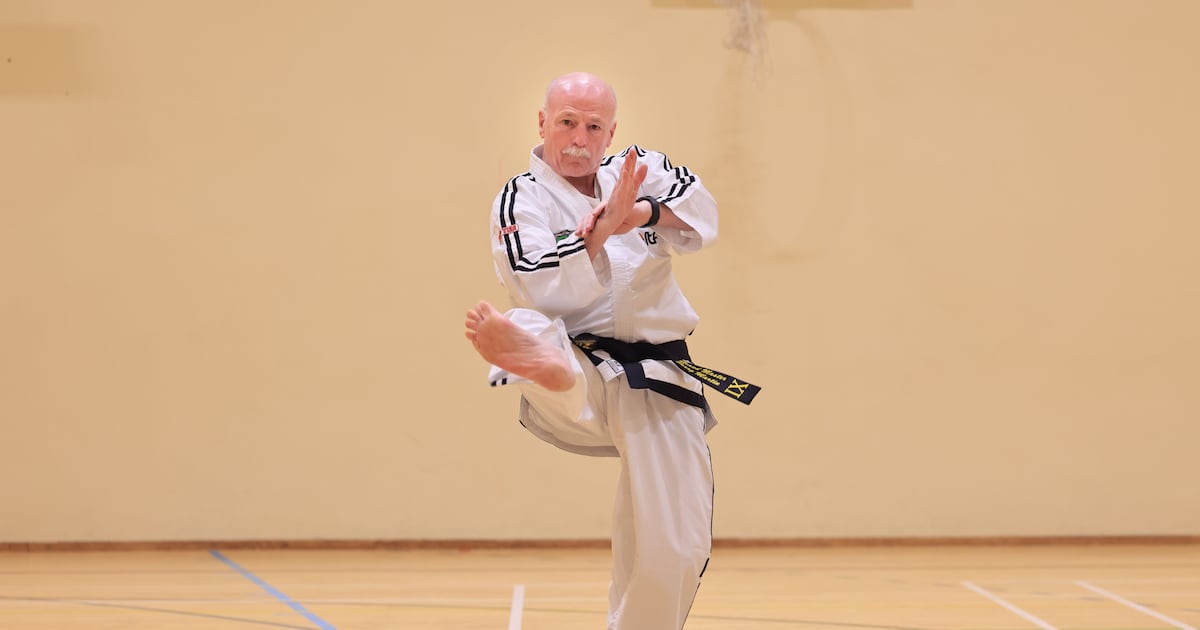
After Taekwon-Do instructor Gerry Martin was told he had oesophageal cancer and was facing major surgery, he intuitively knew he needed to approach this health challenge as if it were an upcoming competition or grading.
He reckoned the fitter he could be for the operation, logically the recovery should be easier. “I just thought I need to do something here to make sure that I can have the best possible outcome. But also, mentally, it gave me something to focus on.”
The oesophagectomy would involve removal of his oesophagus, the food pipe. This would be replaced by stretching up his stomach to reconstruct a pathway for food to travel from his throat to the repositioned stomach.
“I was made aware that there was a possibility of complications such as pneumonia, leakage from the new connection of oesophagus and stomach, weight and muscle loss, bleeding and infection. On researching the operation, I also knew that this procedure and reconstruction would put a lot of pressure on my lungs.”
In devising “a bespoke Taekwon-Do training regime that would improve my cardiovascular fitness, strength, resilience and mental health for both the operation and the recovery”, Martin felt he was able to take control of something himself. “You don’t just completely rely on the doctors to do everything.”
After years of persistent heartburn, he had been diagnosed in 2006 with Barrett’s oesophagus. This is where acid reflux has triggered a change in cells lining the lower oesophagus. It is a possible forerunner of cancer, so patients are monitored through regular endoscopies.
While Martin was unlucky to be among the 1 per cent of people diagnosed with Barrett’s who will develop cancer each year, he considers himself lucky that it was caught early in one of his scheduled check-ups, at the end of 2010. After a second tumour grew back at the site from where the first one had been excised, he underwent an oesophagectomy in April 2011.
In preparing for the surgery he remembered how, about a year earlier, he had heard somebody who had undergone the same procedure talking on the radio about how they had lost a lot of weight, due to being unable to eat for days afterwards. He resolved to try to put on some weight in advance.
“It was common sense but nobody was talking about it,” he says. Advice from dietitians came after surgery, not before. Already training five or six times a week, Martin tweaked his programme to prioritise aerobic fitness through circuits, along with a focus on conditioning, to help counter the inevitable loss of muscle mass ahead.
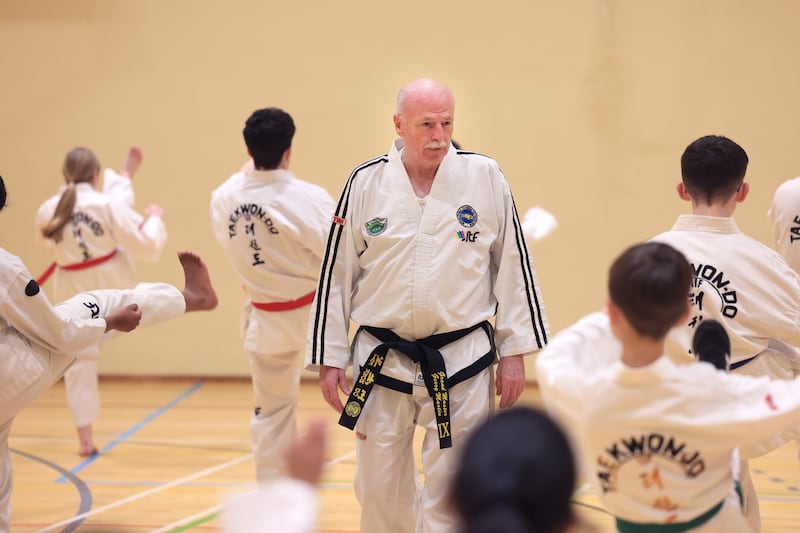 Gerry Martin warming up with students at Beaumont Taekwondo Centre. Photograph: Dara Mac Dónaill
The day after his surgery in Dublin’s Beaumont Hospital, “they actually got me out of bed, walking, which was great. Then I kept that up myself”.
Martin got home after 10 days and did short walks down the road two or three times a day, gradually increasing the distance. He set himself short-term and long-term recovery goals, which he believed would help keep him focused.
“These included attending my son’s First Communion four weeks after the operation and opening a new Taekwon-Do club in my hometown of Beaumont within six months of surgery.” He achieved both.
Almost 15 years later, Martin, at age 66, continues to teach at that club three evenings a week. (At the time of his diagnosis, only 22 per cent of people diagnosed with oesophageal cancer were surviving beyond five years, according to the National Cancer Registry.) Last March he earned his ninth degree black belt, making him a grand master in Taekwon-Do, the highest level in this form of martial arts. He also works as an accountant with the Communications Workers’ Union.
When it comes to the use of exercise as a cancer medicine, Martin “is ahead of the curve and a brilliant example”, says Prof Jarlath Bolger, consultant upper GI surgeon and an associate professor of surgery at the Royal College of Surgeons in Ireland (RCSI). In recent years, evidence-based exercise programmes in preparation for surgery have been introduced in some Irish hospitals, in addition to physical rehabilitation afterwards.
 Prof Jarlath Bolger
Increasing attention is being paid to how exercise can give post-treatment cancer survivors improved quality of life and a better chance of avoiding a recurrence. However, a 2022 scoping review by the National Cancer Control Programme (NCCP), published in 2024, found “overall, there is very little dedicated PA [physical activity] provision for cancer survivors and no systematic approach to PA intervention nationally”.
It identified lack of awareness by healthcare professionals concerning the importance and benefits of exercise in cancer as one of the barriers, along with limited access to programmes, due to lack of availability and the cost.
[ Oesophageal cancer: ‘I was fine, there was nothing wrong with me’Opens in new window ]
Bolger also sees funding as an obstacle to cancer survivors’ wider participation in exercise. “Cancer treatment can be a very financially challenging time for patients. So it’s very difficult to turn around and say to patients, ‘Go and spend more money on an exercise programme,’” he tells The Irish Times.
Many of the community cancer support centres around the country do run free physical activity programmes and at least three of them have purpose-built gyms. ExWell Medical, a social enterprise that offers structured, medically supervised exercise programmes in more than 50 community centres around the country, runs an oncology rehabilitation programme, MedEx “Move On”, for cancer survivors. A small study, conducted through Dublin City University, suggested this 12-week programme “significantly improved the physical and psychological wellbeing of cancer survivors”.
Evidence drives State funding of services and half of Bolger’s job is as a researcher in the RCSI. Addressing a recent patient support meeting organised by the Oesophageal Cancer Fund (OCF), he outlined the results of Irish trials of pre-operative and post-operative exercise programmes. Combined results of four randomised trial studies among oesophageal cancer patients in Ireland and the UK showed that those who followed a pre-operative structured exercise programme had increased fitness, reduced complications and better completion of chemotherapy than those on standard care. In a separate trial on post-operative exercise, significant improvement in cardiorespiratory fitness was recorded for those who followed a 12-week plan.
It’s very difficult to say from those findings that there is definitely an improvement in survival, “but we can extrapolate out and say that there might be”, suggests Bolger. He is working, in conjunction with the OCF, to try to secure funding to involve patients with oesophageal cancer at Beaumont Hospital in exercise programme trials.
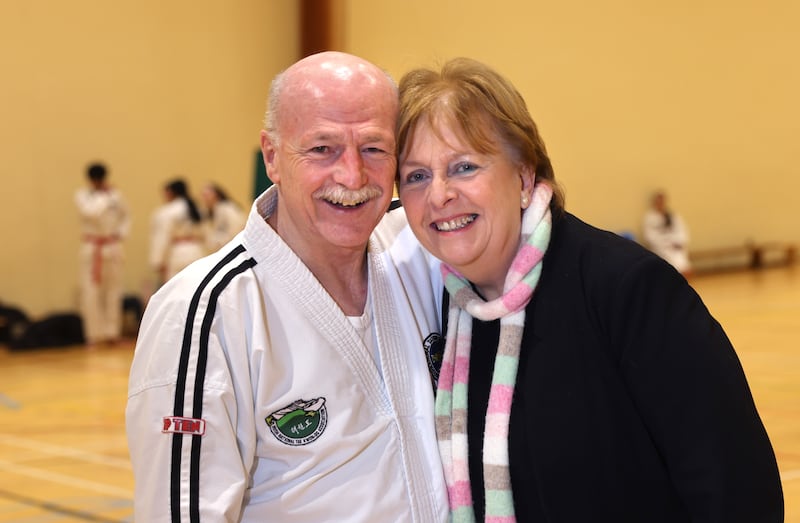 Gerry Martin with his wife, Carmel Doyle, who is chief executive of the Oesophageal Cancer Fund. Photograph: Dara Mac Dónaill
At the meeting, Bolger outlines some promising findings from a large study conducted, primarily in Canada, among patients undergoing treatment for colorectal cancer. The results of the randomised control, which recruited about 900 patients in 55 centres over 15 years, were published last July in the New England Journal of Medicine.
Half the patients received some general health education; the other half got that health education plus three years of training supported by a physical therapist. By the end of the three years, 70 per cent of that group were still doing all the training. “Patients who were getting supported had an increase in their VO2 max, which is your ability to utilise oxygen. This is a really good marker of longevity, of long life and general fitness.”
Not surprisingly, better walking speeds and other physical functions were also recorded among the supported training group, in comparison to those left to their own devices. “What is really interesting though is when they look at survival,” he reports. “At five years the exercise group were less likely to get a recurrence of their cancer than the general education group.”
The difference was 6.4 percentage points – 80.3 per cent of the exercise group were disease free compared to 73.9 per cent of the health education group. “It’s not a perfect study, but it’s very interesting and it does raise the possibility that regular physical activity might impact on cancer recurrence.”
With all the advances in treatments and surgical interventions, Bolger believes it is important to focus on more than longevity of cancer survivorship. The use of less invasive, robotic surgery means patients experience less trauma and can get out of hospital sooner, he points out. They can engage in exercise programmes a lot quicker than they could have in the past.
“It’s making sure,” Bolger adds, “that when patients do come through [treatment], that they come out the other side with a really good quality of life.”
Gerry Martin certainly did that. He now promotes cancer survivors’ involvement in exercise through his role as patient ambassador for the OCF (the chief executive of which is his wife, Carmel Doyle) and Beaumont Hospital; also through involvement with the Irish Cancer Society and the NCCP. In a thesis written last year for his elevation to grand master, he incorporated fundamentals of Taekwon-Do into an exercise programme that could be “used as a medicine and a possible introduction to future training in the martial art”.
“I know, understand and can prove,” he adds, “the real benefits of exercise to those physically and mentally challenged by cancer.”
Oesophageal cancer warning signs
Survival rates for oesophageal cancer have approximately doubled in Ireland in the 25 years since the founding of the Oesophageal Cancer Fund.
The charity was set up in 2001 by Noelle Ryan and others after the death of a childhood friend, Lucilla Hyland, from oesophageal cancer. At that time, awareness of the disease was low; diagnoses were often made at an advanced stage and treatment options were limited and frequently palliative.
OCF’s flagship fundraising and awareness campaign, Lollipop Day, will take place on February 27th and 28th. As well as running campaigns to increase awareness of symptoms, the OCF was, in 2011, instrumental in the setting up and funding of a national registry of anyone diagnosed with Barrett’s oesophagus. This may develop into cancer, which is why the nearly 9,500 people (68 per cent male, 32 per cent female) currently on that registry, are scheduled for regular endoscopies. To date, around 800 patients on the registry, which is now jointly funded by Precision Oncology Ireland, have had pre-cancer or very early-stage cancer diagnosed and treated, with a 100 per cent cure rate.
However, among many of the 500 people who are diagnosed with this type of cancer each year, it is still being detected too late for an optimum outcome.
Warning signs for oesophageal cancer or Barrett’s oesophagus include:
- Difficulty swallowing (dysphagia) or pain when swallowing
- Food feeling stuck in the throat or chest
- Persistent heartburn or acid reflux
- Persistent chest pain or discomfort
- Unexplained weight loss
- Persistent coughing or hiccups
- Vomiting or nausea
- Ongoing fatigue
World Cancer Day
The Irish Cancer Prevention Network will mark World Cancer Day on Wednesday, February 4th, by hosting a free public webinar entitled, Small Steps, Big Impact: Physical Activity for Cancer Risk Reduction. All are welcome to register for the ICPN’s World Cancer Day webinar (see registration link here).
One in two people living in Ireland will be diagnosed with cancer in their lifetime. Each individual’s risk of getting cancer is influenced by a wide range of factors, including things we cannot do anything about, such as age and genetics.
However, 30-50 per cent of all cancers are preventable through changes to lifestyle and environmental factors, according to the World Health Organisation. These include healthy eating, no or low alcohol consumption, smoking cessation and protecting skin from the sun.