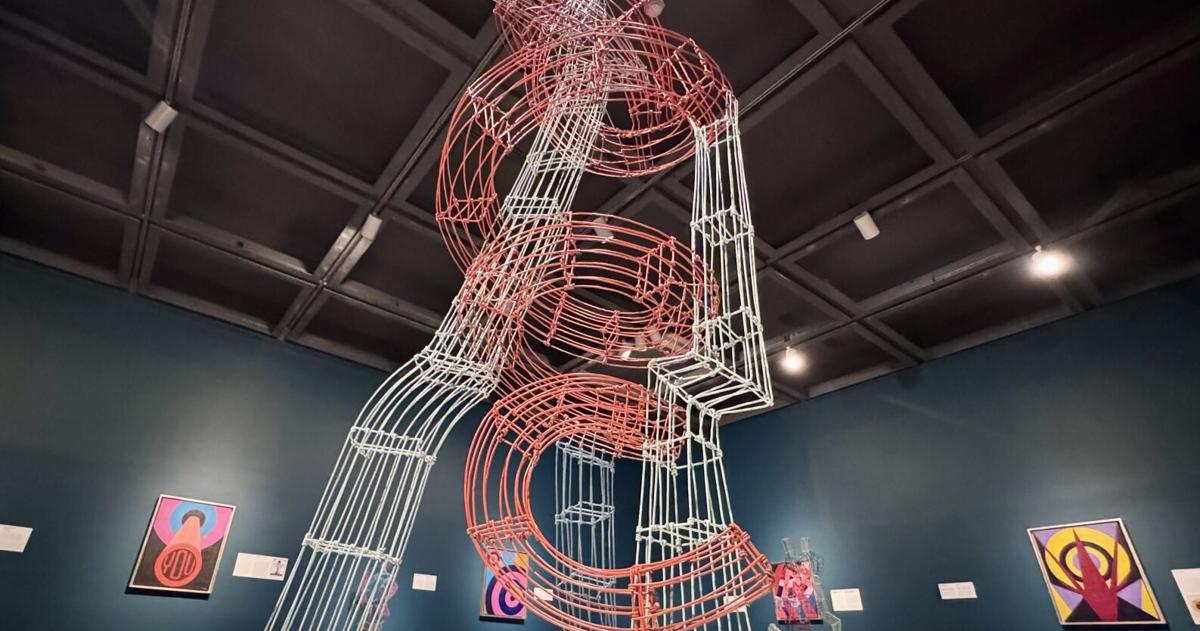
Hayward L. Oubre Jr. was born in New Orleans in 1916 and became the first student to earn a Bachelor of Fine Arts degree from Dillard University. His career as a practicing artist and college professor took him away from his hometown for the rest of his life — he died in 2006.
But his splendid solo exhibit “Hayward Oubre: Structural Integrity” that opens Friday at the New Orleans Museum of Art, gives us a chance to reclaim him as one of our own. It’s a not-to-miss show, particularly for fans of elegant, mid-century modernism.
Oubre was skilled in several media, from etching to oil painting to wood carving. At age 40, he had an artistic epiphany, when he twisted some coat hangers into the shape of a crowing rooster.
The sculpture was simple, just a three-dimensional sketch really. Yet the flowing and wound wire captured the spirit of the proud bird perfectly. This was a folky, handmade rooster, that was also spare and sophisticated.

Made from ordinary coat hangers, ‘Proud Chicken’ was a game-changing sculpture for artist Hayward Oubre in 1956
(Photo by Doug MacCash,NOLA.com | The Times-Picayune)
Oubre had found the art form that would define him. His complex coat hanger sculptures of a horse, a bongo player, the face of Christ and several abstract designs are the highlights of the NOMA show.
For instance, his sculpture of a bighorn ram at the rear of the exhibit is a masterpiece. Its rippling coat seems soft as wool, but is hard as steel. The artwork’s translucence makes it seem weightless, but the meticulously wrapped wire joints imply utter sturdiness.
The structural soundness of his work may be traceable to Oubre’s service as a U.S. Army construction draftsman during World War II.
Hayward Oubre’s coat hanger sculpture ‘Ram’ seems to pulse with life.
(Photo by Doug MacCash,NOLA.com | The Times-Picayune)
Kate Crawford, a curator at the Birmingham Museum of Art, where the exhibit originated, said that Oubre asked his students to save coat hangers to provide him with raw material for his art.
He wasn’t known to make preliminary drawings for his wire sculpture. Amazingly, he just set out bending and joining the wire “with pliers and exceptional hand strength,” she said. So, in addition to all else, his coat hanger sculptures resonate with spontaneity and experimentation.
Eventually, the nature of the wire workmanship became paramount, and Oubre left subject matter behind to create sculptures that are purely abstract. His works such as “Radar Tower,” “Space Rhythms” and “Convolutions,” are marvels of visual movement.
It’s too bad that Oubre’s one-man museum show didn’t take place decades ago. He might have been better known. Of course, Black artists didn’t get the same opportunities of their White contemporaries. According to Crawford, the professor said he “fought racism with his art.” He also resisted by inspiring generations of Black students at Alabama State University in Montgomery and Winston-Salem State University in North Carolina to become the artists of the future.
Hayward L. Oubre, Jr. Self-Portrait, 1948, etching and drypoint on paper
Lily Brooks | The Paul R. Jones Collection of American Art at The University of Alabama
The “Hayward Oubre: Structural Integrity” exhibit continues through May 3 on the first floor of the New Orleans Museum of Art, at One Collins Diboll Circle, City Park. Hours are from 10 a.m. to 5 p.m. on Sunday, Tuesday, Thursday, Friday and Saturday; noon to 7 p.m. on Wednesday; closed Monday. Adult admission is $23 or $18 for Louisiana residents.