I’m now genuinely concerned that the Treasurer doesn’t understand basic economics.
Either that or, if he does, he’s prepared to cast its basic principles adrift in the name of political spin.
He has blamed private demand for rising inflation and pretended that public demand is some sort of separate force that can be waved away as irrelevant.
That’s exactly what Jim Chalmers did in parliament yesterday, when he argued that rising inflation is ‘coming from private demand, not public demand’.
Either he’s brazenly spinning or he’s economically illiterate.
Surely he’s not so daft as to misunderstand that public spending can stoke private demand, therefore contributing to it?
Or doesn’t he understand how a national economy actually functions?
Dr Jim (he loves his title but for a PhD in arts based on politics not economics) has used this type of rhetorical obfuscation before.
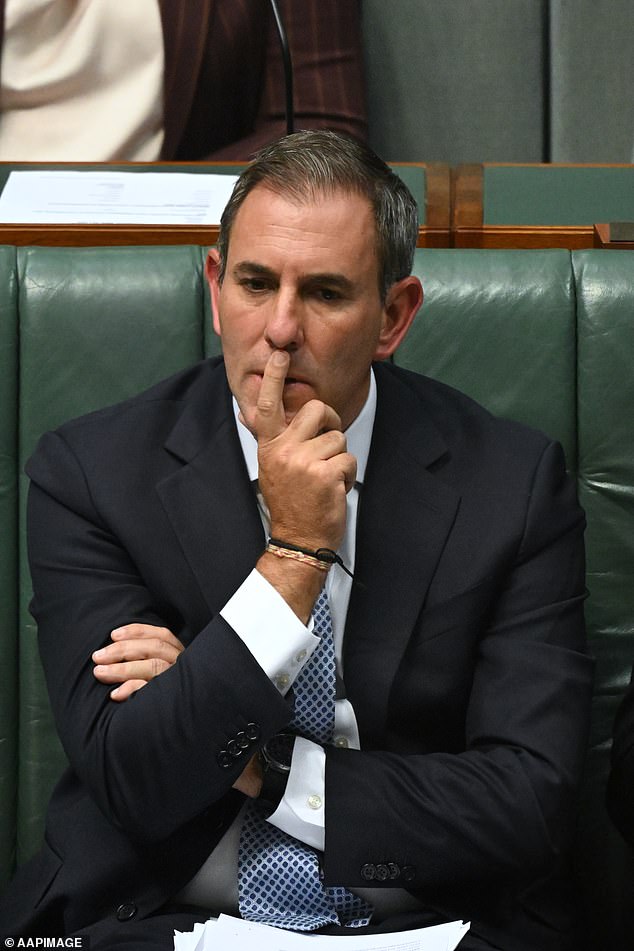
Jim Chalmers is either brazenly spinning – or he’s economically illiterate. I’m betting it’s the former
On January 28, responding to an inflation surge, he declared it was ‘a resurgence in the private sector and not an increase in public sector spending.’
Yet public sector spending is sky high and has been for years.
Coincidentally – ever since the pandemic – governments of both political stripes have continued to grow spending well beyond what it was for decades before that.
What does Dr Jim think that does?
All that extra cash being pumped into the economy certainly doesn’t put downward pressure on inflation.
Why does Dr Jim think we had an inflation problem immediately after the pandemic?
Years later, both he and the PM still like to point to the high inflation rate at that time to score political points against the Coalition.
Yet suddenly record public spending is irrelevant now? It’s absurd.
Join the debate
Do YOU trust Jim Chalmers to steer Australia through tough economic times?

Prime Minister Anthony Albanese in the front row at the Australian Open men’s semi final in Melbourne last week
Dr Jim might not have an economics qualification to speak of, but he’s the Treasurer.
He was the chief of staff to a Treasurer before entering parliament, albeit Wayne Swan.
How can he possibly not realise that public sector spending contributes to private sector demand?
Quite apart from the fact public sector demand is also stoking inflation, and is therefore also problematic.
Unless the Treasurer and everyone around him are economically illiterate, which I choose not to believe, he’s being deliberately misleading by encouraging the public to think government spending has no effect on the economy.
What does the Treasurer think the billions of dollars of taxpayers money rolling out the door as part of the Future Made in Australia policy does, for example?
It subsidises private industries, thus stoking private demand which is driving up inflation.
Public spending doesn’t need to dominate the quarterly growth contribution to be inflationary. It simply needs to add to demand in an economy already running tight in key sectors, especially services and housing.

Peter van Onselen has genuine fears that basic economics is beyond Jim Chalmers
Which is not to downplay the massive increases in public spending that are also pushing up inflation.
Schemes like the NDIS are an obvious example. As a line item in the budget it is forecast to rise exponentially, well in excess of even high inflation.
Public sector wage rises are another example of record public spending that often exceeds inflation. What does Dr Jim think that does?
It also drives inflation up even further, in a cycle that makes the RBA’s task of bringing inflation down all the more difficult.
An economics lesson for Dr Jim
Public spending absolutely stimulates private demand. Decoupling them with political spin is misleading and deceptive.
Public spending stimulates private demand directly by paying private contractors and suppliers.
It does so indirectly by transferring cash or subsidies that households then spend in the private economy.
Sometimes public spending pushes up inflation structurally, by underwriting whole markets, such as childcare and aged care.
The already mentioned NDIS is another example. The transactions that follow more taxpayer money being put into such sectors might be officially booked as private spending, but the oxygen came from the public purse.
This is why reining in public spending, at least for a while, helps fight inflation. If the government won’t do that, the RBA will be forced to continue pushing interest rates even higher, using monetary policy to bring inflation down when Labor won’t help by tightening fiscal policy settings.
Real reason for excuses
If for a moment we assume the Treasurer isn’t a complete economic idiot, why would he want people to think the new inflation problem is a private sector issue only?
Because if rising inflation is a private sector problem then the government can pose as a mere bystander, not responsible for the squeeze. Not therefore also responsible for interest rate rises.
It can then use even more spending to swoop in with taxpayer handouts to assist with voters who are under cost of living pressures because of rising prices.
It’s a neat political trick, but it’s found in the fiction section of the library. And it ultimately makes a bad situation even worse rather than solving it.
Chalmers isn’t the first Treasurer to attempt this deceptive dance with the RBA. Insisting fiscal policy is disciplined (when it’s not) while blaming anyone else when inflation becomes a problem. How many times have you heard politicians attack the RBA for doing its job when putting rates up? Neglecting to even thinking about why it has had to do so: because government keeps spending too much.
But there’s an extra brazenness in insisting public spending isn’t even part of the problem, or playing dumb to the fact public spending stokes problematic private demand.
That’s the path Chalmers is now treading, in a desperate bid to absolve himself of responsibility for the new inflation crisis he’s directly contributed to, by pretending that the government’s role stops at the edge of the public accounts.
That isn’t economics, it’s marketing, and it’s a lie.