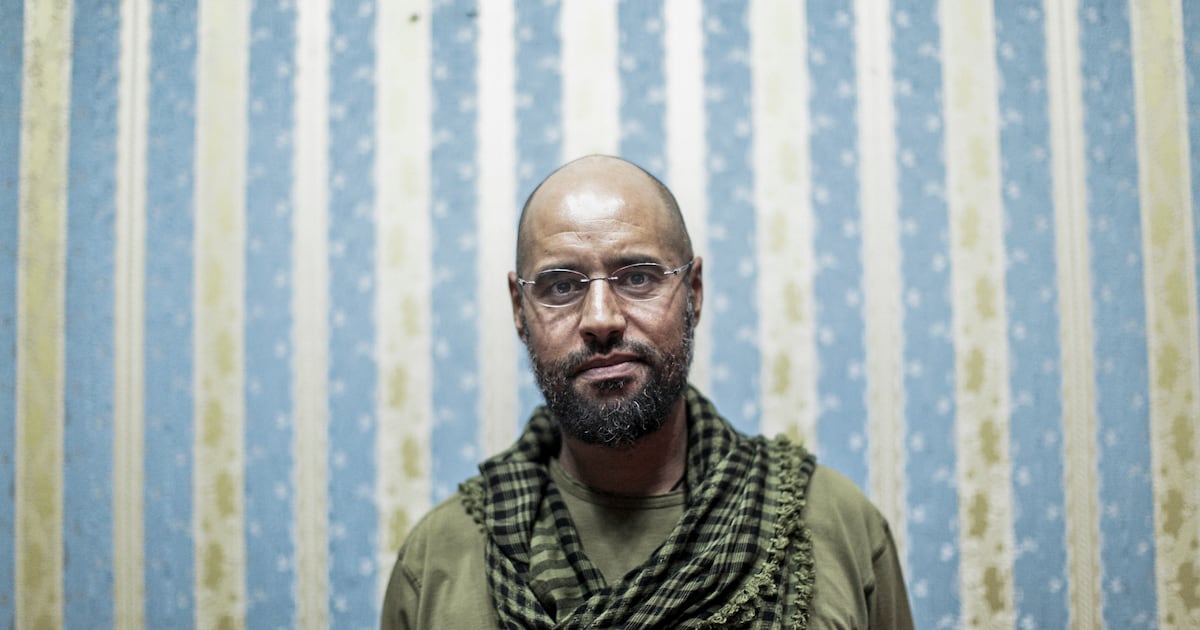
Saif al-Islam Gadafy, a politician and a son of deposed dictator Muammar Gadafy, was killed on Tuesday in an attack at his home in western Libya, according to his lawyer and a political adviser.
Saif al-Islam (53), was killed after four men stormed his home near the city of Zintan and disabled the security cameras, the lawyer, Khaled al-Zaidi, told the New York Times. He did not provide additional details about how Saif al-Islam was killed, who might have been responsible and a potential motive.
Abdullah Othman Abdurrahim, a political adviser to Saif al-Islam and head of his political team, confirmed the death on Libya Al-Ahrar TV, noting that the circumstances were under investigation and that the authorities were treating the death as an “assassination”.
The public prosecution office in Tripoli, the Libyan capital, and the attorney general announced that an official investigation had begun.
Although no suspects were publicly named, a prominent Libyan militia, the 444th Combat Brigade, posted a statement on social media denying any “direct or indirect” involvement in Saif al-Islam’s killing. The group said it was responding to claims circulating on social media that it had been connected to the killing, and warned against the spreading of rumours “aimed at confusing the situation, spreading chaos and fabricating information”.
Saif al-Islam’s death injected more uncertainty into the fraught political landscape in Libya. The country has long been divided between factions that have battled intermittently for control, a development that he had predicted during the Arab Spring uprising in 2011.
The internationally recognised leadership in the country is the Government of National Unity, which is in Tripoli. But much of Libya is controlled by a rival government and militia, which is based in Tobruk, a port city on the country’s eastern Mediterranean coast. The eastern part of the country has its own prime minister, and that region is ruled by Gen Khalifa Hifter, a warlord.
Saif al-Islam was born June 25th, 1972, in Tripoli as the second son of the deposed dictator and his wife Safia Farkash. Information on any survivors was not immediately available.
The British-educated Saif al-Islam was not officially aligned with any Libyan government. For a time, he appeared to support overhauling his father’s brutal regime and was seen by western governments as a symbol of hope. But after joining a crackdown on opposition rebels during the uprising in 2011, he became an emblem of the same kind of brutality his father had inflicted.
Yet, Saif al-Islam’s fate was not the same as his father’s. Muammar Gadafy, who ruled Libya ruthlessly for more than four decades, was summarily executed by rebels in 2011. Another group captured Saif al-Islam, the dictator’s second son, as he tried to escape the country disguised as a Bedouin in a caravan moving south through the desert. The group kept him as its prisoner for years.
Wanted by the International Criminal Court on charges of crimes against humanity associated with the crackdown, he was held as a valuable hostage but never handed over, even as civil war engulfed the country and split Libya between rival eastern and western governments.
Separately, in 2015, he was sentenced to death in Libya in a trial he could not attend. The militia in Zintan that was holding him did not recognise the authority of the Tripoli government or its courts and did not turn him over. The sentence was eventually rendered moot by the civil strife engulfing the country.
Shortly afterwards, some of his captors expressed disappointment with the revolution that had led to his capture and threw their support behind Saif al-Islam, he told The New York Times in an interview in 2021. Released in 2017, he returned to the Libyan political scene a few years later.
In 2021, Saif al-Islam announced that he was running for president. His candidacy was seen by some as a cynical attempt to reclaim power after his father’s destructive rule. Many Libyans, however, were not hopeful that better alternatives existed.
But the electoral process collapsed and Libya again entered a state of political deadlock. – This article originally appeared in The New York Times.