
On March 16th, 1926, just over 100 years ago, a young Kerryman, Michael Quill, arrived at Ellis Island in New York on board the SS Pittsburgh. His cousin met him and brought him to East 104th Street in Harlem to live with his relations. The next day he watched the St Patrick’s Day parade on Fifth Avenue, which was, according to The New York Times, “attended by a record crowd”.
Quill, like his brothers Danny and John, was an anti-Treaty Volunteer who fought in the Civil War as a member of the Kilgarvan company of the IRA.
Life for anti-Treaty IRA Volunteers after the Civil War was difficult, and a large number, including Quill’s brothers, emigrated to the US in the 1920s. Mike formed a partnership with John selling holy pictures in Pittsburgh. The brothers collected weekly dues and each month delivered a religious-themed picture – The Last Supper, the Good Shepherd, and so on. Their enterprise came to an abrupt halt when the printer mistakenly reversed the image plate of Jesus on the Cross, showing blood gushing from the right side of His body instead of the left. Mike and John were nearly martyred themselves by an angry mob of outraged customers.
The brothers applied for jobs with the Interborough Rapid Transit (IRT) company and were accepted as ticket agents. The IRT was the largest subway operation in the US at the time and tended to employ the Irish, as they could speak English and read and write. In fact, there were so many working there – many of whom were former IRA Volunteers – that it was nicknamed “Irish Republican Transit”.
Mike Quill relished the night shift in the change booth, where he read voraciously. He became an expert on politics and human rights. He railed against the unjust treatment of African Americans, especially those working on the subways, who, he said, “were subjected to treatment that makes Little Rock and Birmingham seem liberal and respectable by comparison”.
 Mike Quill and his wife Shirley reading a copy of Eileen O’Faoláin’s Irish Sagas and Folk Tales
Quill discovered industrial unionism after reading James Connolly’s pamphlet Socialism Made Easy. He explained to his fellow employees that they needed a union to represent all workers in the transit sector instead of splitting into smaller craft unions. Quill argued that train drivers, porters and ticket agents should all stand together and leave the “company union”, the Brotherhood, which was essentially part of the IRT.
Jimmy Gralton, made famous by the Ken Loach film Jimmy’s Hall, was running Irish workers’ clubs in Manhattan, which were attended by Quill and other Clan na Gael members. A number of communists also came to Gralton’s lectures, and before long friendships were formed. A meeting was held in Silver’s Cafeteria on Columbus Circle between IRA members and Communist Party activists, and the Transport Workers Union of America (TWU) was established on April 12th, 1934.
Quill was instrumental in uniting African-American workers and Irish workers when so-called “Brotherhood” unions were “whites only.” Three African-American workers – Clarence King, Hislop Arkless and Louis Manning – were elected as officers in the TWU and Quill was an early advocate of the civil rights movement. He not only contributed financially but actively encouraged union members to attend demonstrations against the Ku Klux Klan.
 Under Mike Quill’s stewardship, the TWU broke the race barrier in the subways of New York. Quill’s version of industrial unionism encouraged racial integration in an industry that traditionally allowed segregation
Thanks to the charismatic leadership of Quill, the TWU grew at a phenomenal rate. By the end of 1937, 30,000 transit workers in New York were members of the TWU. Gerald O’Reilly, one of the co-founders of the union, said: “James Connolly gave us our inspiration. Mike Quill gave us our leadership. The Communist Party gave us the financial help and the trained organisers to put us on the road to success.”
[ James Connolly influenced by Irish born US labour activistOpens in new window ]
The following year, the Special Committee on Un-American Activities was established by Texas Democrat Martin Dies. Dies first aimed his ire at the film industry after discovering that some actors had sent greetings to the left-wing newspaper Ce Soir. One journalist noted: “They’ve gone into Hollywood and there discovered a great Red plot. They have found dangerous radicals there, led by little Shirley Temple. Imagine the great committee raiding her nursery and seizing her dolls as evidence!”
Dies also targeted the TWU, and Quill appeared before the committee in May 1940. The culmination of the day centred on investigators asking Quill who he would support if the United States were to go to war with Russia. Quill angrily shook his finger and, in his great Kerry accent, shouted: “I am opposed to going overseas and leaving America. You are trying to bring about a war hysteria to stampede the American people into war.” Quill wore his persecutors down, and they suspended the session.
Later that evening, Quill addressed the accusations when he spoke to the United Rubber Workers: “I’d rather be called a red by the rats than a rat by the reds.” He denied that the TWU was involved in communism: “If Dies is interested in routing `isms’, he should go back to Texas, where the people are menaced by a dangerous `ism’ – virtual nudism – because they don’t have enough to eat and clothe themselves.”
With the end of the second World War and the beginning of the cold war, Quill realised it was time to part company with the Communist Party of America. Their relationship was souring anyway, as Quill backed the City of New York in its efforts to raise the subway fare from five cents to 10 cents. The Communist Daily Worker said he was no longer “Mike the Red” but was now “Mike the Dime.”
However, Quill had negotiated a 20 per cent raise for subway workers, and most of the TWU locals were still very loyal to their president. At the 1948 TWU Convention, Quill pulled a master stroke and changed the order of business to elect union officers on the first day rather than the last. The communists were caught off guard and, one by one, were purged until the international executive of the TWU was completely replaced.
On January 1st, 1966, New York was to get a new mayor, John Lindsay. Quill was not a fan and purposefully mispronounced his name as “Lind-es-ley,” dragging it out in that lovely Kerry voice. Traditionally, contracts between the TWU and city council representatives were negotiated and settled by New Year’s Eve. If contracts were not signed, Quill explained to the incoming mayor, there would be a subway strike on New Year’s Day. Lindsay, with the encouragement ofNew York governor Nelson Rockefeller – who saw Lindsay as a political threat – decided to call Quill’s bluff, and no contracts were signed.
 Mike Quill, surrounded by TWU officers, being interviewed on TV just days before the 1966 strike that brought New York public transport to a standstill
On New Year’s Day 1966, Quill called a transport strike and brought New York City to a complete standstill. Some 6,280 subway cars, 481 stations, and 720 miles of track fell silent. That night, attendees at the mayor’s inaugural ball heard Sammy Davis jnr joke that Lindsay needed to be congratulated for eliminating crime on the subway after only 24 hours on the job.
On Monday, the third day of the strike, people walked to work. Over the bridges they came from Brooklyn – multitudes cursing Quill or Lindsay or both – as wind and rain pounded them. That evening, state supreme court judge Abraham Geller ordered the arrest of Quill and eight other union officials if they refused to call off the strike.
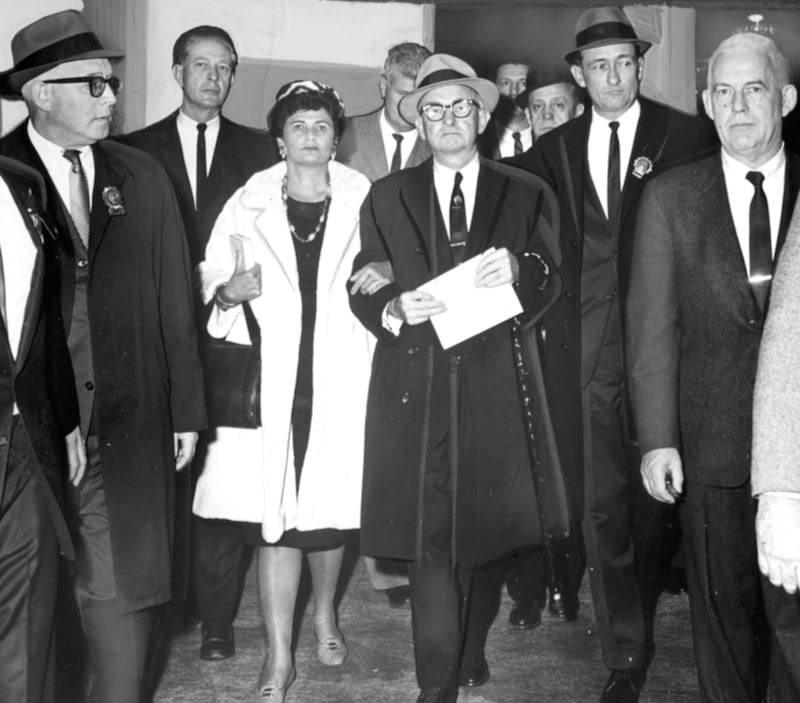
The next morning, in the Americana Hotel in Manhattan, scores of TV cameras, photographers and reporters milled around Quill. He was asked what he thought of Geller: “The judge can drop dead in his black robes, and we would not call off the strike.”
A large squad of police arrived, and Quill was arrested. He was hustled through a seething mob of angry people who hissed and booed as he was whisked away to the Alimony Jail. His wife, Shirley, demanded to be allowed access to give him his heart medication. After she left the jail, news came on the radio that Quill had suffered a heart attack and had been taken to Bellevue Hospital.
Quill survived, despite being in a terrible condition. The strike dragged on for 12 days, costing the City of New York an estimated $1 billion. But Quill was successful, and contract terms worth $60 million for the workers were agreed upon.
On January 28th, three days after he was released from hospital, Quill asked Shirley to listen to Micheál Mac Liammóir’s recording of Robert Emmet’s Speech from the Dock with him. Shirley said there were tears in his eyes, and he vowed to make it home to Ireland to celebrate the jubilee of the Easter Rising. He told Shirley he was tired and went to take a nap. Fifteen minutes later, his secretary went into his bedroom to see if he would take a phone call, only to find that Quill had died. He was 60.
His friend Dr Martin Luther King said: “Mike Quill was a fighter for decent things all his life – Irish independence, labour organisation and racial equality. He spent his life ripping the chains off his fellow man. When the totality of a man’s life is consumed with enriching the lives of others, this is a man the ages will remember – this is a man who has passed but who has not died.”
[ Mark O’Connell: You’re not on the right side of history – there is no right sideOpens in new window ]
Today, the TWU is run by Irish-American international president John Samuelsen, who carries on the legacy of Quill, representing the interests of 165,000 workers in airlines, buses, trains and subways.
Lorcan Collins is the author of A Mighty Union: Quill, Connolly and the TWU, which is available to read on the website 1916rising.com. He founded the 1916 Rebellion Walking Tour and runs the Revolutionary Ireland podcast.