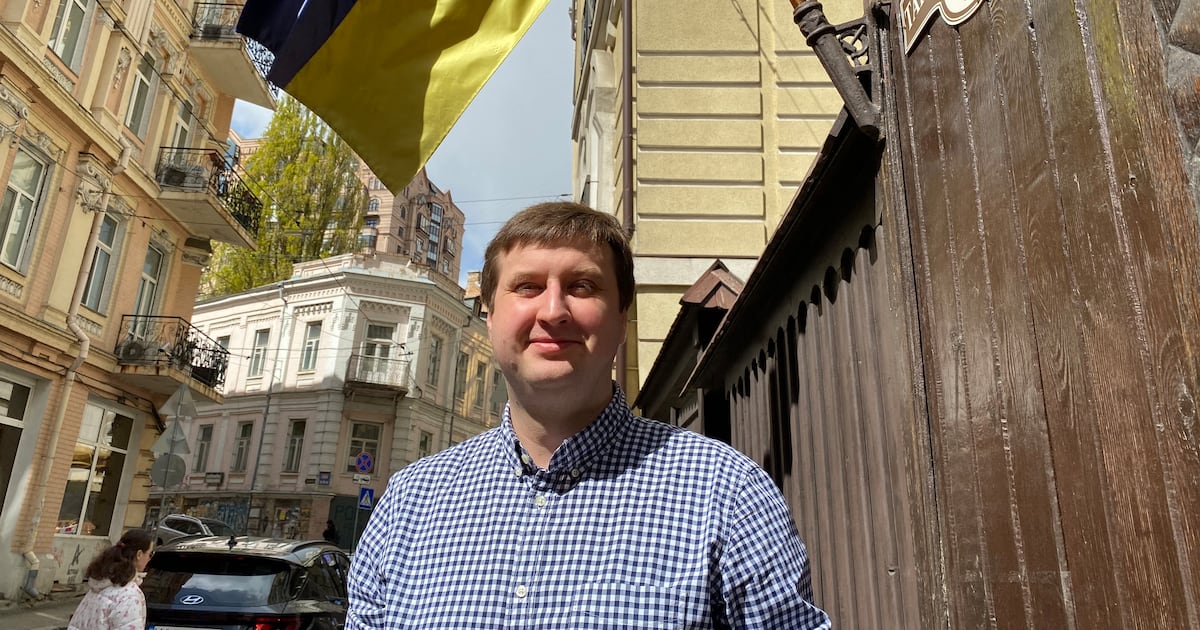
Ukrainians differentiate between Americans, the US as a country and president Donald Trump, says Anton Grushetskyi, executive director of the Kyiv International Institute of Sociology (KIIS), the leading polling institute in Ukraine.
When Trump was elected, most respondents (54 per cent) told KIIS it was a good thing for Ukraine. “Trust in Biden had declined because he did not give Ukraine the weapons it needed when it needed them,” says Grushetskyi.
In the aftermath of the verbal lynching of Ukraine’s president Volodymyr Zelenskiy in the Oval Office, favourable opinions of Trump dropped to 20 per cent.
Over the past year, 70 per cent of Ukrainians have consistently said Trump’s presidency is bad for Ukraine. Yet 55 per cent now have a favourable view of the US, and that climbs to 80 per cent when Ukrainians are asked if they have a favourable view of ordinary Americans.
A similar situation prevailed regarding Russia before the full-scale invasion. Eighty per cent of Ukrainians disliked Russia’s president Vladimir Putin, but the same percentage viewed ordinary Russians favourably. Since 2022, 80 per cent dislike Russians and 95 per cent dislike Putin.
Between 10 and 15 per cent of Ukrainians still have a positive view of ordinary Russians, Grushetskyi says. Significantly, that percentage is the same in all regions of Ukraine. Before the full-scale invasion, the residents of southern and eastern Russian-speaking regions were more favourably inclined towards Russia.
 Ukraine’s president Volodymyr Zelenskiy and US president Donald Trump during the infamous meeting in the Oval Office last year. Photograph: Jim Lo Scalzo/EPA/Bloomberg
Casualties have been high in the Russian-speaking frontline cities of Kharkiv, Odesa and Dnipro, says Grushetskyi. “The Russians are shelling Russian-speaking cities. For those people, it’s a betrayal. They say, ‘We were brothers and sisters, and you came to kill us.’ That is why these people feel hatred towards Russia. About 80 per cent of Ukrainians know someone who has been killed, and that creates strong emotions.”
Europe: ‘90 per cent want to join EU’
Public opinion on Europe depends on how the question is worded, says Grushetskyi. Ninety per cent of Ukrainians say they want to join the EU. But only 70 per cent would go to a polling station to vote in a referendum. Fifty per cent say they trust Europe; between 25 and 30 per cent say they do not and 20 per cent are undecided.
In the early days of the full-scale invasion, pollsters received more positive responses. “People were more romantic about the EU then. They have become cynical and pragmatic,” says Grushetskyi.
 European Commission president Ursula von der Leyen welcomes Volodymyr Zelenskiy prior to a meeting in Brussels, Belgium, in August 2025. Photograph: EPA
Ukrainians still view Europe favourably by comparison with the US. “We have two pillars of Ukrainian resistance,” says Grushetskyi. “One is the perception of the war as existential. About 70 per cent of Ukrainians believe Russia wants to destroy the Ukrainian nation or commit genocide.”
Trust in Europe is “the other pillar of resistance”, says Grushetskyi. “The feeling that we have friends who have our back, even if they’re not very brave … To Ukrainians, Europe represents hope for a better future. Around 55 to 60 per cent still consider Europe our ally.”
Since January, KIIS has been asking Ukrainians if they would trust European or US security guarantees in the event that Russia attacked again after a peace agreement. Fifty-two per cent would trust Europe to help, while only 40 per cent believe US security guarantees would be reliable. Zelenskiy has made obtaining US security guarantees a requirement for any peace deal. As Grushetskyi notes, “Without trust in US support, peace deals are senseless for Ukraine.”
Trust in Europe is declining because of the EU’s internal divisions. Outgoing Hungarian prime minister Viktor Orbán, the leading opponent of Ukraine in the EU, just lost an election. But Ukrainians are not sure about his successor, or about the prime ministers of Bulgaria and the Czech Republic. And Robert Fico, the prime minister of Slovakia, is due to visit Moscow for Putin’s May 9th victory day parade.
Nato: 50 per cent would renounce membership for peace
Ukrainians also had a “romantic perception” of Nato in the immediate aftermath of the full-scale invasion. Disillusionment with Nato is more pronounced than with Europe. About 50 per cent say they could renounce joining Nato forever in exchange for peace. Sixty per cent would accept a 20- or 30-year postponement.
Trump’s threats to seize Greenland, which belongs to Nato ally Denmark, have destroyed the credibility of Nato, Grushetskyi says. Ukrainians are also cynical about Article 5 protection, which in theory guarantees that all Nato allies would go to war if one were attacked.
 Nato secretary general Mark Rutte. Photograph: Nicolas TUCAT/AFP via Getty Images
Ukraine received promises of protection in exchange for giving up its nuclear weapons under the 1994 Budapest Memorandum. It has been attacked by one signatory, Russia, and the others, the US and UK, have broken promises to protect Ukraine. Between 70 and 80 per cent now want Ukraine to obtain nuclear weapons. A Russian demand for the demilitarisation of the Ukrainian army is “the thickest red line for Ukraine”, says Grushetskyi.
Middle East war: most do not support US, Israel or Iran
Ukraine is often portrayed as anti-Semitic, because a quarter of Jews murdered in the Holocaust were killed in Ukraine by the Nazis. Yet nearly 70 per cent of Ukrainians told pollsters they sided with Israel after the October 7th, 2023, attacks. Because the Soviet Union, then Russia, supported Israel’s enemies, many Ukrainians saw Israel as a brave, creative and tech-savvy country fighting implacable enemies – in other words, a country resembling themselves.
 US secretary of defence Pete Hegseth. Photograph: Win McNamee/Getty Images
Opinion has shifted because of the perception that Israel has not helped Ukraine in the war and because, as documented by the Israeli newspaper Haaretz, Israel has repeatedly purchased grain stolen by Russia from Ukrainian occupied territories.
In a poll about to be published, KIIS found that 60 per cent of Ukrainians support neither the US and Israel nor Iran in the current Middle East war, while 25 per cent support the US and Israel and 5 per cent support Iran.
Ireland: no resentment over benefit cuts
Ireland is perceived as a dynamic and prosperous EU country, Grushetskyi says. Ukraine celebrates St Patrick’s Day and O’Brien’s is a popular pub in Kyiv.
Ukrainians are aware that Ireland has received large numbers of Ukrainian refugees, but they do not resent the fact that Ireland is cutting benefits for them.
 Taoiseach Micheál Martin wth Ukrainian president Volodymyr Zelenskiy. Photograph: Clodagh Kilcoyne/Getty Images
“Ukrainians in Ukraine feel less sympathy for refugees abroad than for internally displaced people,” says Grushetskyi. “Stories that while we are dying under bombardment, they receive benefits, do not create good feelings. A lot of people in Ukraine believe that after more than four years of war, they’ve had enough time to integrate and earn money.”
Zelenskiy: approval ratings in upper 50 percentile range
Zelenskiy’s approval rating has averaged in the mid to upper 50 percentile range for the past two years, Grushetskyi says, “mainly because he is the wartime leader of Ukraine”.
But Ukrainians want to see a new generation of politicians, led by veterans, when the war ends. Ninety-five per cent say they trust the armed forces and 80 per cent trust volunteers. “People say, ‘We have a leader now. Let him work to end the war’ … They like the example of Churchill, who was voted out of office in 1945. The same could happen to Zelenskiy,” says Grushetskyi.
Zelenskiy appointed Lt Gen Kyrylo Budanov, the 40-year-old former head of Ukrainian military intelligence, to lead his presidential office last January. Budanov enjoys a 70 per cent popularity rating, thanks to tales of his derring-do against the Russians. Zelenskiy might choose Budanov to succeed him.