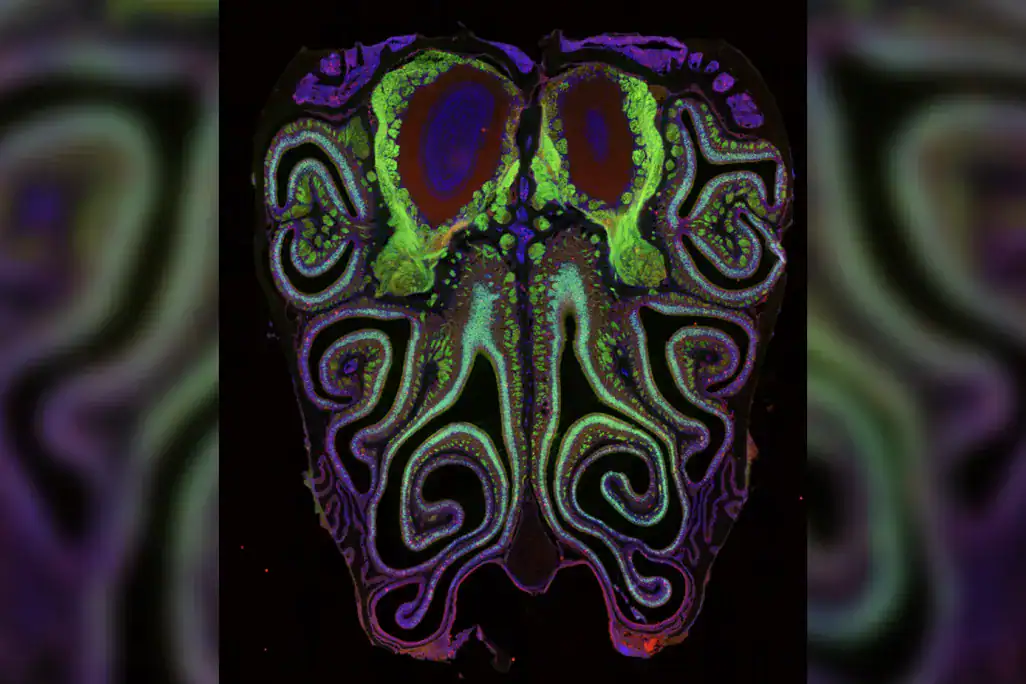
 A microscope photo of a cross section of a mouse nose. The mouse was genetically modified to express green fluorescent protein in smell neurons. A small subset of dying neurons is labeled in red. Image: Datta Lab
A whiff of coffee, smoke, rain, or spoiled milk feels instant and effortless. But inside the nose, that simple act depends on one of biology’s most complicated sensory systems.
Scientists know that smell depends on a vast library of receptors, each tuned to different odor molecules. But they could not find the kind of clear spatial order that helps organize vision, hearing, and touch. The nose appeared to work by a looser, perhaps more chaotic system.
Now scientists have found that this system is far more orderly than they thought.
In two new studies published in Cell, researchers mapped the smell receptors inside the mouse nose in unprecedented detail. They found that roughly 1,100 receptor types are not scattered randomly through nasal tissue. Instead, each receptor tends to occupy a predictable position, forming overlapping stripes from the top of the nose to the bottom. The same order appears to be reflected in the olfactory bulb, the part of the brain that first processes smell.
“The organization of information in space is a major organizing principle for all sensory systems, and that is what has, until now, made olfaction super weird,” Sandeep Robert Datta, a neurobiologist at Harvard University and an author of one of the new papers, told The New York Times. “We have, to some extent, unveiled this long lost map for smell.”
The Sense Scientists Couldn’t Map
Scientists have long understood how the body organizes other senses. In the eye, neighboring cells process neighboring points in the visual world. In the ear, different regions detect different sound frequencies. In the skin, touch maps onto the body’s surface.
Smell was the exception.
Mice have about 20 million olfactory neurons and more than 1,000 types of odor receptors. Humans have fewer, but still several hundred. Each receptor can detect a different set of odor molecules, and each smell neuron usually expresses just one receptor type. However, the sense of smell relies on a combinatorial code, where a limited set of receptors (roughly 400 types in the case of humans) works together to identify an almost infinite variety of scents. One 2014 study found the human nose can distinguish between one trillion smells.
×
Thank you! One more thing…
Please check your inbox and confirm your subscription.
Until now, researchers thought these receptors were divided into a few broad zones in the nose. Within those zones, the receptor choice seemed mostly random.
“For 30 years, we’ve taught students that the mouse olfactory epithelium is divided into a handful of broad zones, within which receptor choice is essentially random,” Johan Lundström, a psychologist and experimental neuroscientist at the Karolinska Institute, told Nature.
The new study suggests that model was too crude.
“This is a landmark paper that overturns one of the foundational textbook models of olfactory organization,” Lundström added.
A Thousand Overlapping Stripes
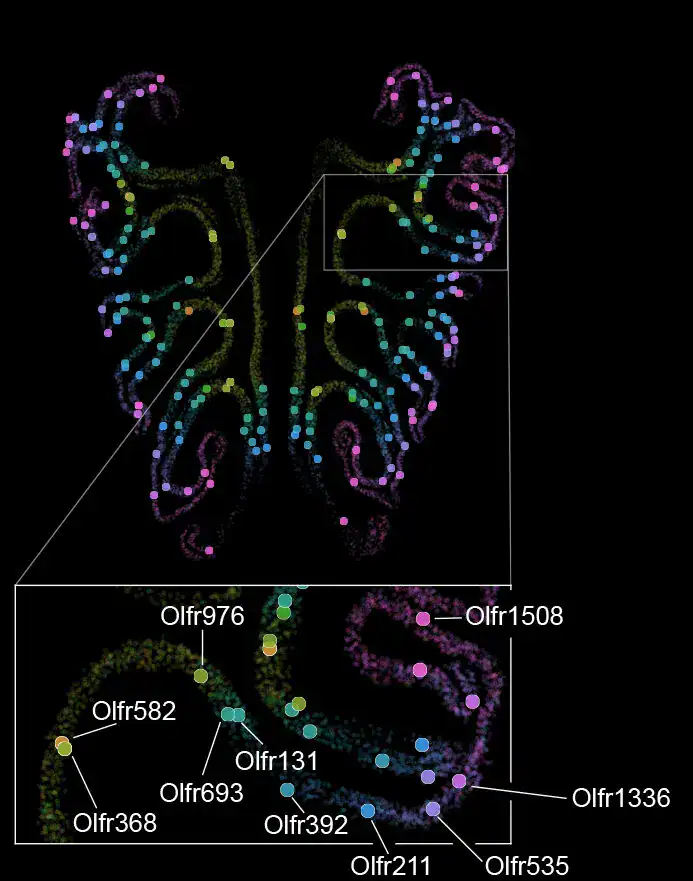 A map of the thousand types of smell receptors in the olfactory tissue of a mouse nose, labeled by a color gradient. The bottom inset shows the precise spatial positions of a tagged subset of receptors. Credit: Datta Lab
Datta’s team used two powerful tools to build the map. First, single-cell sequencing showed which receptor genes individual neurons were using. Then spatial transcriptomics showed where those neurons sat in the nasal tissue.
The scale was enormous: around 5.5 million neurons from more than 300 mice. The scientific paper reports that each olfactory receptor has a unique average position along the nose’s top-to-bottom axis, creating a stereotyped receptor map rather than a few rough zones.
“Each receptor adopts a particular position in the nose. Since there are a thousand positions in the nose, each receptor is expressed basically in a stripe that overlaps with other receptor stripes, in a thousand overlapping stripes,” Datta told Nature.
That does not mean the nose works like graph paper, but the average position of each receptor was remarkably consistent from mouse to mouse.
The finding brings smell closer to the other senses. It suggests that organization matters in the nose just as it matters in the eye, ear, and skin.
How the Map Gets Built
The team also found a likely mechanism behind the map: retinoic acid, a vitamin A-related molecule that helps guide development.
Retinoic acid forms a gradient across the nose. That gradient appears to tell developing smell neurons where they are. Based on that position, the cells activate a broader genetic program and become more likely to choose certain receptors.
When the researchers increased or blocked retinoic acid signaling, the map shifted. Adding retinoic acid pushed cells toward one spatial identity. Blocking it pushed them the other way.
“We show that development can achieve this feat of organizing a thousand different smell receptors into an incredibly precise map that’s consistent across animals,” Datta said in a press release.
This is especially important because smell neurons are constantly replaced. Unlike many neurons, olfactory neurons regenerate throughout life. The nose therefore has to rebuild its map again and again.
The new work suggests it does this by using location as a guide. A young neuron first reads where it is in the nasal tissue. Then it narrows down which receptor it is likely to express.
The Nose and Brain Match
The map does not stop in the nose.
Smell neurons send signals to the olfactory bulb, the first brain region that processes odor information. There, neurons that express the same receptor converge into small structures called glomeruli.
Datta’s team found that the nose map and brain map align. Receptors that occupy certain positions in the nose project to predictable positions in the olfactory bulb.
“This means that the maps in the nose and the brain are not two separate problems the system has to solve, but two readouts of the same developmental logic,” Lundström told Nature.
The discovery suggests that the olfactory system uses one organizing principle to build both the receptor map in the nose and the odor map in the brain.
Why It Matters
The research was done in mice, not humans. Scientists still need to show whether the human nose has a similar map.
But if it does, the finding could prove practical in broader medical science. Loss of smell can follow viral infections, head injuries, aging, chemical exposure, and neurodegenerative disease. COVID-19 famously made smell loss a widespread public concern.
Smell helps people detect smoke, gas leaks, and spoiled food. It also shapes taste, appetite, memory, emotion, and mental health.
“Smell has a really profound and pervasive effect on human health, so restoring it is not just for pleasure and safety but also for psychological well-being,” Datta said in the Harvard release. “Without understanding this map, we’re doomed to fail in developing new treatments.”
The map may also affect future stem cell therapies. If doctors want to restore smell, they may need to rebuild the full spatial layout of the nose, not just add new smell neurons in one place.
“It means those stem cells have to occupy the whole spatial extent of the nose in order to repair the nose. You can’t just infuse stem cells in one location and expect your sense of smell to recover,” Datta told Nature.
For years, smell looked like the odd sense out. Now it looks like scientists were simply missing the map.
The findings appeared in two complementary studies in Cell (study one and two).