
Main PointsKey Reads
Órla Ryan – 6 minutes ago
Maersk hikes shipping prices to offset Iran war costs
Shipping container giant Maersk has revealed it is facing a $500 million (€425m) hit each month from disruption caused by the Iran war and is passing on costs to customers through higher freight rates.
The Danish group, which carries around one in five of the world’s seaborne containers, said costs will surge in the current quarter and next, but it is so far fully offsetting this through price rises.
Chief executive Vincent Clerc said the closure of the Strait of Hormuz could start impacting global trade and consumer demand.
He told Bloomberg TV: “There is a lot of uncertainty if we look further into the year with respect to what are going to be the secondary impacts of this war – inflation, possibly a reduction in demand.
“There are some question marks about how this is eventually going to flow through the economy.”
The group reported better-than-expected first quarter results as it said the Middle East conflict had a limited effect on the period, though it posted a steep drop in pre-tax profits to $292 million (€248 million), down from $1.43 billion (€1.2 billion) a year earlier.
Revenues fell 2.6 per cent to $12.97 billion (€10.9bn).
Maersk kept its guidance unchanged for 2 per cent to 4 per cent growth in the global container market, but said the outlook was “highly uncertain”. – PA
Órla Ryan – 22 minutes ago
IDF claims to have killed Hizbullah commander  The aftermath of an Israeli airstrike in southern Beirut, Lebanon, is pictured today. Photograph by European Pressphoto Agency
The Israel Defense Forces (IDF) said it has killed the commander of Hizbullah’s Radwan force, the most elite unit of the pro-Iran armed group, in a strike on Beirut’s southern suburbs.
In a statement, the IDF named the Radwan commander as Ahmed Ghalib Balut, saying he was killed in a strike in the Dahiyeh neighbourhood in southern Beirut.
Hizbullah has not immediately commented on the report. Israel struck Beirut yesterday for the first time since a ceasefire took effect on April 16th. At least 11 other people were killed in strikes across the south and east, according to the Lebanese health ministry. – The Guardian
Órla Ryan – 59 minutes ago
EU tells airlines to pay passengers for fuel-linked cancellations
Airlines must continue to reimburse passengers for flight cancellations caused by high energy prices, the EU’s transport chief has warned, rejecting claims of jet fuel shortages in Europe.
EU transport commissioner Apostolos Tzitzikostas told the FT that cancellations driven by fuel prices were not considered extraordinary circumstances, meaning airlines must still compensate passengers. He said the rising cost of kerosene was part of doing business in this sector.
The Greek commissioner also claimed Europe “can sustain jet fuel supplies for a long period”, despite warnings from the International Energy Agency (IEA) and fellow EU commissioners that airlines would soon run out of kerosene.
“The price of jet fuel is the reason why we have cancellations of flights and if they cancel flights without extraordinary circumstances – jet fuel prices are not extraordinary circumstances – they will have to reimburse the people,” he said.
France preps aid for airlines hit by jet fuel price hikes
The French government is preparing to provide financial aid for airlines hit by jet fuel price hikes, transport minister Philippe Tabarot has said.
Anticiper, adapter, soutenir : c’est le cap que nous fixons pour accompagner le secteur aérien à l’approche de l’été.
Avec Roland Lescure, Serge Papin et Maud Bregeon, nous avons adressé aux acteurs du secteur aérien un message clair : confiance et mobilisation pour la saison… pic.twitter.com/0FiL0GAQmG
— Philippe Tabarot (@PhilippeTabarot) May 6, 2026
In a post on X, Tabarot said the government and airlines had made progress in a meeting on Wednesday on aid including deferrals of social security contributions, extended tax payment deadlines and flexibility on fuel loads.
“Airlines are facing a major shock. The government is fully committed to supporting them and helping them get through this difficult time,” he said.
European authorities are scrambling for solutions to prevent broad aviation disruptions this summer after European airlines have warned of jet fuel shortages within weeks as a result of the Iran war. Europe is more dependent on jet fuel imports, with some 75 per cent from the Middle East, than for any other transport fuel. – Reuters
Message from the Editor
 Irish Times Editor Ruadhán Mac Cormaic
Thanks for reading. If you’re interested in world news, The Irish Times has the largest network of foreign correspondents of any Irish news organisation.
Our team provides sharp reporting, in-depth analysis and thought-provoking commentary. Receive our Global Briefing newsletter in your inbox every morning to enjoy Denis Staunton’s guide to understanding world events; what’s happening, why it matters and how it affects you.
At The Irish Times, our journalism is free of any personal, political or commercial control. Unlike most publishers, we have no shareholders to satisfy, no media baron owner in the background telling us what we can and cannot publish.
We are owned by a Trust that mandates us to uphold a set of public-interest values. Those values describe a worldview that is outward-looking, tolerant, curious, interested in divergent views and attentive to the needs of minorities.
Our watchwords are fairness and accuracy. Our goal is to enable you to make informed and independent judgments. And any profit we make goes towards supporting our journalism.
Ruadhán Mac Cormaic
Editor
To join Ireland’s biggest community of news subscribers, sign up here
Here is a round-up of some of the latest images emerging from the Middle East:
 Smoke rises following an Israeli bombardment on the town of Nabatieh in southern Lebanon on Thursday. Photograph: Abbas Fakih/AFP via Getty Images
  A man walks past rubble following an Israeli air strike the previous day in the Haret Hreik neighbourhood of Beirut’s southern suburbs on Thursday. Photograph: AFP via Getty Images
  People drive near an anti-US billboard with an image depicting US president Donald Trump at Valiasr square in Tehran, Iran, on Wednesday. Photograph: Abedin Taherkenareh/EPA
 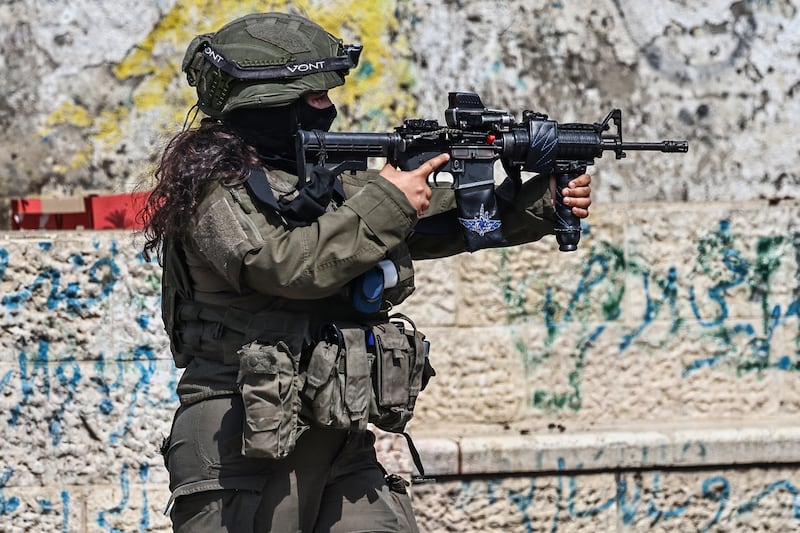 An Israeli security force member patrols during a military raid at the Qalandia refugee camp, south of the city of Ramallah, in the Israeli-occupied West Bank, on Wednesday. Photograph: Zain Jaafar/AFP via Getty Images European shares pause as Nikkei hits new closing high
 An electronic quotation board displays the Nikkei 225 stock prices on the Tokyo Stock Exchange in Tokyo on Thursday. Photo by Philip Fong/AFP via Getty Images
European shares were steady on Thursday, after a sharp rally in the previous session, with investors holding on to optimism that a US-Iran peace deal may be close.
The pan-European Stoxx 600 was muted at 623.56 points, as of 8am Irish time. Major regional bourses were mixed, with Germany’s Dax flat and London’s FTSE 100 down 0.2 per cent.
The European index gained 2 per cent on Wednesday, leaving it about 2 per cent away from pre-war levels.
Japan’s Nikkei 225 stock index has ended today’s session at a new closing high. The Nikkei jumped by over 5.5 per cent to end the day at 62,833 points, now up 24 per cent so far this year. – Reuters and The Guardian
Eurozone yields head lower as optimism over Iran peace deal grows
Eurozone government bonds eased for a third day on Thursday, after staging their biggest rally in a month the previous day, as investors grew optimistic that the US and Iran might soon reach a deal to end the war.
Brent oil prices, which have been a driving force for broader financial markets since the war broke out in late February, were last up modestly above $100 (€85) a barrel on Thursday, having slid over 10 per cent the previous day on the back of the prospect of a US-Iran peace deal, even though the fate of the critical Strait of Hormuz appeared unresolved.
With some concern about a damaging energy-price shock abating, bonds held on to most of the gains made on Wednesday, when two-year yields, which are most sensitive to expectations for inflation and interest rates, dropped sharply.
Two-year Schatz yields fell nearly 12 basis points (bps) on Wednesday, the most since April 8th, and were last at 2.536 per cent, down 2.4 bps on the day.
Two-year Italian yields, some of the worst-affected by concerns about inflation, were last down 4.4 bps at 2.7 per cent, having dropped 13 bps the previous day. Italian two-year bonds have been the second-worst performing major economy bonds during the war, having risen 60 bps, behind British two-year yields, which are up 85 bps. – Reuters
Anger over Shell’s ‘monstrous’ profits
Danny Gross, climate campaigner at Friends of the Earth, has said Shell’s profits are “indefensible”, after the company doubled its quarterly earnings.
“Once again, fossil fuel giants are pocketing monstrous profits while drivers are being squeezed at the petrol pump and households are set to pay higher energy bills,” Gross said.
“Our fossil fuel-reliant energy system siphons money away from ordinary people to the rich and powerful.” – The Guardian
Shell profits soar amid surging oil prices
Shell has announced a higher-than-forecast surge in profits for the first three months of the year, thanks to rocketing oil prices caused by the Iran war.
The oil giant reported underlying earnings of $6.92 billion (€5.88 billion), more than double the result in the previous three months and 24 per cent higher on a year ago.
Most analysts had expected the group to report profits of $6.36 billion.
It said the soaring cost of crude had boosted its oil trading business, and the wider chemicals and products division saw underlying earnings more than quadruple to $1.93 billion from €449 million a year earlier.
The group announced more returns for shareholders, with another three billion dollarsin share buy-backs for the next three months and a 5 per cent increase in its dividend payout.
Chief executive Wael Sawan said: “Shell delivered strong results enabled by our relentless focus on operational performance in a quarter marked by unprecedented disruption in global energy markets.
“The safety of our people remains our priority as we work closely with governments and customers to address their energy needs.” – PA
Israeli army strikes southern Beirut suburbs  Collapsed rubble on a building following an Israeli air strike on Wednesday in the Haret Hreik neighbourhood of Beirut’s southern suburbs. Photograph: AFP via Getty Images
The Israeli army carried out a strike in the southern suburbs of Beirut on Wednesday, the first in the vicinity of the Lebanese capital since a fragile ceasefire came into effect last month.
The assault in Dahiyeh was intended to kill a Hizbullah commander. There has been no official confirmation of his death.
The strike was the first to hit Beirut’s suburbs since the April 16th ceasefire, although hostilities in the south of Lebanon have not halted.
Maersk first-quarter profit beats forecasts A cargo ship carrying containers from Maersk photographed sailing through the Panama Canal. Photograph by Martin Bernetti/AFP via Getty Images
Danish shipping group Maersk posted first-quarter operating profits slightly above analyst forecasts on Thursday and kept its full-year earnings guidance unchanged.
Underlying earnings before interest, tax, depreciation, and amortisation (EBITDA) for the January-March period came in at $1.73 billion (€1.47 billion), compared to a median forecast of $1.66 billion in a company-provided poll of 10 analysts.
Maersk, which is often seen as a bellwether for global trade, still projects global container volume growth of between 2 per cent and 4 per cent this year.
“We’ve seen strong demand across most regions this quarter, supporting robust volume growth in our three business segments,” chief executive Vincent Clerc said in a statement.
The first quarter does not capture the Middle East war’s full impact on global supply chains as the conflict began on February 28th. The war has disrupted shipping routes across the region after Iran closed the Strait of Hormuz to commercial traffic, pushing up costs such as fuel. – Reuters
Tehran deploys new legal framework as it hangs 14 men in two weeks
Tehran has stepped up hangings of people accused over antigovernment unrest earlier this year or of working with foreign forces, deploying a new legal framework in the wave of politically linked executions, the Financial Times reports.
At least 28 men have been executed since March 18th, at the height of the US-Israeli war on Iran, according to official accounts in state media. Half of those were killed over the past two weeks as the pace of hangings accelerated following a fragile ceasefire in the conflict.
Many were accused of collaborating with the enemy or killing members of the security forces during unrest in January, when the Islamic Republic faced its biggest anti-regime protests in years. Others were accused of spying for Israel during the war.
At least 11 of the 28 men were hanged without being charged with killing anyone or engaging in armed struggle, state media records showed. They were largely charged with carrying large knives as an act of intimidation, attacking police stations to grab weapons or setting fire to state property.
Their deaths followed a new law ratified last year that increased penalties for espionage-related offences after Israel’s 12-day war with Iran in June 2025, the FT reports.
Iran had already stepped up executions last year – carrying out more than 1,000 between the start of the year and late September, according to Amnesty International, the highest rate in at least 15 years – fuelled by attempts to quash dissent and a surge in executions for drug offences, Amnesty said.
Read the full story here.
Oil prices edge up again after Wednesday’s dip
Oil prices rose over $1 (€0.85) on Thursday, rebounding from the previous day’s sharp losses, as investors weighed the prospects of a Middle East peace deal succeeding.
Brent crude futures were up 78 cents (€0.66), or 0.8 per cent, at $102.05 (€86.84) a barrel at 5am. US West Texas Intermediate gained 76 cents (€0.64), or 0.8 per cent, to $95.84 (€81.56) a barrel.
Both benchmarks slumped more than 7 per cent on Wednesday, hitting two-week lows on optimism over a possible end to the Middle East war. They pared losses, however, after Trump said it was “too soon” for face-to-face talks with Tehran and a senior Iranian lawmaker said the US proposal was more of a wishlist than a reality.
“While peace negotiations are likely to continue at least until next week’s US-China summit, the outlook beyond that remains uncertain,” said Hiroyuki Kikukawa, chief strategist of Nissan Securities Investment, a unit of Nissan Securities.
Trump and Chinese president Xi Jinping are scheduled to meet next week. – Reuters
Rubio to meet Pope Leo after Trump’s personalised attacks US secretary of state Marco Rubio arrives at Rome’s Ciampino airport on Thursday for a two-day visit to Italy and the Vatican. Photograph: Andrew Medichini/AFP via Getty Images
US secretary of state Marco Rubio will meet Pope Leo XIV at the Vatican on Thursday, in a potentially fraught encounter as president Donald Trump has continued a series of disparaging attacks on the Catholic leader over the Iran war.
Rubio, who also serves as Trump’s national security adviser, was due to arrive at the Vatican’s Apostolic Palace around 10.15am (Irish time) for the visit, the first between the pope and a Trump cabinet official in nearly a year.
The closed-door meeting is expected to last about a half-hour, after which Rubio will also meet the Vatican’s top diplomat, Italian cardinal Pietro Parolin.
Leo, the first US pope, drew Trump’s ire after becoming a firm critic of the US-Israeli war on Iran and the Trump administration’s hardline anti-immigration policies.
The president has kept up an unprecedented series of public attacks on the pope in recent weeks, drawing a backlash from Christian leaders across the political spectrum.
On Monday, Trump falsely suggested the pope believed it was okay for Iran to obtain nuclear weapons and said Leo was “endangering a lot of Catholics” by opposing the war.
Leo told journalists after the latest attack that he was spreading the Christian message of peace. The pope also firmly rejected the idea that he supported nuclear weapons, which the Catholic Church teaches are immoral.
“The mission of the Church is to preach the Gospel, to preach peace,” said the pope. “The Church has spoken out for years against all nuclear arms, on that there is no doubt.” – Reuters
‘More wishlist than reality’: Iran’s verdict on Trump’s peace strategy
United States president Donald Trump predicted a swift end to the war with Iran as Tehran considered a US peace proposal that sources said would formally end the conflict while leaving unresolved key US demands that Iran suspend its nuclear programme and reopen the Strait of Hormuz.
An Iranian foreign ministry spokesperson cited by Iran’s ISNA news agency said Tehran would convey its response, while Iranian lawmaker Ebrahim Rezaei, a spokesperson for parliament’s powerful foreign policy and national security committee, described the proposal as “more of an American wishlist than a reality”.
“They want to make a deal. We’ve had very good talks over the last 24 hours, and it’s very possible that we’ll make a deal,” Trump told reporters in the Oval Office on Wednesday, saying later “it’ll be over quickly”.
Trump has repeatedly played up the prospect of an agreement to end the war that started on February 28th, so far without success.
The two sides remain at odds over a variety of difficult issues, such as Iran’s nuclear ambitions and its control of the Strait of Hormuz, which before the war handled a fifth of the world’s oil and gas supply.
A Pakistani source and another source briefed on the mediation said an agreement was close on a one-page memorandum that would formally end the conflict. That would kick off discussions to unblock shipping through the strait, lift US sanctions on Iran and set curbs on Iran’s nuclear programme, the sources said.
Operation Trust Me Bro failed. Now back to routine with Operation Fauxios.
— محمدباقر قالیباف | MB Ghalibaf (@mb_ghalibaf) May 6, 2026
Iran’s parliament speaker, Mohammad Bagher Ghalibaf appeared to mock reports that indicated the two sides were close, writing on social media in English: “Operation Trust Me Bro failed.” – Reuters