
Untreated spruce was used to reconstruct parts of the Haus W lodge and boutique hotel in Zug, Austria, which features bespoke furniture, interior details by local craftspeople and a gridded wooden screen.
Haus W, located in Austria’s Alpine Lech region, was built in 1609 and is a traditional Walser house.
Hoteliers Gerold and Katia Schneider, who were also the project’s architects, partially restored the building while preserving its existing fabric.
 The 17th-century Haus W building was carefully restored
“Our approach was rooted in demonstrating that the architecture of our ancestors is both timeless and singular, a lasting expression of Lech’s humble agricultural beginnings,” Gerold Schneider told Dezeen.
The duo, which also runs the nearby Sonnenhof lodge, worked with local craftspeople using traditional methods to restore and revive the building. They chose to use untreated local spruce for the renovation.
 New and old wood are juxtaposed inside the hotel
The exterior of Haus W is clad in timber shingles, often used in the area’s more recent local architecture, while inside, the light spruce is juxtaposed with older wooden walls.
The use of wood throughout the four-bedroom lodge creates a calming material palette, especially as the rooms have been left otherwise largely unadorned.
 Low timbered ceilings hark from the early 1600s
“We applied similar building methods to those used hundreds of years ago by collaborating with local craftsmen who hone, perfect, and keep these techniques alive,” Gerold Schneider said.
“In some rooms, centuries-old timber is lined up against newly introduced wood,” he continued.
“It’s a visible manifestation of the passage of time, underscoring Haus W and Sonnenhof’s layered histories – something which cannot be replicated.”
 The lodge has an elegant, moody colour palette
Local craftspeople also worked on the stone-laying inside the house and created upholstery for the custom-made furniture, with the colour palette featuring moody dark greens and slate hues.
“The character of the wood is complemented by a selection of natural stones and warm textiles, mostly linen,” Gerold Schneider said. “The furniture inside Haus W is also bespoke, facilitated by local carpenters and upholsterers.
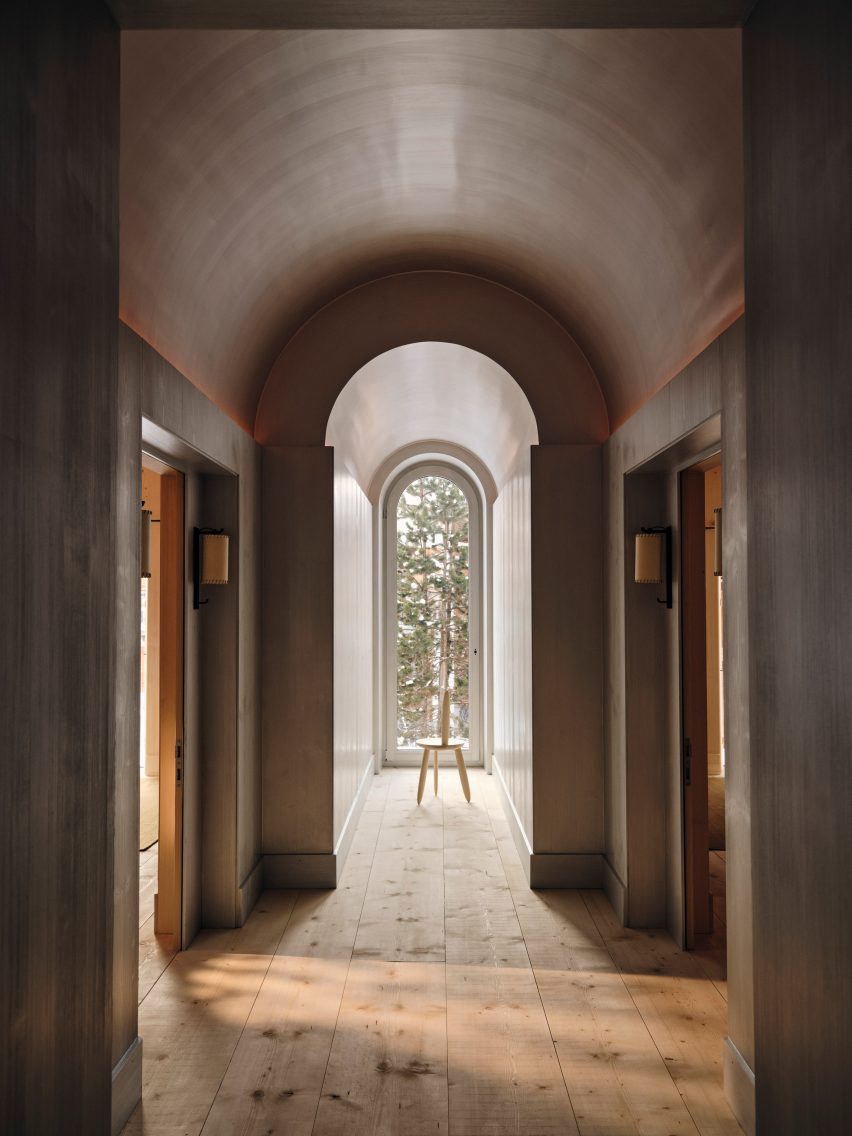 Two bedrooms are located in a vaulted hallway
The ground floor of the hotel holds the living room, dining room and kitchen, while the first floor has a library with a fireplace by artist Giuseppe Ducort.
This is also where the bedrooms are located, with two of them behind the library and the other two located in a private hallway with a vaulted ceiling.

Jan Tyrpekl raises glass micro home on stilts in rural Austria
In one, the building’s heritage can be seen in its low, timbered ceilings, a remainder from the 17th century.
At the lower ground floor is a spa and sauna by designer Shinchiro Ogata, who also designed a decorative wooden gridded screen for the front of the lodge.
 A dining room was clad in spruce wood and features matching furniture
“The wooden screen has been designed by our friend Shinichiro Ogata, according to a Japanese sense of equilibrium,” Gerold Schneider said.
“It toes the line between seeing and being seen, the public and the private, the interior and the exterior,” he continued.
“The screen operates as a second layer in front of a freestanding glass structure on the ground floor, which functions as a showroom or shop.”
 The hotel is located in the Austrian Alps
The adjoining studio and shop will be available to artists in residence for part of the year, as the founders, who also have a gallery and exhibition space nearby, hope to create more of a cultural offering in the area.
Other recent Austrian projects featured on Dezeen include a glass micro-home raised on stilts and a timber and straw holiday cabin.
The photography is by Jake Curtis.