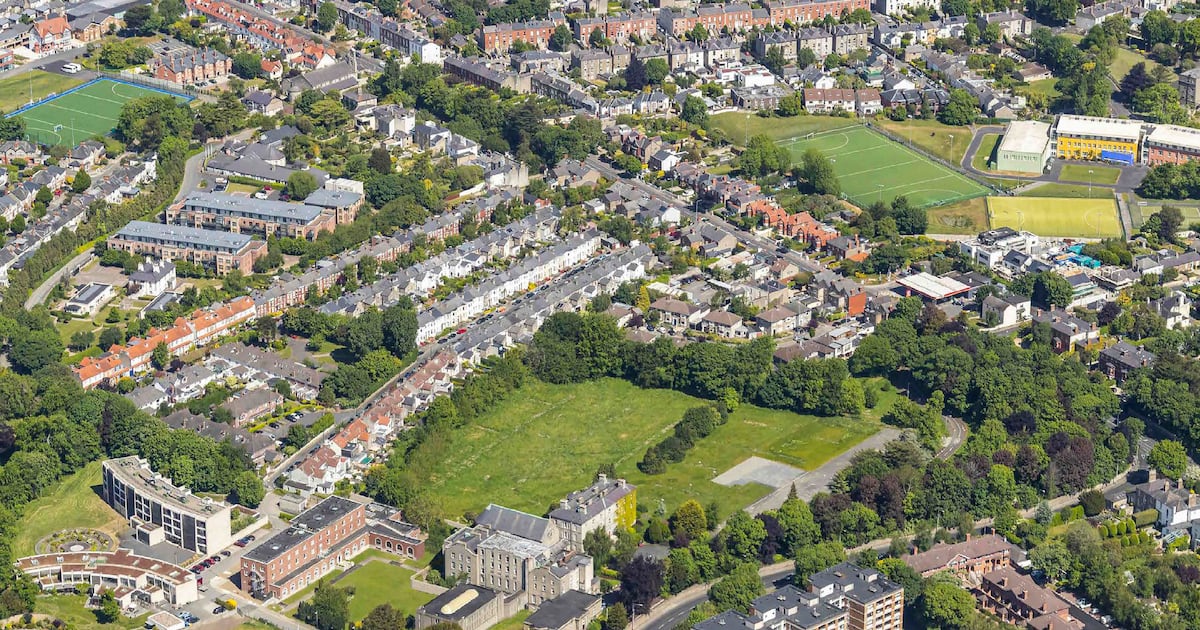
Few sites illustrate Ireland’s planning paralysis better than a 10-acre plot at the corner of Sandford Road and Milltown Road in Dublin 6.
Real estate developer Ardstone bought the land from the Jesuit Order in 2019 for about €69 million.
The site – located 1km from the Milltown Luas stop – forms part of the larger 18-acre Milltown Park in Ranelagh, which runs to the back of Gonzaga College secondary school and which contains the Irish Jesuit Provincialate, Cherryfield Nursing Home and the Milltown Community building.
In 2021, Ardstone, via its subsidiary Sandford Living Ltd, applied directly to An Bord Pleanála – under the former Strategic Housing Development (SHD) system – for permission to build 667 homes, mainly build-to-rent apartments.
In December that year An Bord Pleanála granted planning permission.
However, the permission became the subject of High Court judicial review proceedings initiated by local residents’ bodies and various individuals, who took issue with the scale of the project, the potential impact on traffic and the proposed removal of trees.
The height of the proposed apartment blocks, 10 floors in the case of the highest one, was raised as a concern.
In May 2024, An Bord Pleanála conceded there were issues raised in the judicial review that it could not defend.
These included the fact that Stefan Hyde, brother of Paul Hyde, former deputy chairman of An Bord Pleanála who was forced to resign over alleged conflicts of interest, was a director of a company that produced a five-page disability access report for the developer.
 Could we be heading toward a world recession if Trump can’t broker a deal with Iran?
A request to allow An Bord Pleanála to make a new decision to address these and other issues was granted by the courts and the original application awaited a fresh decision by An Bord Pleanála’s successor An Coimisiún Pleanála.
While this legal wrangle was ongoing, Ardstone, in 2023, came up with a modified plan for the site involving 636 homes (31 fewer homes than the first plan).
It applied for planning under the Large-scale Residential Development system (the successor to the SHD) and was in September that year granted planning by Dublin City Council.
A subsequent appeal against the permission was rejected by An Bord Pleanála but the planning application, like its predecessor, became the subject of judicial review proceedings initiated by Cherryfield Avenue Residents Association, Norwood Park Residents Association and Dermot Murphy of Cherryfield Avenue Upper.
The appellants claimed the density of Ardstone’s scheme materially contravened guidelines for the outer suburbs laid out in the Dublin City Development Plan 2022–2028.
They also claimed the proposed tree removal contravened the development plan’s green infrastructure objectives and that the developer only provided a “theoretical capacity of public transport”, not an actual capacity.
They also maintained that the Environmental Impact Assessment of bat fauna in the area had been inadequate.
The case has yet to be heard. A High Court hearing date is expected later this year.
Despite two separate plans being knocked back, Ardstone in January this year renewed its bid to secure planning for the site.
It came up with a new scheme involving 562 housing units, 105 fewer than the initial 667 proposed.
The revised plan reduced the height across the scheme and on the main apartment block from 10 storeys to eight.
“This scaled-back approach is a direct response to concerns raised about building heights, density and overlooking, while still seeking to unlock the delivery of housing on a site designated for residential development,” Ardstone said.
Dublin City Council granted planning for this scheme last month, noting that the site will provide for a large number of homes “in a highly sought after existing residential area which is located in an area within close proximity to employment, public transport and a range of services and facilities”.
An Coimisiún Pleanála, however, confirmed on Tuesday this week that a third-party appeal has been lodged against the grant of permission by Cherryfield Avenue Residents’ Association.
In its objection, the residents’ group, represented by BPS Planning and Development Consultants, contended that the scheme should be refused as the proposals “would have an overbearing, overshadowing and overlooking impact on adjoining properties on Cherryfield Avenue Lower and Upper”.
The objection also said permission should be refused as it would “adversely impact on the amenity of the local area, the skylines enjoyed by adjoining properties and residential areas and adjoining residential properties”.
BPS’s objection stated that “in objecting to the current proposals, our client’s concerns are no longer to prevent the entire scheme because of its overall cumulative adverse impacts on them and their area.
[ Is Ireland’s housing market finally turning?Opens in new window ]
“Instead, the current objection focuses on a list of revisions needed to the scheme to make it acceptable to them.”
Armstrong Planning Ltd, representing the Norwood residents, has also lodged an appeal, highlighting what it describes as the “excessive density” and “excessive building height” of the scheme.
A decision on these appeals is expected later this year.
So seven years after the site was bought and after the three separate planning grants, one from An Bord Pleanála and two from Dublin City Council, and two judicial reviews, not a single brick has been laid on the site.