
APOD: 2026 June 17 – Longmore 8: The Hamster Wheel Nebula
Discover the cosmos!
Each day a different image or photograph of our fascinating universe is featured, along with a brief explanation written by a professional astronomer.
2026 June 17
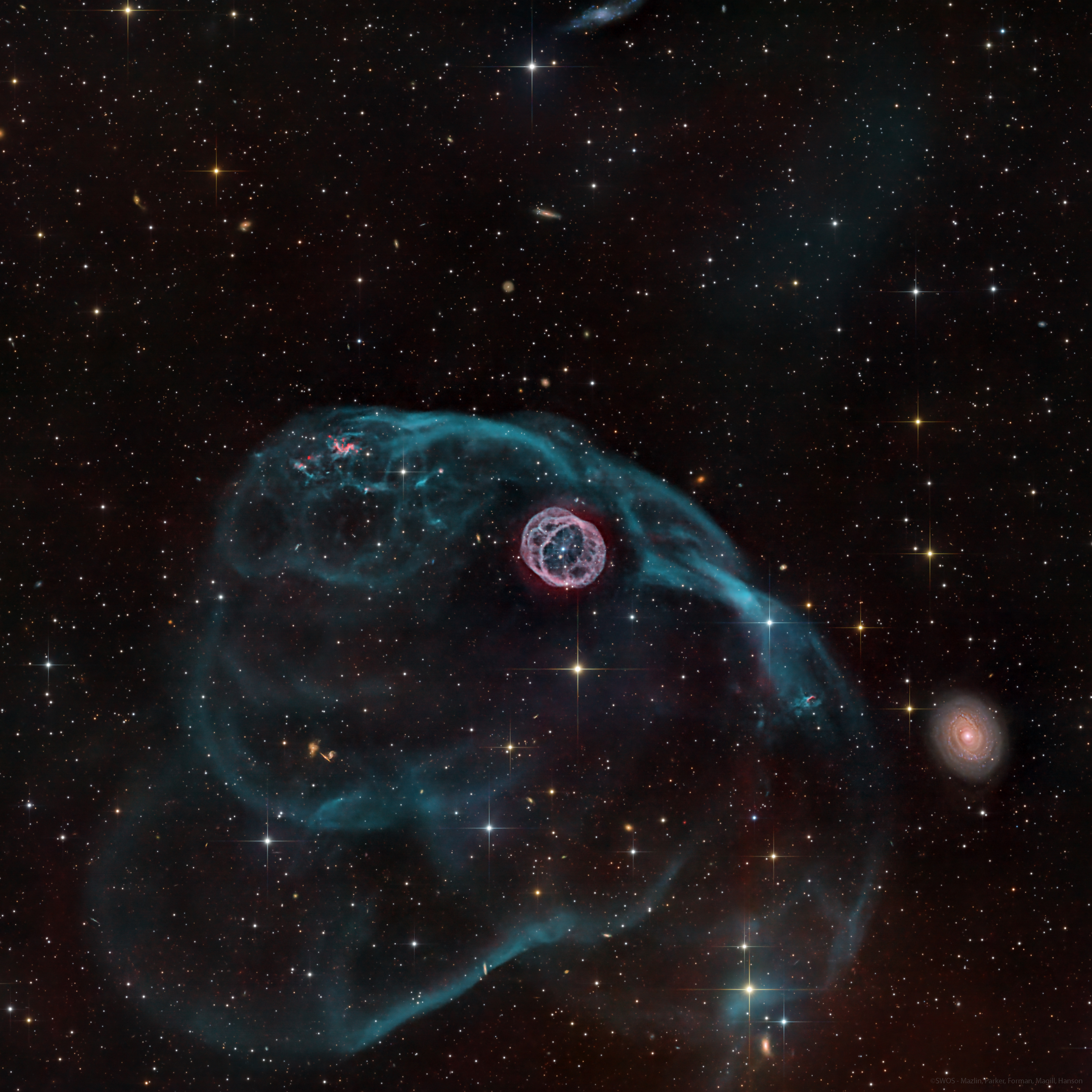
Longmore 8: The Hamster Wheel Nebula
Image Credit & Copyright:
Mazlin,
Parker, Forman, Magill,
Hanson
Text:
Keighley Rockcliffe
(NASA
GSFC,
UMBC CSST,
CRESST II)
Explanation:
How did a hamster wheel get into space? The Hamster Wheel Nebula (Longmore 8) was
discovered by Andrew Longmore
in 1976 as a part of a larger survey of the southern sky. This survey employed several improvements in
photographic technology,
including the use of
highly sensitive film,
to capture deeper and fainter objects on
plates
that were examined
by eye
and catalogued.
The featured image,
taken at Observatorio El Sauce
in Chile, depicts an intricate wheel structure of glowing hydrogen that was thrown out into space by a
dying star
and ionized
by the leftover
white dwarf.
This structure was barely visible on the original plate, emphasizing the power of modern
telescopes and cameras. Two opposing clumps of red hydrogen gas encased in
the blue veil of ionized oxygen
hint at the presence of a
companion
to the bright white dwarf at the wheel’s center!
Tomorrow’s picture: a supernova remnant?
<
| Archive
| Submissions
| Index
| Search
| Calendar
| RSS
| Education
| About APOD
| Discuss
| >
Authors & editors:
Robert Nemiroff
(MTU) &
Jerry Bonnell (UMCP)
NASA Official: Amber Straughn
Specific rights apply.
NASA Web Privacy,
Accessibility,
Notices;
A service of:
ASD at
NASA /
GSFC,
NASA Science Activation
& Michigan Tech. U.