
kengo kuma on architecture rooted in local materials
Throughout his career, Kengo Kuma has challenged architecture’s tendency toward uniformity. While twentieth-century modernism enabled the rapid spread of standardized building methods around the world, the Japanese architect has consistently looked toward local materials, regional knowledge, and traditional craftsmanship as the foundations of architecture.
For Kuma, craft is not simply a matter of preserving heritage. Rather, it offers a way of understanding the relationship between people, materials, and place. Speaking with designboom, the architect reflects on the lessons contemporary practice can learn from regional building cultures, the continued relevance of traditional knowledge, and why craftsmanship remains essential in an age increasingly shaped by digital technologies.
Kuma traces his interest in craft back to his early years working outside Japan’s major urban centers. Shortly after establishing his practice, he spent years designing small-scale projects in rural communities, where local building traditions and material cultures remained closely tied to their environments. ‘There was a time when modern architecture was severed from the ground and local materials,’ he says. Referring to the international ambitions of modernism, Kuma argues that architecture became increasingly detached from local character, climate, and resources in pursuit of standardization.

GC Prostho Museum Research Center | image © Daici Ano
evolving through adaptation
‘I spent many years designing small-scale buildings in rural areas across Japan, far from Tokyo. There, I learned about the diversity of the land and materials, as well as the craftsmanship cultivated in those places. Prioritizing the uniqueness of a place has become my architectural principle and never has this experience been more relevant than it is today,’ the Japanese architect tells us.
That experience continues to shape his understanding of architecture today. Kengo Kuma sees craft as a form of knowledge that emerges through generations of observation and adaptation. Traditional techniques, he suggests, are inseparable from the environments in which they developed.
‘Architecture, by its very nature, has been created by local craftsmen using local materials, upon their careful observation,’ he shares with designboom. ‘Architecture is rooted in the earth and cannot be moved in the air from one place to another. Therefore, understanding the local materials and craftsmanship is essential for anyone involved in architecture.’
Kengo Kuma’s work frequently reinterprets traditional Japanese construction techniques at larger architectural scales, rejecting the notion that tradition and innovation exist in opposition. In his view, traditions survive precisely because they continue to evolve. ‘The reason things labeled ”traditional” have survived is that ”tradition” is not a fixed, unchanging matter, but rather the result of flexibly adapting to the changes of the times,’ he explains. ‘Whether it’s a traditional method or not, we simply use the techniques that are most appropriate for the architecture of that location.’
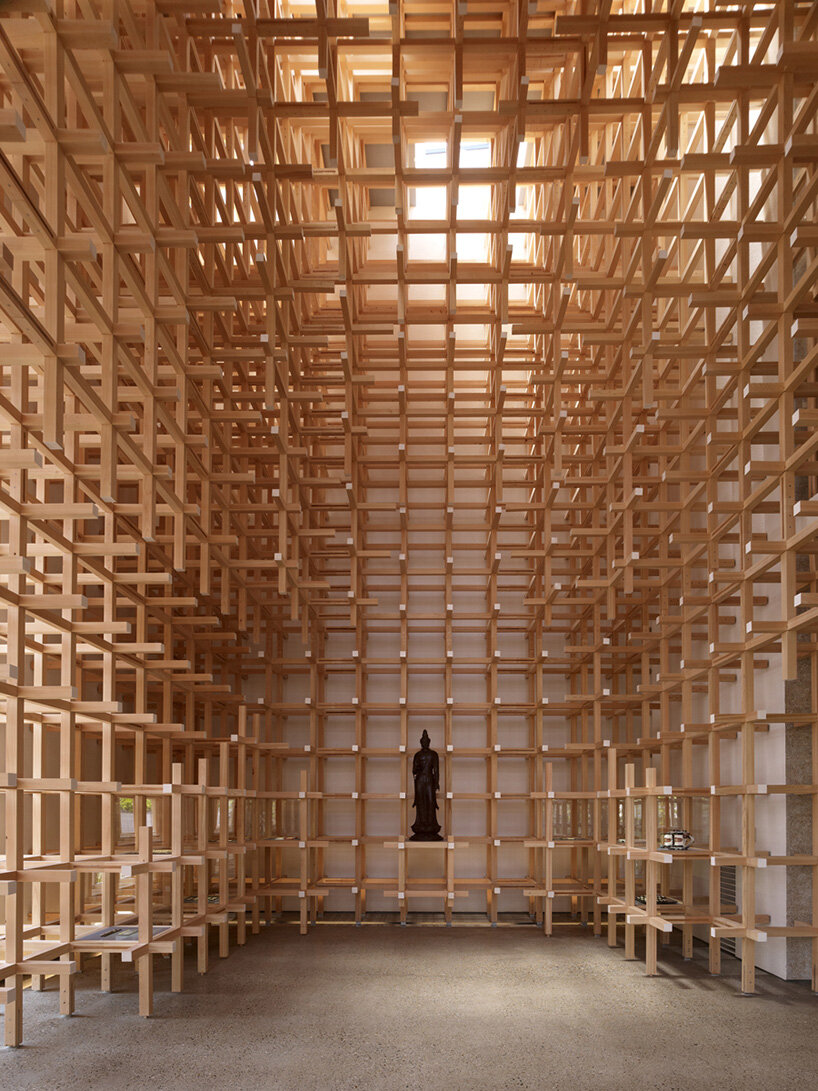
GC Prostho Museum Research Center | image © Daici Ano
why craftsmanship remains relevant in the age of AI
This understanding of craftsmanship as an adaptive process also informs Kuma’s perspective on contemporary technologies. As artificial intelligence becomes increasingly integrated into architectural workflows, he remains cautious about claims that it will fundamentally transform the discipline.
‘AI presents us with various options at every stage of the design process. However, it is humans who are building in reality,’ he highlights. ‘I believe that rather than transforming the very nature of architecture, AI will continue to serve merely as a tool to support our thinking.’
At the same time, Kuma sees signs of renewed interest in material knowledge among younger generations. Through workshops and pavilion-building exercises with students, he observes a strong sensitivity toward the physical qualities of materials and the possibilities they offer.
‘They are surprisingly sensitive to materials and come up with amazing ideas to make the most of them, which I find very inspiring,’ the architect points out.

SunnyHills at Minami-Aoyama | image © Daici Ano
sustainability and architecture’s relationship with nature
For Kuma, traditional building cultures also offer important lessons as architects grapple with questions of sustainability. Long before sustainability emerged as a contemporary framework, builders worked within strict geographic, material, and technological constraints.
‘In the old days, people and technologies involved in building construction could not move freely and their available resources were limited — but outstanding architecture and craftsmanship we admire today were cultivated under such circumstances,’ Kengo Kuma reflects. ‘I believe that learning about the wisdom of our predecessors is a far more sustainable act than merely conducting research on sustainability.’
The value of craftsmanship, however, extends beyond technical expertise alone. Embedded within traditional techniques are cultural values, collective memories, and ways of understanding relationships between communities and their environments.
‘Behind craftsmanship and traditional techniques lie the vision and culture of the people who created them,’ the architect observes. ‘We must respect the work of our predecessors and create an environment where today’s craftsmanship can prosper.’

Yusuhara Wooden Bridge Museum (read more here) | image © Takumi Ota
returning to the land
Looking ahead, the Japanese architect believes the growing desire to reconnect architecture with its surroundings will only increase the importance of craft. As construction becomes increasingly globalized and buildings are often treated as commercial assets detached from their contexts, he argues that architecture must find ways to rebuild its relationship with the natural world.
‘Modernist architecture severed the connection between people and the land, and architecture has become a mere mechanical production process that generates a commercial asset for investment,’ Kengo Kuma suggests. ‘Now more than ever, I feel there is a demand for architecture that reconnects people and nature.’
For Kuma, craftsmanship remains the mechanism through which that reconnection can occur.
‘It is only craftsmanship that enables architecture to serve as that mediator.’

Japan National Stadium (read more here) | image courtesy of Taisei Corporation, Azusa Sekkei, and Kengo Kuma & Associates

Nakagawa-machi Bato Hiroshige Museum of Art | image © Mitsumasa Fujitsuka

Yusuhara Community Library / Yururi Yusuhara | image ©Kawasumi・Kobayashi Kenji Photograph Office