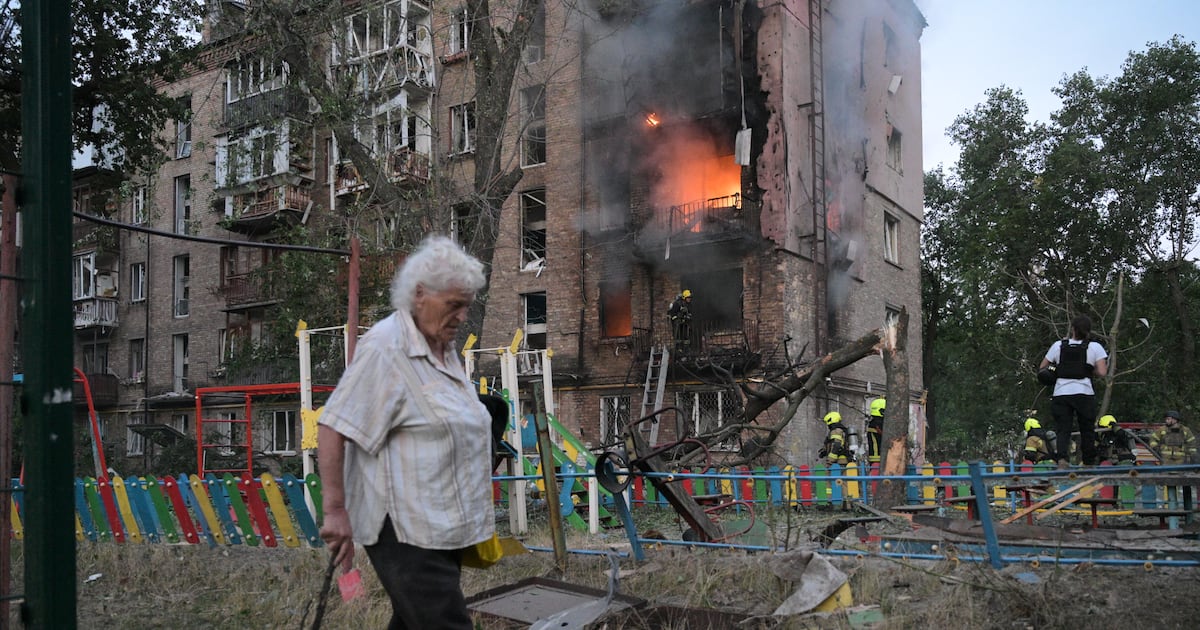
Russia launched hundreds of drones and dozens of missiles at Ukraine’s capital Kyiv early on Thursday morning, tearing apart several residential buildings, killing at least 18 people and wounding scores.
Multiple explosions shook central Kyiv and reverberated across the capital throughout the night as thousands of residents rushed to bomb shelters and underground metro stations.
The attack caused the widest destruction in Kyiv so far this year, and was the deadliest since at least May when 24 people were killed in a strike that brought down an apartment block.
President Volodymyr Zelenskiy said damage had been reported at more than 20 sites across the capital.
“The main strike was directed at Kyiv,” he said. “Air defence supplies for Ukraine are an absolute and critical priority,” he said, urging Ukraine’s allies to maintain contributions to a fund to buy US weapons including Patriot air defence missiles for Ukraine.
Russia launched 74 missiles and 496 drones overnight, the Ukrainian air force said. Yuri Ihnat, the Air Force spokesperson, said the number of ballistic missiles was unusually high and the interception rate for them was low. Ukraine has struggled with shortages of Patriot missiles in recent months.
The Russian Defence Ministry, in a Telegram post, said its “massive attack” using long-range, high-precision air-, land-, and sea-launched weapons and drones hit military and energy facilities, as well as airports in Kyiv and other locations.
Moscow said the attacks were retaliation for Ukrainian drone strikes on Russia. Kyiv, which has stepped up strikes in recent weeks on Russia’s domestic fuel supply, said it had hit an oil refinery overnight in the Russian region of Nizhny Novgorod, where the governor reported one person killed in a strike on an industrial facility.
The Kremlin said Russian military commanders briefed president Vladimir Putin about the Russian attacks, adding that Moscow would continue to increase pressure on Ukraine to achieve its war aims.
Kyiv mayor Vitali Klitschko announced a day of mourning in Kyiv for Friday. He said that damage was recorded across the entire city of about three million people, with some buildings heavily damaged.
Katarina Mathernova, the EU ambassador to Ukraine, said “Russia unleashed hell on Kyiv” overnight, and had struck accommodation used by diplomatic personnel. Diplomats were unharmed, but their belongings were damaged in the fire that engulfed the building, she said.
Foreign minister Andrii Sybiha called on Ukraine’s allies to strengthen the country’s air defences following what he described as a “night of horror” in Kyiv, urging partners not to delay decisions on supplying air defence systems and missiles.
Emergency services were sifting through the rubble of what used to be a nine-storey building on the left bankof the Dnipro River that bisects the city as the sun rose and fires flared up around it.
 Smoke rises after a Russian strike on Kyiv. Photograph: Efrem Lukatsky/AP
City officials said that more than 90 people, including children, paramedics and drivers at an ambulance station, were wounded and that some people were still trapped inside damaged residential buildings.
“Our house is on fire. Oleg was pulling our neighbour out of the burning house, while I was phoning all the emergency services during the explosions,” Iryna Plekhova, a Kyiv resident, said on Facebook, posting a picture of a half-destroyed apartment building with no windows.
“We do not have an apartment any more.”
Damage was recorded in 30 locations across the city, mainly in residential buildings and civilian infrastructure, according to interior minister Ihor Klymenko.
Ukrainian emergency service said it deployed nearly 500 personnel and 100 units of specialised vehicles, including a helicopter, to deal with the aftermath of the attack.
The National Institute of Biochemistry was among many buildings damaged: its state-of-the-art biochemistry laboratory and other offices were gutted during the attack.
“This is a catastrophe for medical and biological science of Ukraine,” biologist Yurii Danylovych told Reuters, saying the lab housed rare equipment.
Ukraine’s neighbour Poland, a Nato and EU member, briefly scrambled fighter jets as a preventive measure. Finland also briefly issued a temporary aviation restriction zone in the eastern Gulf of Finland, its defence forces said.
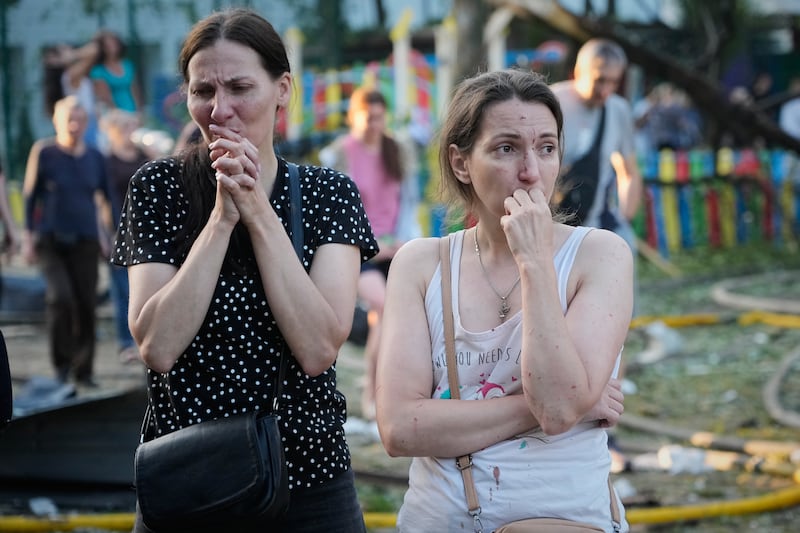 People react at the site of a Russian missile strike that hit a residential building in Kyiv, Ukraine. Photograph: Efrem Lukatsky/AP
After years in which Ukraine bore the brunt of relentless long-range attacks from Russia, Kyiv has intensified its own strikes deeper into Russian territory in recent months, mainly hitting energy targets. That has triggered a fuel crisis in Russia, forcing the world’s third-biggest oil producer to import gasoline from as far away as India.
Russia has responded with a stepped-up air campaign against Ukrainian cities, last month hitting a thousand-year-old Kyiv cathedral foundational to the Orthodox faith in both countries.
Kaja Kallas, the EU’s foreign policy chief, said only sustained military support for Ukraine and increased pressure on Moscow could help stop Russian attacks.
“Today, I will propose to sanction more entities supporting Russia’s military-industrial complex in response to the strikes,” she said in a post on X. “The more Moscow attacks civilians, the more sanctions must be imposed.”
Zelenskiy has proposed talks with Putin to end the more than four-year-old war, an offer the Kremlin leader has rejected. – Reuters