
The Israeli Chief Rabbinate appeared on Thursday to authorize the liberal Tzohar Rabbinical Organization to issue kashrut certifications under Israeli law for the first time, following a High Court of Justice ruling last month requiring it to withdraw its refusal to recognize the group.
But within hours, the decision came under dispute, with senior officials saying the approval had not been properly authorized and therefore had no legal standing.
Religious Services Ministry Director General Yehuda Avidan said the approval signed by Israel’s Chief Rabbinate Director General Yehuda Cohen was issued without the necessary consultations and exceeded his authority.
“Therefore, this approval has no power and cannot be acted upon,” Avidan said in a statement.
Tzohar responded that the matter is subject to the approval of the Rabbinate only, not the Religious Services Ministry, and that the license is valid.
Get The Times of Israel’s Daily Edition
by email and never miss our top stories
By signing up, you agree to the terms
“Hundreds of businesses with Tzohar certification, and hundreds of thousands of their customers, can already eat in places that are certified kosher by Tzohar with the authority and permission of the Chief Rabbinate, starting yesterday evening,” the statement read.
“Tzohar provides excellent kashrut and its procedures, and we call on the general public and business owners to start consuming Tzohar’s kashrut,” it added.
The Chief Rabbinate has not issued a final clarification on the matter, which remains unresolved.
If Tzohar, a Modern-Orthodox, liberal-leaning organization founded to bridge gaps between religious and secular Israelis, were ultimately cleared to give kashrut certification, it would likely lead to significant shakeups within Israel’s food industry, experts said, increasing transparency and reducing prices while decentralizing state control over the kosher certification process.
However, the Chief Rabbinate will likely resist efforts to weaken its control over kosher certification, said Benjamin Porat, Director of the Institute for Research in Jewish Law at Hebrew University. According to reports in the Hebrew press, ultra-Orthodox parties in the government are looking to overturn the 2021 reform that opened the door for organizations outside the rabbinate to provide such certifications in the first place.
In Israel, the right to use the word “kosher” on food labeling is highly regulated, with only certification bodies recognized by the Rabbinate allowed to recognize a product or establishment as meeting religious requirements. Unlike in other countries, where Kashrut is seen as a strictly religious matter, any business claiming to be “kosher” without receiving certification from a recognized body would be in violation of Israeli law.
However, critics of the current system say the Rabbinate’s certification process is expensive, bureaucratic and inflexible, while others object to its religious standards or its role as Israel’s sole kashrut regulator.

Representatives of the Chief Rabbinate deliver a kashrut certificate to a local restaurant in central Jerusalem, on December 31, 2019. (Hadas Parush/Flash90)
In response, Tzohar has offered an “alternative” supervision service since 2018, saying that the supervisors [mashgichim] it sends to establishments are more likely than the rabbinate’s to work fairly and transparently with vendors to establish kashrut compliance. Its certificates don’t state that food is kosher but offer ambiguous statements like “All raw materials were checked and approved by the Tzohar rabbinic organization.”
That effort led to the 2021 kashrut reform, spearheaded by then-MK Matan Kahana, which allows private Orthodox organizations to issue kosher certificates in their own name, provided they meet the state’s standards.

Rabbi Rafi Feuerstein (L), Rabbi Dr. Moshe Be’eri (C) and Shai Berman, CEO of the Israel Restaurant Association, at a press conference on the establishment of a new kashrut system, in Tel Aviv on February 26, 2018. (Flash90)
In principle, that opened Israel’s kashrut market to competing certification bodies, although it requires any competition to the Rabbinate’s monopoly to receive recognition from the Rabbinate itself.
Since then, Tzohar has worked to get this approval. The decision Thursday “was reached following years of efforts by Tzohar to ensure its kashrut supervision should be established as a recognized certifying agency based on the perspectives of justice and impartiality,” the organization said in a statement.
The High Court’s ruling on Tzohar’s Kashrut operation put the Rabbinate into a unique political bind, Porat said.
Ultra-Orthodox members of the current government have been seeking to overturn the 2021 Kashrut reform and disallow anyone outside of the Rabbinate to offer kosher certification. Their success now depends on the results of the upcoming Knesset elections in September or October, and members of the Rabbinate will likely look to stall the rollout of Tzohar’s new authority until then, he said.
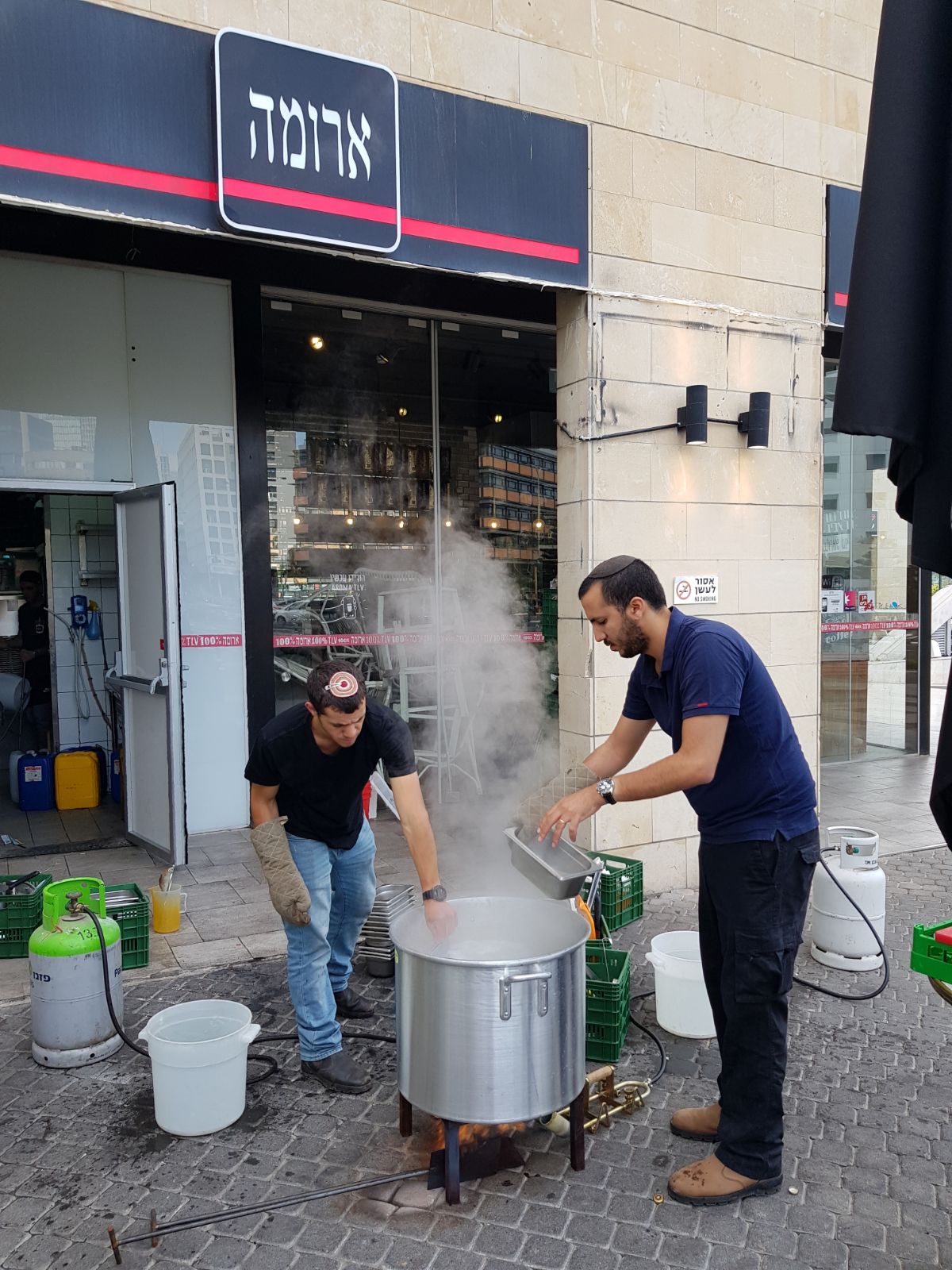
Supervisors from the Tzohar organization work to prepare a branch of the Aroma coffeehouse chain in Tel Aviv that was awarded a kosher license on May 9, 2018. (Tzohar)
Granting power to Tzohar would have significant impacts on the nation’s kashrut regime, bringing greater transparency and moderation, Porat said.
“Today the world of kosher is controlled exclusively by the Rabbinate, which very often is subject to the dictates of Haredi or extremely religious elements,” he said. “Once Tzohar comes into power, there will be competition between two visions of kashrut – one that is more moderate and one that is more extreme.”
It would also challenge the current operating system in which supervisors receive their salaries from the venues they supervise, Porat said. This arrangement creates endemic conflicts of interest that harm the entire system’s integrity, critics charge, while Tzohar pays supervisors a flat salary to do their work.
One of the biggest changes Tzohar could bring to the system could be allowing restaurants open on Shabbat to receive kosher certification, Porat noted. Currently, working seven days a week automatically disqualifies most venues from certification, but a more liberal approach could create criteria that would allow some restaurants to have it both ways, he said.
“That change would be quite significant, assuming that the ruling doesn’t change after the coming elections, Porat said.
We can’t do this work alone.

The war with Iran has been draining for all of us in Israel. But when I heard about a high casualty incident – ballistic missile impacts in Arad and Dimona that left nearly 200 people wounded – I drank a cup of coffee, packed a bag, and headed south.
There, I spoke with Shilgit, the head of an after-school program for underprivileged youth. Standing outside her destroyed center, Shilgit said it was a miracle that no children were hurt and spoke about the community coming together in the hours since.
As a Times of Israel reporter, I’m committed to telling stories of resilience like Shilgit’s. But my colleagues and I can’t do this alone. If you value work like this, please consider joining our reader support group, The Times of Israel Community. Your financial support is essential to keep real human reporting like this going.
— Stav Levaton, military reporter
Already a member? Sign in to stop seeing this
You’re a dedicated reader

That’s why we started the Times of Israel – to provide discerning readers like you with must-read coverage of Israel and the Jewish world.
So now we have a request. Unlike other news outlets, we haven’t put up a paywall. But as the journalism we do is costly, we invite readers for whom The Times of Israel has become important to help support our work by joining The Times of Israel Community.
For as little as $6 a month you can help support our quality journalism while enjoying The Times of Israel AD-FREE, as well as accessing exclusive content available only to Times of Israel Community members.
Thank you,
David Horovitz, Founding Editor of The Times of Israel