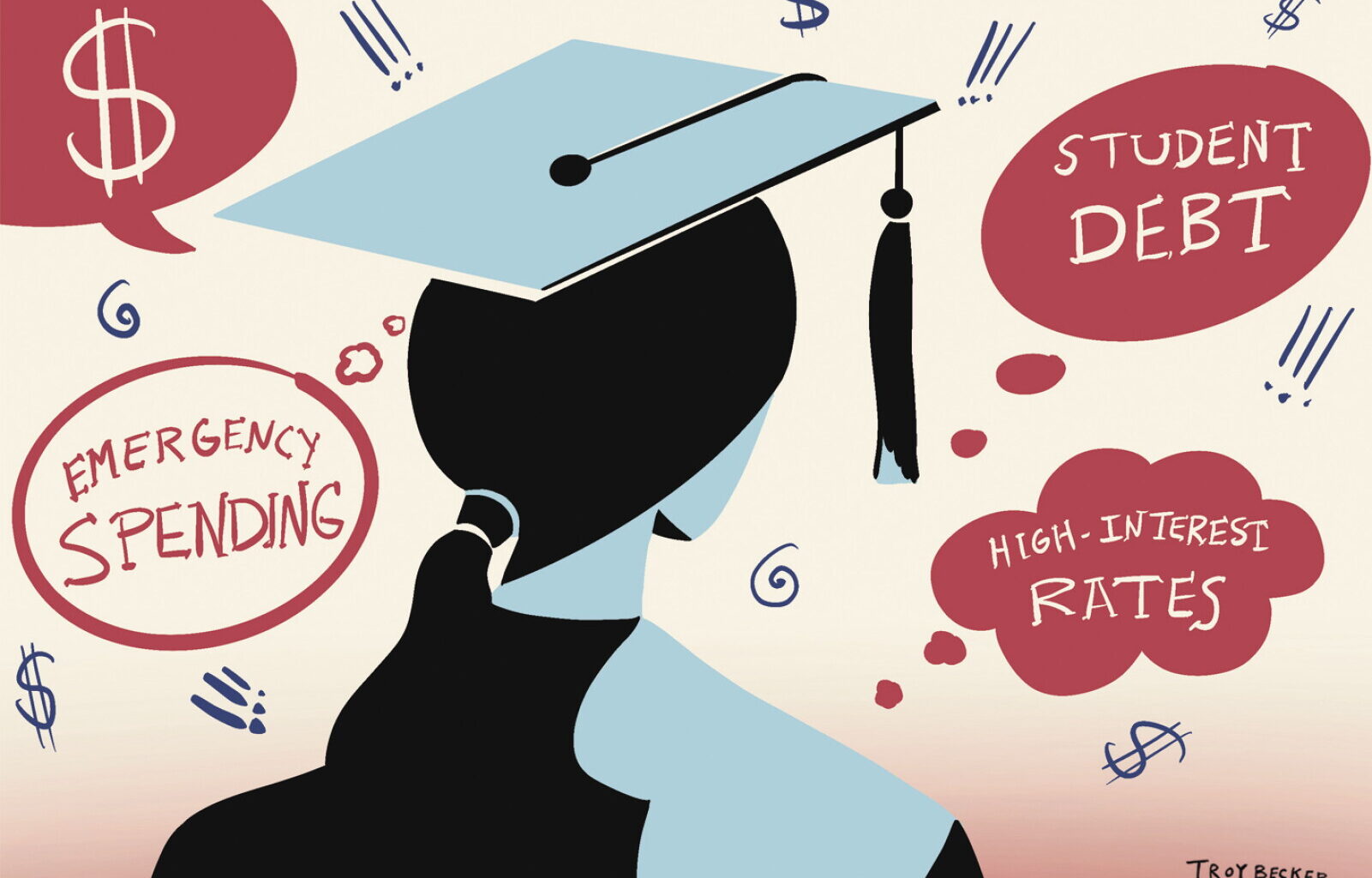
MOORHEAD — As graduation parties wind down and job applications ramp up, many Gen Z adults are entering an unfamiliar chapter of life: managing money on their own.
Student loan payments begin. Health insurance changes. Rent is due. Retirement plans appear in employee onboarding paperwork – even though retirement seems so far away – alongside unfamiliar terms like Roth IRAs and 401(k)s.
For me, the transition started shortly after graduating from Minnesota State University Moorhead in fall 2025.
I was fortunate. A college opportunity evolved into a paid internship that evolved further into a full-time reporting position with The Forum. But even with steady employment, I found myself navigating financial decisions I didn’t feel entirely prepared to make — setting up insurance, repaying student loans and figuring out how to balance saving money with actually enjoying my early twenties.
That last part has been the hardest. A quick lunch can cost an hour’s wages, while a concert can now mean tickets, gas and a weekend trip to the cities.
The irony wasn’t lost on me. I had taken business classes and learned how to build a budget. I knew the difference between a checking and savings account, yet I still questioned whether I truly understood personal finance.
That uncertainty appears to be common among my generation.
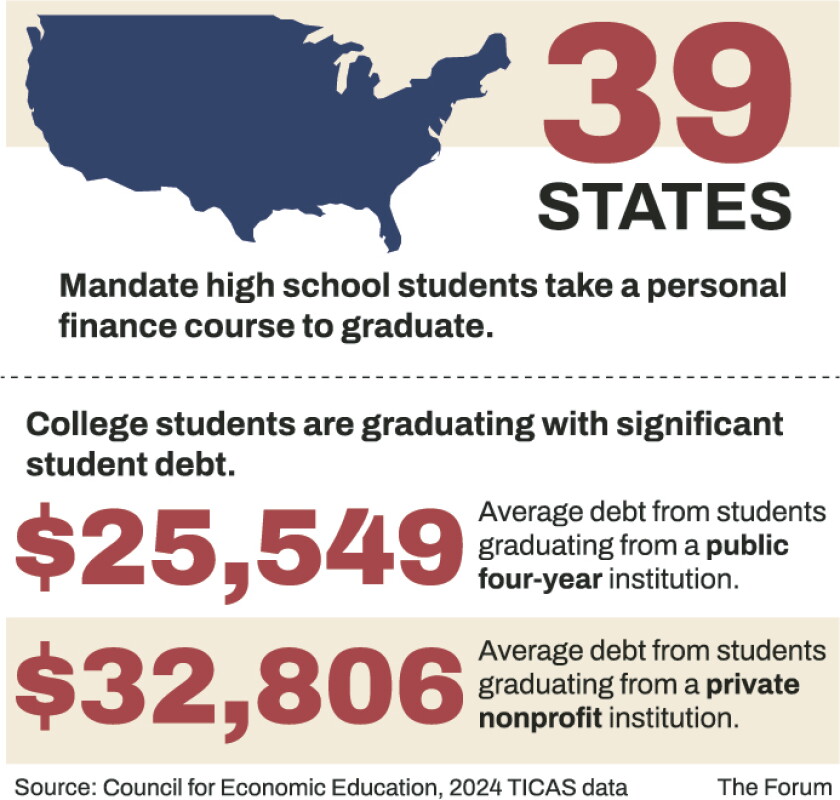
According to the Council for Economic Education, 39 states now require high school students to complete a personal finance course before graduating. Even so, financial literacy education varies widely depending on where students live and the courses available through their schools and colleges.
Troy Becker / The Forum
According to the Council for Economic Education, 39 states now require high school students to complete a personal finance course before graduating. Even so, financial literacy education varies widely depending on where students live and the courses available through their schools and colleges.
I experienced some of those gaps firsthand. My high school personal finance class shifted online during the COVID pandemic, and lessons that previous students received weren’t covered with the impromptu online curriculum.
I looked forward to taking that class, and even though it taught me the basics and some important lessons, I passed feeling unprepared for significant future financial decisions.
Later, coursework through community college and undergrad helped strengthen my understanding of budgeting and spending priorities, but I still felt questions remained.
How much should someone my age be saving? Should paying off debt come before investing? Is one credit card enough to build credit? What financial advice should we actually trust in an age of TikTok influencers and artificial intelligence?
Those were some of the questions I brought to Joe Bloodgood, a financial advisor with Boulay Financial Group.
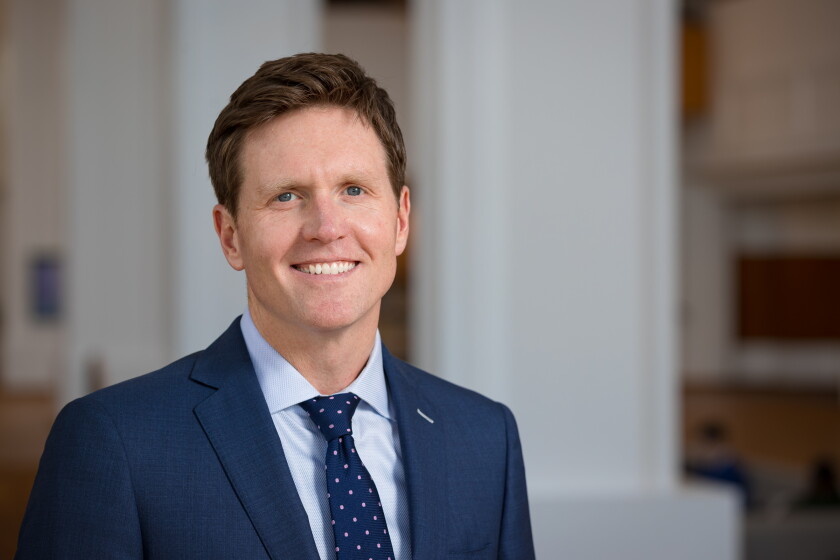
Joe Bloodgood, financial advisor with Boulay Group.
Contributed / William J. Adams of Bill Adams Photography
Because while Gen Z is often criticized for not understanding money, many young adults are trying to make informed financial decisions while facing rising housing costs, significant student debt and an overwhelming amount of sometimes conflicting advice.
According to the College Board and the Federal Reserve, graduates carrying student loans owe an average of roughly $29,100 to $39,457 in federal and private debt, with more than half of college graduates leaving school with loans. For many young adults, financial literacy isn’t simply about building wealth — it’s about learning how to navigate adulthood.
For Bloodgood, conversations and concerns like ours are becoming increasingly common.
Bloodgood has spent the past 13 years advising clients through Boulay Financial Group, with a broad spectrum of clients from individuals and families navigating everything from retirement planning to major life transitions. More recently, he has found himself working alongside younger colleagues and clients who are eager to learn about building wealth and managing money.
“They are really passionate about financial planning,” Bloodgood said about the Gen Z interns. “It’s been fun to see them in roles that they love.”
Many young adults know the basics of saving and budgeting, but become overwhelmed by the sheer amount of financial information available online. Between social media influencers, investing trends and artificial intelligence-generated advice, it can be difficult to know where to start.
Bloodgood’s advice is surprisingly simple: start early, automate what you can and don’t underestimate the power of consistency.
Build and start with a strong foundation
Snowball effect. “The snowball” was a comparison he returned to throughout our conversation.
Building wealth rarely feels rewarding at first, he explained. For years, savings can seem insignificant. But over time, compound interest begins to work in your favor, creating momentum that becomes increasingly difficult to stop — like the snowball.
Automate Your Savings. Bloodgood says one of the easiest ways to create that momentum is by automating savings. Whether through a 401(k), Roth IRA or recurring transfer to a savings account, Bloodgood recommends treating savings as a monthly bill rather than an afterthought.
“It’s really hard to write out a check for 15% of your income every month,” he said. “And so, that’s why I do like things like the 401(k) – it’s automated through payroll deduction and you know it’s going to get in there. Same with funding a Roth IRA, most providers will allow you to set up a monthly contribution directly from your checking account to the IRA company.”
Automating your savings, payments and other debits or credits can make planning easier.
“Anything that can kind of take our own human behavior out of it, I find, is a good way to do it,” Bloodood said.”
Pay yourself first. Instead of waiting to see what money is left over at the end of the month, he encourages Gen Z to “pay yourself first” by directing money towards savings before spending it elsewhere.
“At age 25, if you can save around 15% every year, saving and setting that aside, by age 35, you usually have about two times your income,” he said.
The 50/30/20 Rule. Bloodgood also recommends following a simple budgeting framework: roughly 50% of take-home pay for needs, 30% for wants and 20% towards savings or debt repayment.
Avoid lifestyle creep. For many Gen Z adults, however, the challenge isn’t budgeting for coffee or the occasional concert— it’s avoiding what Bloodgood calls “lifestyle creep.”
As income increases, so does the temptation to spend more.
“We can be in a situation where we make three times as much money as we did when we first started, but we still feel like we’re living paycheck to paycheck,” Bloodgood said.
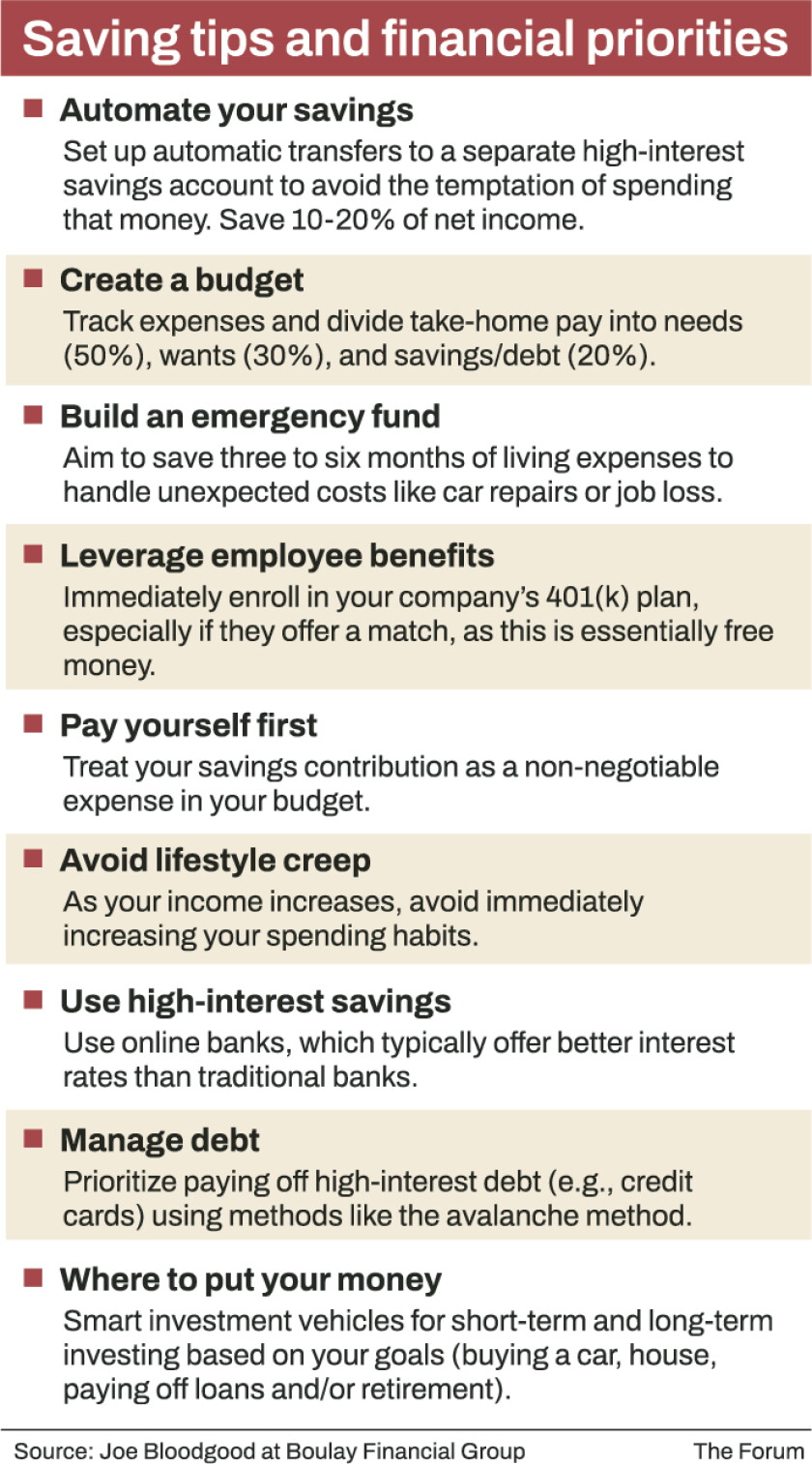
Savings tips and financial priorities provided by Joe Bloodgood, a financial advisor with Boulay Financial Group.
Troy Becker / The Forum
Follow an order of operations
As we talked, Bloodgood pulled out a simple diagram he calls the “order of operations,” mapping out the sequence he recommends for building financial security. Rather than viewing financial planning as a list of unrelated tips, Bloodgood encourages young adults to think about it as a hierarchy that prioritizes financial security before long-term investing.
The framework starts with building a financial cushion before gradually taking advantage of employer benefits and tax-advantaged retirement accounts.
Emergency savings: First is to build a foundation of 3-6 months of living expenses in an accessible account – like a money market or savings account — to protect against unexpected costs.
“Set aside six months of expenses right after a graduation or starting your professional career,” he said. “The point there is not to do it at the exclusion of everything else, but to make it kind of the foundation.”
Health Savings Account (HSA): If you have a qualifying health plan, Bloodgood says to prioritize the HSA as it offers unique “triple” tax benefits — contributions reduce taxes, investments grow tax-free, and withdrawals are tax-free for medical expenses.
An HSA was something I personally initially opted out of because I was afraid to take that money out of my paycheck, but speaking with Bloodgood proved to me that it is important to sign up for. Following an unexpected health issue, I had medical insurance, but still paid a lot out of pocket for my visit since my deductible was high, and I did not have a health savings account set up.
Retirement accounts and Employer 401(k) Match: Retirement accounts were one topic I specifically wanted Bloodgood to explain. Like many people in their 20s, I knew the names — 401(k), Roth IRA, Traditional IRA — but not necessarily how they worked or fit together.
Bloodgood explained that while retirement accounts have different tax advantages and rules, his advice for young adults was straightforward: begin contributing as early as possible, especially if an employer offers a matching 401(k) contribution.
He advised joining a company plan as soon as possible, and if there is a waiting period for signing up, then to save into a Roth IRA during that time. Confirming that employees are always entitled to the money they contribute, plus earnings, even if they leave before being fully vested in the company match, Bloodgood said that funds transfer easily into a new plan or IRA.
In short, the main options are traditional 401(k), Roth 401(k), traditional IRA, and Roth IRA, with the 401(k) offering automation and company sponsorship, while the IRA provides flexibility in choosing any investment
Bloodgood says when it comes to the employer 401(k) match, always take the full company match as it is essentially “free money.”
Bloodgood strongly recommended Roth contributions for 401(k) and IRA accounts for individuals in their 20s, citing that early career years are often the lowest-earning, making the tax-free status of future withdrawals more beneficial later on.
After-Tax Contributions: Bloodgood completed the hierarchy by discussing the fourth tier: after-tax contributions, which he said should only be pursued after fully maximizing tax-advantaged accounts (HSAs, IRAs, 401ks).
Avoid habits that hold you back
Manage debt, prioritize paying off high-interest debt using an avalanche method. While social media tips often focus on small daily purchases, Bloodgood believes larger financial decisions frequently have a greater impact. A $600 monthly vehicle payment, for example, can affect long-term savings far more than the occasional latte.
“Boring is Better.” When it comes to investing, Bloodgood encourages young adults to avoid chasing trends.
Rather than trying to find the next hot spot, cryptocurrency or viral investment opportunity, he advocates for diversified investments designed for long-term growth.
“Almost regardless of your age and where you’re at with your net worth and the size of your portfolio, you don’t have to take wild amounts of risk to be able to grow your wealth,” he said. “Boring is often better.”
For young investors, he said, success is less about taking big risks and more about starting early and remaining consistent.
Be strategic with large purchases – Avoid making large purchases that lock you into significant monthly payments before you have a solid financial foundation.
Bloodgood said large purchases, especially vehicles, can have a much bigger impact on long-term finances than many people realize. While social media often focuses on skipping coffee or eating out less, a vehicle with a large monthly payment can affect someone’s ability to save for years.
I recently faced that decision while shopping for a used vehicle, debating whether to finance it or pay cash. Car issues are never fun, and my head hurt after all the research I did.
Avoiding unnecessary credit cards and financial simplicity: Bloodgood recommended avoiding store-based credit cards, which offer minor one-time savings but add responsibility and potential pitfalls. He prefers keeping spending on one or at most two credit cards for simplicity and ease of tracking expenses. Bloodgood emphasized the value of simple, reliable, and easy-to-understand financial practices, especially for individuals just starting their careers.
For me, I have always treated my credit card with a debit card mentality — only use my credit card if I have the money to pay it off. Even with monthly notifications, I also shoot for paying my card off early, so I never miss a payment.

Stephanie Dickerson graduated with her Bachelor’s degree from Minnesota State University Moorhead in the spring of 2025.
Contributed / Emily Felling
While a college degree prepares students for a career, it doesn’t always prepare them for adulthood.
The first paycheck quickly becomes a lesson in taxes. The first apartment introduces rent and insurance. The first full-time job brings retirement accounts and employee benefits that suddenly matter.
Before our conversation, I thought financial literacy meant knowing every investing term, understanding every retirement account and never making a mistake.
Instead, I learned it starts with something much simpler: asking questions, building good habits and beginning before you feel completely ready.
Building wealth isn’t about finding the perfect investment or timing the market — it’s about making one good decision after another, even when those decisions seem small.
Saving $25. Paying off a credit card. Contributing to a retirement account. Saying no to a purchase you can’t afford.
Those choices may not feel significant today, but, as Bloodgood described it, that’s how the snowball starts rolling.