
 Close-up of Realta’s direct energy converter assembly prototype. Credit: Realta Fusion/UW-Madison
A fusion company has made a few light bulbs glow by converting plasma straight into electricity for the very first time.
The demonstration was reported by Madison startup Realta Fusion using the University of Wisconsin-Madison’s WHAM device. It converted the motion of charged plasma particles into current, drawing multiple amps at around 100 volts.
This is no practical fusion power plant though, as the device did not produce net electricity. Most of the captured power came from energy fed into the plasma, not from fusion reactions themselves.
A Shortcut Around Steam
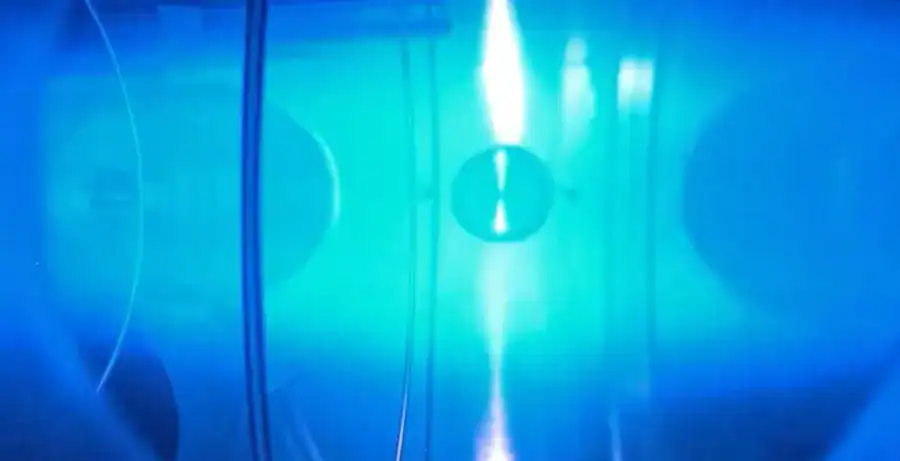 Plasma held in the WHAM experimental reactor. Credits: Mason Yu/UW-Madison
Most thermal power plants follow the same recipe as a hundred years ago: make heat, boil water, spin a turbine. Fusion power plants, if they become commercially viable, are expected to work much the same way for the bulk of their electricity.
Realta is trying to add another route. Its system uses direct energy conversion (DEC), a method that turns the motion of charged particles into electricity without first turning that energy into heat and then having to lose energy with all the intermediary steps like the mechanical motion of a turbine. The company says it is the first private fusion company to demonstrate DEC on a fusion plasma.
“We can take power from a plasma,” Kieran Furlong, Realta’s co-founder and chief executive, told TechCrunch. He claimed that the experiment shows “what’s possible.”
The test took place on WHAM—Wisconsin HTS Axisymmetric Mirror—a prototype fusion machine at the University of Wisconsin-Madison that Realta operates with the university.
In the kind of fusion plant Realta wants to build, about 80% of the energy would still be collected as heat and used to make electricity the traditional way. The remaining 20% would come from charged particles racing out of the reaction. Those particles are what DEC is designed to catch.
×
Thank you! One more thing…
Please check your inbox and confirm your subscription.
The Useful Leak
 WHAM, a prototype magnetic mirror fusion machine at the University of Wisconsin-Madison, where Realta Fusion tested a direct energy converter. Credit: Realta Fusion/UW-Madison
WHAM uses a design called a magnetic mirror. It holds superhot plasma in place with powerful magnetic fields, so the plasma does not touch the walls of the machine.
But the trap is not perfect. Some particles escape through the ends.
That escape has long been seen as a drawback of magnetic mirror machines. But Realta is trying to exploit the leak. The company says the escaping particles can help carry waste out of the plasma, while a converter at the end of the machine catches some of their energy.
For the June test, Realta placed a small converter at one end of WHAM, where some charged particles naturally escape the magnetic trap. Because those particles are moving fast, they carry energy with them. The converter creates an electric field that slows the particles down and collects their charge. In effect, some of their motion becomes electrical current.
The setup used three fine metal grids and produced power in the hundreds of watts, enough to light several bulbs. That’s a very modest output but it showed that the basic idea works on WHAM.
The concept itself has been around for some time. Physicist Richard Post proposed direct energy conversion in the 1970s, and researchers have tested versions of it before. Realta claims it is the first private fusion company to show the technique on a fusion machine and to build it into a commercial plan.
The Long Road
Realta says DEC could operate at more than 90% efficiency in a future plant, compared with up to 45% for the thermal cycle in its first-generation design. The company argues that this boost could cover the electricity needed to start and sustain the plasma, lowering power costs by 10 to 20%. Those figures remain projections, not measured results from this test.
“While we’ve demonstrated DEC works on WHAM, this is not yet a demonstration of net-electricity or a large-scale conversion of fusion power directly into electricity. Those are milestones for our future fusion machines,” said Derek Sutherland, Realta’s chief scientific officer.
Fusion has a long history of breakthroughs that mark real scientific progress without immediately solving the engineering problem. In 2022, the National Ignition Facility produced more fusion energy than the laser energy delivered to its fuel target. That was a landmark ignition result, but it was still far from a working power plant.
Realta’s light bulbs point to a way to reclaim energy from plasma that would otherwise leave a mirror machine. The next tests will need to show higher voltages, more captured power, and that the converter can collect energy without disrupting the plasma.
For now, the bulbs are a signpost. The power plant remains the hard part.