
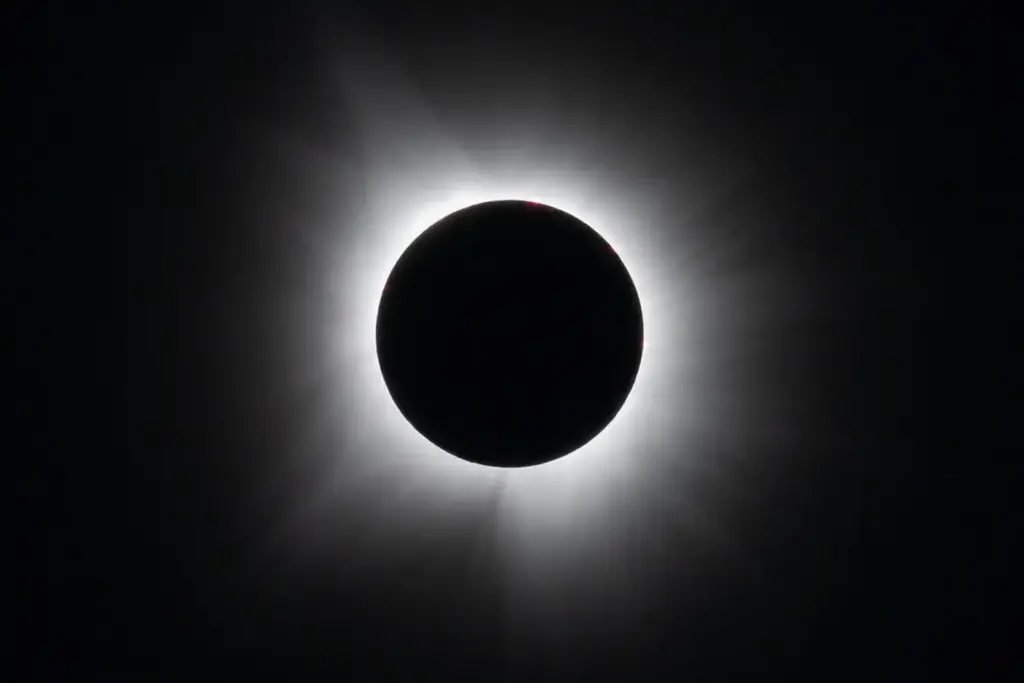
 The eclipse will reach the U.K., Ireland, mainland Europe, and Africa in the evening. Credit: NASA
Spain will see its first total solar eclipse in more than a century on August 12, 2026, when the Moon completely covers the Sun along a path crossing the Iberian Peninsula. The event will also pass through Greenland, Iceland, the North Atlantic and a small part of Portugal, but Spain will contain one of the largest land areas in Europe from which to observe totality. The eclipse will occur late in the day, placing the Sun close to the western horizon in many locations. Spain’s National Geographic Institute describes the event as the first total solar eclipse visible from the Iberian Peninsula in more than 100 years.
The Iberian Peninsula prepares for its first total eclipse in more than a century
The August 12 event will cross northern Spain from Galicia toward the Mediterranean, passing through several regions before reaching the Balearic Islands. Observers inside this narrow corridor will see the Moon completely cover the Sun, while locations outside it will experience only a partial eclipse.
The last major total solar eclipse visible across mainland Spain occurred in 1905. The 2026 event will therefore return totality to much of the Iberian Peninsula after more than a century, although the Canary Islands saw a total solar eclipse in 1959. The next total solar eclipse visible from Spain will arrive on August 2, 2027, followed by an annular eclipse in 2028. After that sequence, Spain will not see another total solar eclipse until 2053.
The eclipse will arrive at a challenging time of day. In many Spanish locations, totality will occur shortly before sunset, leaving the Sun only a few degrees above the western horizon. A clear, unobstructed view will therefore be essential.
Totality will last a maximum of 2 minutes and 18 seconds near Iceland, where the eclipse will reach its global maximum at 7:46 p.m. local peninsular time. Spain will experience shorter periods of totality. In A Coruña, totality will last around 76 seconds, while observers in Burgos could experience approximately 104 seconds. In Palma de Mallorca, the Sun will sit only about 2 degrees above the horizon at the eclipse’s maximum.
Totality will cross Spain from Galicia toward the Mediterranean
The eclipse’s path will enter the Iberian Peninsula from the west, sweeping across the entire breadth of mainland Spain. Cities and provincial capitals along or near the path include A Coruña, Oviedo, León, Bilbao, Burgos, Zaragoza and Valencia, with the eclipse eventually reaching the Balearic Islands.
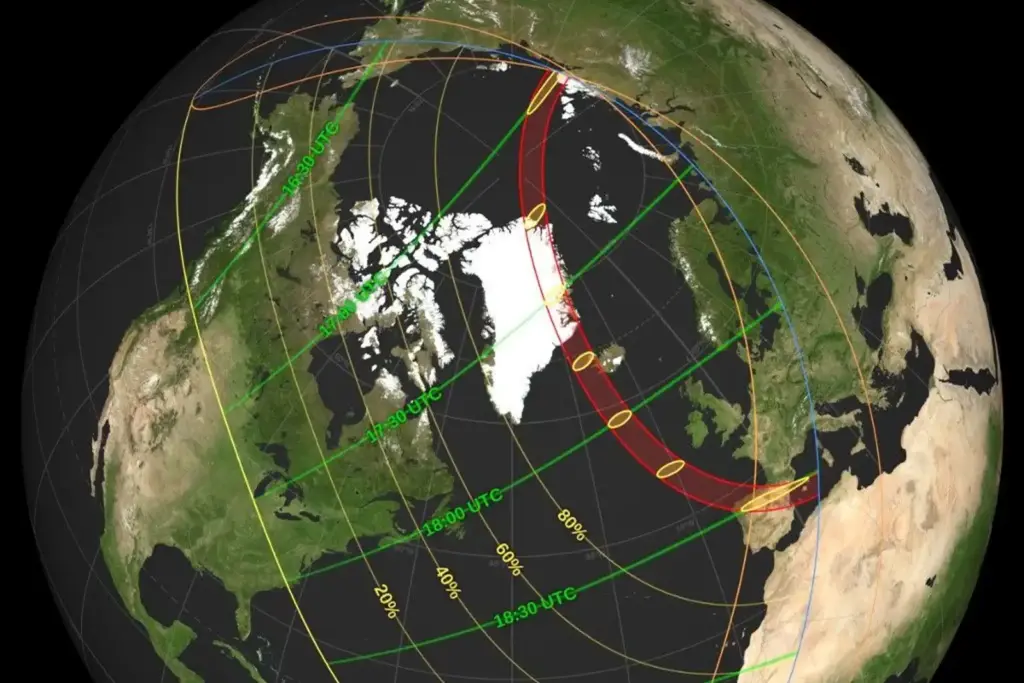 Credit: NASA
Almost all of northern Spain will experience totality, while much of the southern half of the country will see only a partial eclipse. The exact boundary between the two experiences will depend on the observer’s location.
A total solar eclipse occurs when the Moon passes directly between Earth and the Sun and completely blocks the Sun’s visible surface. The Moon’s shadow creates a narrow path across Earth’s surface. Only observers inside that path can experience totality.
The eclipse will begin over the Bering Sea at 5:34 p.m. local peninsular time before concluding over the Atlantic at 9:58 p.m. The point of greatest eclipse will occur near Iceland at 7:46 p.m., offering up to 2 minutes and 18 seconds of totality. From start to finish, the entire event will span 264 minutes.
Weather will remain one of the main variables for observers. The eclipse will occur during the Northern Hemisphere’s summer, when many parts of Spain often experience clear conditions, but local cloud cover can still determine whether an observer sees totality.
The low angle of the Sun introduces another unique challenge. A location inside the path may still offer a poor view if mountains, buildings, or trees block the western horizon. For that reason, an open view toward the west will matter as much as proximity to the center of the eclipse path.
Solar eclipse viewers will remain essential before and after totality
A total solar eclipse does not make every phase of the event safe to watch with the naked eye. Observers must use certified solar viewing glasses or another appropriate solar filter while any part of the bright Sun remains visible. Ordinary sunglasses do not provide adequate protection.
During the brief period of totality, when the Moon completely covers the Sun’s bright surface, observers can look without protection. But as soon as sunlight begins to reappear, eye protection must be used again.
NASA also recommends indirect viewing methods, such as a pinhole projector, during the partial phases. These methods allow people to observe the changing shape of sunlight without looking directly at the Sun.
The August eclipse will also offer different viewing experiences across the Northern Hemisphere. The total path will cross the Arctic Ocean, Greenland, Iceland, the Atlantic and the Iberian Peninsula. A partial eclipse will remain visible across much of Europe and northwestern Africa, as well as parts of North America, including Alaska, Canada and the northern United States.
For observers in Spain, the event will combine a rare astronomical occurrence with a demanding viewing setup. The late hour means that many viewers will need a clear western horizon to see it.
The best viewing location will therefore depend on more than the eclipse map. A place inside the path, with an unobstructed view of the western horizon and favorable weather conditions, will offer the strongest chance of seeing totality. Locations such as Burgos combine a relatively long period of totality with the opportunity to observe the eclipse before sunset, while coastal and island locations may face greater challenges from the Sun’s low position.