
An investigation into Aughinish Alumina and the company’s export of raw material to Russia has made “no adverse findings” against the Co Limerick plant, Minister for Enterprise Peter Burke has said.
In a statement setting out the findings of the inquiry, Burke said there was “no information of a sufficient evidentiary level” found to confirm that alumina produced by the Russian-owned plant was later being used to supply Russian arms manufacturers making missiles and weapons for Moscow’s war in Ukraine.
On Thursday, Taoiseach Micheál Martin told reporters in Kyiv during a visit to Ukraine that although the review did not find “concrete or definitive” evidence to prove Aughinish Alumina was supplying alumina to the Russian military, the report equally could not rule that scenario out.
The Department of Enterprise was tasked with investigating a report by The Irish Times, in co-operation with the Organised Crime and Corruption Reporting Project, that drew on leaked documents to detail how Aughinish Alumina is shipping vast amounts of alumina to smelters in Russia, where it is then sold to a company that supplies aluminium to Russian arms and missile manufacturers.
The plant is owned by Rusal, the Russian metals giant controlled by sanctioned oligarch and Kremlin insider Oleg Deripaska.
The revelations pointing to the downstream role the Co Limerick plant plays in the supply chain of the Russian defence industry has seen calls for exports of alumina to Russia to be cut off.
Ukrainian president Volodymyr Zelenskiy, who was briefed on the department’s findings by Martin during his visit, said he felt there was enough grounds for the EU to sanction alumina, in effect barring Aughinish from shipping the material to Russia.
In a statement, Aughinish Alumina said it welcomed the outcome of the investigation and was willing to take part in any work to enhance the traceability of alumina made in Ireland.
“As a supplier of a critical raw material to Europe and as a large regional employer, Aughinish will continue to cooperate with all Government departments,” the company said
From the Shannon to Siberia: How alumina from a Limerick refinery enters Russia’s weapons supply chain
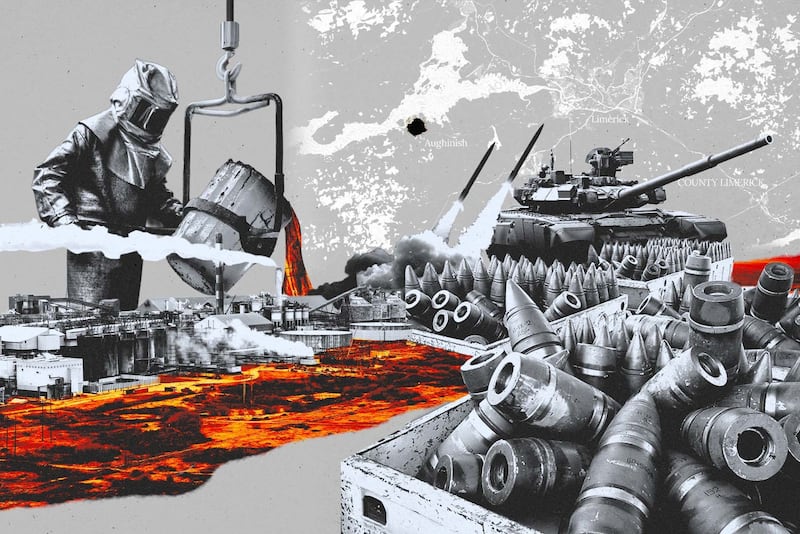
- Aughinish Alumina in Co Limerick supplies vast amounts of raw materials to Russian aluminium smelters, according to an investigation by The Irish Times and the Organised Crime and Corruption Reporting Project (OCCRP).
- Read the full investigation here.
In his statement on Friday morning, Burke said department officials had made “every effort” to substantiate the reporting by The Irish Times and other media outlets.
“However, there is a lack of verifiable internal trade data within Russia since the full-scale invasion of Ukraine in 2022,” the Minister said.
“The company has provided data stating that no alumina produced in Limerick is used for military purposes, and is solely used in the production of aluminium for export from Russia. However, this cannot be independently verified by the department,” the Fine Gael Minister said.
A copy of the report has been shared with the European Commission, the EU’s executive body, that will decide whether to propose targeting alumina in the next round of economic sanctions aimed at choking off Russia’s ability to wage its war.
The Shannon estuary refinery is owned by Russian metals giant Rusal, which Swedish tax authorities recently concluded remains under the control of sanctioned oligarch Oleg Deripaska.
About half of the alumina produced by the Co Limerick facility is shipped to Russia, while a sizeable amount is sold to aluminium smelters in France and Sweden, who in turn supply European heavy industry.
“Now that the review is complete, my officials have submitted the report setting out the findings to their counterparts in the European Commission responsible for EU sanctions. The matter is now with the European Commission for its consideration,” Burke said in his statement.
Speaking later on RTÉ’s Morning Ireland, Burke said it was “very difficult to ascertain the evidence” that would “stand up in court”.
Asked what he thought Russia was doing with the alumina from Ireland at a time their economy was stagnating and they were at war, he said: “We have got assurances from Aughinish that the alumina that goes into Russia is separated into compartments due to an export taxation relief … The majority is exported as aluminium back out from Russia into other countries, which includes the EU.”
“Some also goes – a small proportion, maybe less than 10 per cent – into civil society … That’s the documentary evidence we’ve received from the company,” he said.
“However, that’s coming from a Russian entity and we’re very clear in the department that it’s very difficult to ascertain the evidence to say it’s not getting into the Russian military complex,” Burke added.
Asked why the report would not be published, Burke said it contained a significant amount of confidential data shared by other EU countries and by the company.
Ultimately, the report found “no evidence to suggest the company has not done its due diligence or that alumina from Limerick is ending up in the Russian military complex”.
“We haven’t reached the evidentiary threshold that would stand up in a court of law … Suspicion is not evidence,” Burke told RTÉ.
Ireland was an “exceptionally strong supporter of Ukraine” and the department would now hand over its report to the commission, which would need to “review that and decide if they want to engage an independent entity”, he said.
“We would not tolerate evidence and proof, if it was furnished, that there was product getting into the Russian military complex and ultimately killing Ukrainian people … That is a very emotional issue for Irish people,” he said.