
Ealing Planning Committee voted through the application earlier this month (15 July), paving the way for the ‘world-class’ data centre campus on the former Honey Monster Food Factory cereal production site.
Designed to meet a pressing need for data capacity in London, the project, described in planning application documents as ‘a hyperscale data centre’, also includes affordable workspace and new public realm that can be opened up for community events.
Apt has worked with townscape and heritage consultant Montagu Evans and landscape architect Cameo & Partners to draw up the scheme for developer CyrusOne.
The Southall site was previously occupied by a 10-storey factory constructed in 1936 for the Quaker Oats Company. In 1957 it became the source of Sugar Puffs, later rebranded to Honey Monster Puffs in 2014. The factory closed in 2016 and the building was demolished in 2022.
The site was earmarked for a massive Galliard Homes residential project for 1,997 flats and 28,000m2 of creative employment space, known as Quayside Quarter. The never-realised scheme was masterplanned by EPR and also involved AHR, Levitt Bernstein and PRS and received planning consent in 2020.
Galliard Homes sold the site in 2022, citing disruption to the residential market caused by the COVID-19 pandemic and following a strategic review of its portfolio.
Another planning consent was awarded in 2023 to a hybrid application for an industrial campus and logistics redevelopment by UMC Architects for HM Devco and known as Blueprint, Southall. That scheme was not progressed either.
Now CyrusOne, as part of its all-new proposals, has agreed to provide Ealing Council with £17,700,000 in financial contributions towards supporting local infrastructure and ‘mitigating the impacts of the development’.
This, along with the benefits of a new and improved public realm and the contribution of the data centre to the infrastructure needs of the city, led planning officers to recommend the scheme for approval.
The planning officer’s report said: ‘The substantial economic, infrastructure, employment, public realm, environmental and regeneration benefits of the scheme attract significant weight and outweigh the limited adverse impacts.’
While councillors voted to approve the application earlier this month, concerns were raised over the ‘colossal’ amount of electricity and water required to run the data centre and its impact on the carbon footprint of the borough.
According to the developers, however, the scheme includes a ‘comprehensive sustainability package’, which achieve a 79 per cent reduction in carbon dioxide emissions compared with the Part L 2021 baseline, result in an at least a 10 per cent biodiversity net gain, as well as providing a £5.36 million carbon offset payment. The project is aiming for a BREEAM Excellent rating.
Heat generated by the data halls will be recovered through heat exchanges, upgraded through heat pumps, and used to provide heating and hot water to office spaces in the data centre and affordable workspace buildings.
The surrounding public realm includes a large screen mounted on the eastern end of the façade, creating a ‘setting for programmable community events’. A water feature is planned as a centrepiece of the public realm, sitting next to the affordable workspace building.
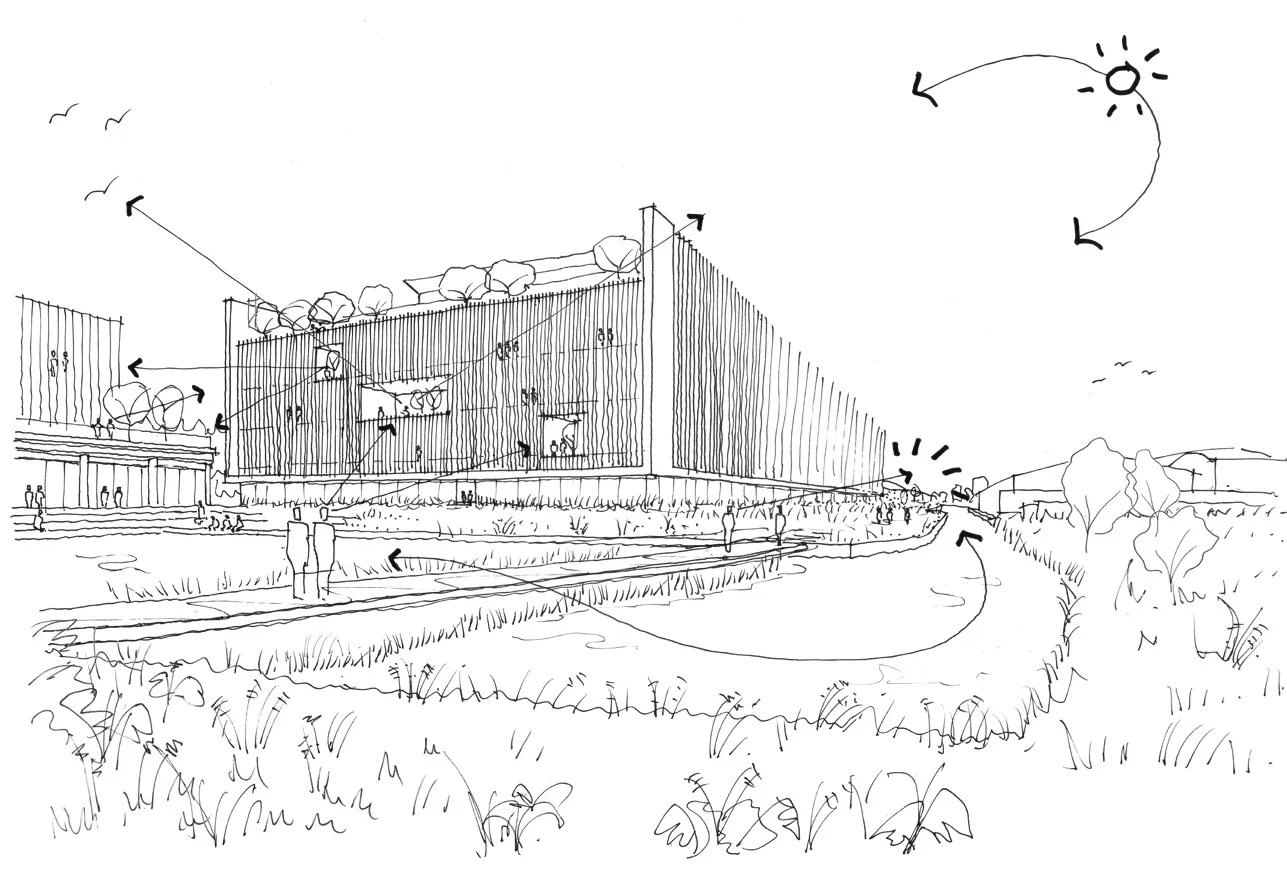
Sketch of Apt’s consented data centre on the Former Honey Monster Food Factory site
Source: Apt
A spokesperson for CyrusOne said it wanted to ‘recognise the depth of engagement that has shaped these plans’, stating: ‘We’ve worked closely with a wide variety of relevant local politicians, community leaders, businesses, residents and community groups.
‘We’ve also held public events to give residents the opportunity to directly understand the data centre development, ask questions and share their feedback. Local input has shaped the scheme, and continued community engagement will remain central to this project as it progresses.’
They added that the planning committee’s vote was ‘another positive milestone in bringing our Southall project to fruition’.
The application was approved just one day before the new Draft London Plan was released, which includes specific guidelines for the construction of data centres.
The ballooning demand for data centre infrastructure has led to a proliferation of the facilities in and near urban environments. According to a parliamentary research briefing published on 3 November last year, almost 100 new data centres are planned for the next five years.