
The X-Ray Imaging and Spectroscopy Mission (XRISM)1 is the successor to the Hitomi X-ray observatory2, which ceased operations prematurely in 2016. The Resolve instrument onboard XRISM is a cryogenically cooled, non-dispersive X-ray microcalorimeter that provides an energy resolution of 4.5 eV full-width at half-maximum, with a gain uncertainty of <0.3 eV at 5.9 keV, equivalent to a velocity resolution of better than <15 km s−1 (ref. 3). The 6 × 6 px2 array of Resolve covers a 3′ × 3′ field of view with a half-power diameter of ~1.3′. These capabilities enable direct measurements of the thermodynamic and dynamic properties of diffuse X-ray-emitting plasma, such as the intracluster medium (ICM) in galaxy clusters, just as Hitomi observed the Perseus cluster4,5.
H1821+643 (z = 0.29708; ref. 6), the nearest galaxy cluster hosting a central quasar7,8, is an ideal target for examining the impact of quasar activity on the surrounding ICM. Hitomi and recent XRISM observations have shown that turbulent motions in the ICM core are generally moderate, namely ≲160 km s−1 in nearby cluster cores without undergoing large mergers, even though they host active galactic nuclei (AGNs) launching relativistic jets4,9,10,11,12,13,14. H1821+643 hosts an extremely powerful AGN classified as a radio-quiet quasar. The AGN has a bolometric luminosity LQSO ≈ (1–2) × 1047 erg s−1 (refs. 7,15), making it 1–5 orders of magnitude more luminous than other quasars (Supplementary Table 1), while hosting only weak FR I-like twin radio jets16. The black hole mass estimated by reverberation mapping is MBH ≈ 2.6 × 10⁹ M⊙ (M⊙ is the solar mass)17. Previous multiwavelength observations have revealed that quasars can drive galactic-scale energetic winds18, but there is almost no evidence for substantial energy injection beyond galactic scales (≳20 kpc)19,20,21,22. To assess the influence of the quasar-mode feedback on cluster-scale environments, we observed H1821+643 with XRISM between 4 and 10 September 2024, obtaining a net exposure of 283.7 ks.
Figure 1 shows the redshift-corrected X-ray spectrum of the Fe XXV Heα emission lines from the ICM in H1821+643 as observed with Resolve and extracted from the full field of view. For comparison, we overlaid the Hitomi spectrum of the Perseus cluster, which hosts a less luminous AGN4. The linewidth is substantially broader than that in the Perseus cluster (Fig. 1). We modelled the observed 4–7-keV spectrum (rest frame 5.2–9.1 keV), which includes Fe XXV Heα, Heβ, Heγ and Fe XXVI Lyα (Methods and Extended Data Fig. 1). The model consists of collisionally ionized plasma emission for the ICM and a power-law emission and a neutral Fe Kα line for the quasar, yielding a line-of-sight velocity dispersion of \({\sigma }_{{\rm{v}}}=29{5}_{-28}^{+34}\;{{\rm{km}}}\;{{\rm{s}}}^{-1}\). Next, we masked the Fe XXV Heα lines in the spectral analysis and refitted the spectrum, thereby obtaining a consistent velocity dispersion of ~300 km s−1 (Extended Data Fig. 2). However, the observed flux of the resonance (w) line was smaller than predicted by the model, indicating potential resonance scattering23,24. To account for the resonance scattering, we included a Gaussian absorption component for the w-line, yielding \({\sigma }_{{\rm{v}}}=28{3}_{-29}^{+26}\;{{\rm{km}}}\;{{\rm{s}}}^{-1}\) and a temperature \(kT=6.{2}_{-0.4}^{+0.3}\;{{\rm{keV}}}\). In summary, even after accounting for systematic uncertainties, the observed velocity dispersion (~300 km s−1) is substantially higher than that observed in nearby cluster cores hosting less luminous AGNs observed with XRISM and Hitomi (≲160 km s−1; Methods), including the Perseus cluster (~164 km s−1; ref. 4 and Fig. 1).
Fig. 1: Fe XXV Heα spectrum from the ICM in H1821+643.
XRISM/Resolve spectrum (black) and the best-fitting model (red) are shown in the rest frame of the source (zICM = 0.2973). For comparison, the Hitomi spectrum of the Perseus cluster core (zICM = 0.017284) is shown in purple, normalized to match the continuum level and peak line intensity of H1821+643. Uncertainties correspond to 1σ. The resonance (w) line (marked by a short red line) in H1821+643 has a broader profile than that of Perseus (σv ≈ 164 km s−1), indicating substantially stronger ICM turbulence and velocity shear.
The observed redshift of the ICM is zICM = 0.2973 ± 0.0002, consistent with that of the host galaxy, indicating only a modest line-of-sight bulk velocity. The systemic redshift of the host galaxy, measured by the Hubble Space Telescope using ultraviolet absorption lines (such as Lyα, Lyβ and C IV), is zabs = 0.29708 ± 0.00003 (ref. 6), consistent with that measured by optical emission lines of narrow components of the Balmer and forbidden lines (such as [O III] lines from the quasar narrow-line region), zemi = 0.2972 ± 0.0002 (ref. 17). Thus, the line-of-sight bulk velocity was measured to be vbulk = 51 ± 46 km s−1 relative to the host galaxy. This is comparable with or smaller than the bulk velocities measured for other nearby non-merging clusters (vbulk ≲ 300 km s−1; Cygnus A25, Perseus4,26, Abell 20299,10, Hydra A11, Virgo12, Ophiuchus13 and the Centaurus cluster14).
To determine the spatial origin of the highly ionized Fe lines, we extracted XRISM spectra from the core region of the central 2 × 2 px2 (or 1′ × 1′) and the outer region of the other pixels. These regions are overlaid on the Chandra rest-frame 5.8–7.8-keV image of H1821+643 (Fig. 2a). The spectra from the two regions are almost identical and both contain the neutral Fe Kα fluorescent line from the cold gas around the quasar (Fig. 2b). This similarity arises from photon leakage due to the moderate angular resolution (half-power ~1.3′), as characterized by the point spread function. This leakage especially contaminates the outer region due to emission from the bright core, including the quasar. To measure the emission from the ICM, we simultaneously fitted these two spectra with the core (quasar plus ICM) and outer (ICM) components by taking into account the appropriate weights, using what is known as a spatial–spectral mixing analysis27. As shown in Fig. 2c, the broad emission lines (Fe XXV Heα and Fe XXVI Lyα) originate primarily from the ICM in the core region around the quasar, corresponding to projected spatial scales of ≲130 kpc with a velocity dispersion \({\sigma }_{{\rm{v}}}=28{1}_{-29}^{+26}\;{{\rm{km}}}\;{{\rm{s}}}^{-1}\) and a temperature \(kT=6.{0}_{-0.3}^{+0.4}\;{{\rm{keV}}}\). Less than 10% of the ICM emission line originated from the outer region, for which we fixed σv to that of the core because of limited statistics and found \(kT=8.{2}_{-1.6}^{+2.8}\;{{\rm{keV}}}\) (Methods).
Fig. 2: Spatial distribution and spectral decomposition of Fe line emission.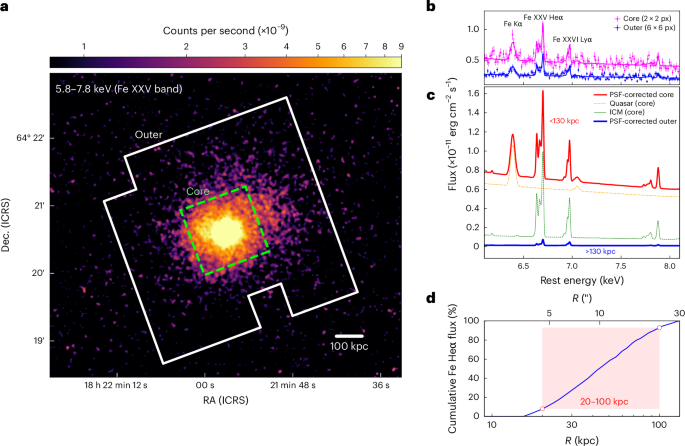
a, Background-subtracted Chandra image in the 4.5–6.0-keV band (rest frame 5.8–7.8 keV) highlighting Fe XXV Heα emission. The green dashed square and white solid line show the central 2 × 2 px2 and outer pixels of the Resolve detectors. b, Resolve spectra from the core (magenta) and outer (blue) regions with 1σ uncertainties. Solid curves mark the best-fitting models. c, Red and blue curves show the models corrected with the point spread function from the core and outer emission, respectively. The dashed orange and green curves represent the quasar and ICM components in the core. d, Cumulative plot of the Fe XXV Heα line flux as a function of projected radius. The fraction in the 20–100-kpc region is highlighted in red. Dec., declination; ICRS, International Celestial Reference System; PSF, point spread function; RA, right ascension.
To better constrain the effective spatial scale of the bright core region, we referred to a previous Chandra study28 (Methods). Using the ICM flux, temperature and metallicity, we estimated the flux of the highly ionized Fe lines. Based on the spatial distributions of these parameters from the literature28, we calculated the line fluxes at different radii and constructed a cumulative profile of the Fe XXV Heα flux in the core region (Fig. 2d). Over 90% of the Fe XXV Heα flux originated from the 20–100-kpc region. The line flux from the innermost ≲4″ (≲18 kpc) region is negligible, consistent with the nuclear Chandra spectrum without Fe XXV and Fe XXVI lines (Extended Data Fig. 3). This rules out substantial contamination from photoionized lines near the quasar. These results demonstrate that, within the core region, nearly all of the lines originated from the 20–100-kpc region.
If the large velocity dispersion in H1821+643 arises from turbulence or radial flows, the non-thermal-to-thermal energy ratio \({f}_{{\rm{nth}}}=8.{4}_{-1.8}^{+1.6} \%\), which is mostly within the 20–100-kpc region (Methods). This value is higher than the fractions observed within comparable scales (≲100 kpc) in other clusters observed by XRISM and Hitomi, where fnth ≈ 1–5% in clusters with lower AGN luminosities (Supplementary Figs. 1 and 2).
Figure 3 compares fnth with the intrinsic, absorption-corrected 2–10-keV X-ray luminosity of AGNs (LAGN,X). The figure indicates that fnth increases with AGN luminosity. Notably, Cygnus A is radio-loud25, whereas H1821+643 (LAGN,X ≈ 4.2 × 1045 erg s−1) is radio-quiet yet shows the highest fnth, which indicates that powerful quasars can drive large velocity dispersions regardless of the presence of jets. Although it is difficult to distinguish whether the velocity dispersion arises from turbulence or velocity shear—including motions such as sloshing or radial winds—the ICM motions in this quasar–host system are exceptionally vigorous.
Fig. 3: Non-thermal energy fraction within ≲100 kpc versus AGN luminosity.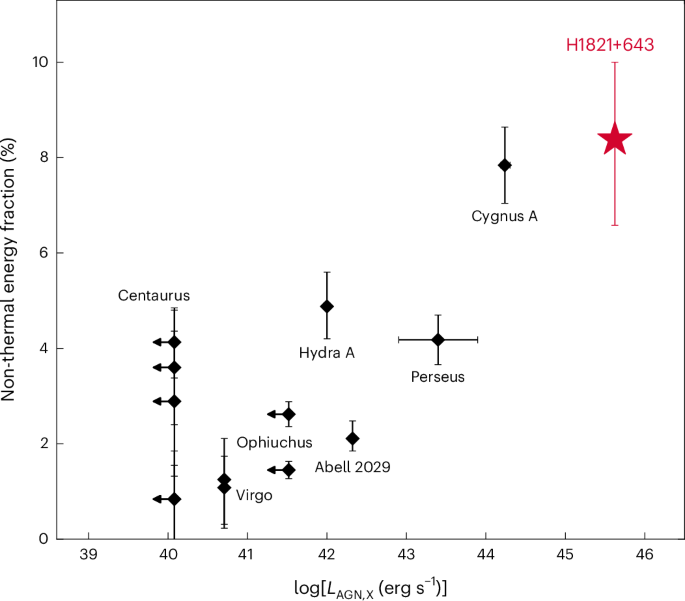
The non-thermal-to-thermal energy fraction fnth, measured within ≲100 kpc of the hot ICM (>2 keV), is plotted against the 2–10-keV AGN luminosity for clusters observed by XRISM and Hitomi. The red star marks H1821+643. Black diamonds denote other clusters. Error bars indicate 1σ uncertainties, and arrows denote 3σ upper limits. H1821+643, despite hosting a radio-quiet quasar, exhibits the most vigorous gas motions (turbulence and velocity shear) and the brightest X-ray AGN.
H1821+643 hosts a giant radio halo extending over ~1.1 Mpc (ref. 29). However, particle acceleration through violent mergers is probably not the origin of the halo because the cool core has survived. We note that relaxed cool-core clusters, such as Perseus and Abell 2029, also host large radio haloes30,31. This indicates that even minor mergers can create haloes29. The extended halo in H1821+643 may have originated from minor mergers unrelated to the central ICM motions.
In the core region, Chandra images of H1821+643 reveal a cold front and some asymmetries, potentially indicating sloshing in the ICM7,28. Current observations do not allow a definitive assessment of its contribution to the measured linewidth. If sloshing were occurring, it could contribute to broadening, but the total velocity range implied by the observed ~300 km s−1 dispersion would require several components spanning Δvbulk ≈ 600 km s−1 (Methods). For comparison, in the Centaurus cluster, the line-of-sight bulk velocities range from −130 km s−1 to −310 km s−1, corresponding to Δvbulk ≈ 180 km s−1 (ref. 14). Given the near-zero net bulk velocity and the extraordinarily large velocity range in H1821+643, such a highly symmetric configuration appears unlikely.
A plausible driver of non-thermal energy injection is powerful quasar-driven winds. As these winds expand, they can drive a forward shock that propagates supersonically through the surrounding ICM with a temperature of ~6 keV (its speed of sound is 1,260 km s−1), hereafter referred to as the ‘quasar-driven shock’ (Fig. 4). Because of the high temperature, the shock will probably weaken rapidly. If the shock front has propagated beyond ≳100 kpc, its low surface brightness would make it difficult to detect, as predicted by mock Chandra simulations of weak shocks with typical Mach numbers of the order of ~1.1 (ref. 32). This is consistent with the absence of obvious shock features in deep Chandra imaging of H1821+64328. Instead, the vigorous gas motions expected to be generated behind the shock may leave observable imprints, as indicated by our XRISM measurements. The measured linewidth does not trace the shock speed itself, but the velocity dispersion of the post-shock gas, which is expected to be substantially smaller for such weak shocks. Within 20–100 kpc, the ICM mass is estimated as MICM ≈ 1.6 × 10¹² M⊙, based on the volume-weighted electron density (\({\sigma }_{{\rm{v}}}=28{1}_{-29}^{+26}\;{{\rm{cm}}}^{-3}\)) measured with Chandra28 (Methods). The corresponding non-thermal energy, for \({\sigma }_{{\rm{v}}}=28{1}_{-29}^{+26}\;{{\rm{km}}}\;{{\rm{s}}}^{-1}\), is \({E}_{{\rm{nth}}}=(3/2){M}_{{\rm{ICM}}}{\sigma }_{{\rm{v}}}^{2}\simeq 4\times 1{0}^{60}\;{{\rm{erg}}}\), an order of magnitude above the mechanical energy from X-ray cavities attributed to jets (3 × 1059 erg)28.
Fig. 4: Schematic of energy injection into the ICM beyond galactic scales via quasar-mode feedback.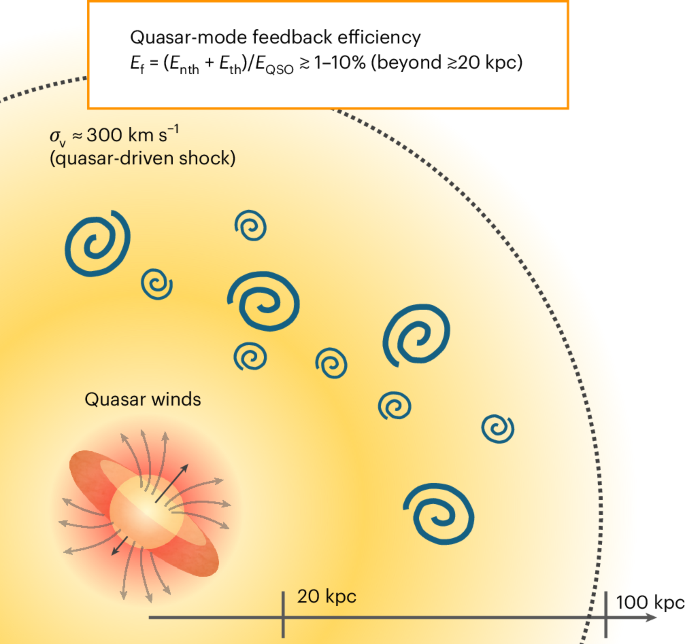
On galaxy scales (<20 kpc), the luminous quasar (yellow sphere) inflates a hot gas region (red sphere), thereby launching energetic winds (grey arrows) along the polar axis (black arrows) perpendicular to the accreting gas ring. At cluster core scales of 20–100 kpc, the winds expand and drive a forward shock wave that propagates supersonically through the surrounding ICM (dashed circle). The quasar-driven shock amplifies the turbulence and velocity shear (spiral curves), thereby producing velocity dispersions of ~280 km s−1 (or ~300 km s−1 if resonance scattering is negligible). The resulting large velocity dispersion and thermal structure of the ICM (large yellow sphere) carry the imprint of quasar energy injection and provide strong constraints on the efficiency of quasar-mode feedback.
Owing to the high temperature of the ICM, the shock is expected to be weak. In this scenario, the required shock expansion energy injected by the quasar is approximately the product of the surrounding ICM pressure and the volume inside the shock33. This energy is comparable with the thermal energy of the ICM within the shock. Assuming that the shock radius is ~100 kpc, which is comparable with the cooling radius (Supplementary Table 1), the enclosed thermal energy Eth ≈ 4 × 1061 erg. For comparison, we define the total energy potentially injected by the quasar as EQSO ≲ ηMBHc2 ≈ 4 × 1062 erg, corresponding to the maximum energy available from the central supermassive black hole with radiative efficiency η ≈ 0.1 and c being the speed of light, which indicates that the black hole could, in principle, supply the energy required to drive the observed turbulence and velocity shear. Comparing these values implies that the quasar-mode feedback in H1821+643 operates with an efficiency ϵf = (Enth + Eth)/EQSO ≳ 10% beyond galactic scales (≳20 kpc). However, this estimate strongly depends on the assumed shock radius. Alternatively, considering only the non-thermal energy supplied by the current quasar activity provides a conservative lower limit on the feedback efficiency, ϵf ≳ Enth/EQSO ≳ 1%. This level of coupling, ϵf ≳ 1–10%, is far higher than previous estimates of ≲0.01% from similar-scale ionized winds in other quasars20,21 but consistent with the energy requirements of recent cosmological hydrodynamical simulations34,35,36. Taken together, these observations provide compelling evidence that quasar-mode feedback can substantially influence the surrounding ICM over 20–100-kpc scales.
From a theoretical perspective, state-of-the-art cosmological simulations adopt feedback efficiencies of comparable magnitudes. For example, the COLIBRE simulation36 uses thermal coupling efficiencies ϵf ≈ 5–10% in its fiducial model and somewhat lower values (ϵth ≈ 2–3%) supplemented by comparable kinetic jet power in its hybrid implementation35. The IllustrisTNG simulations similarly show that quasar-mode (thermal) feedback dominates at high accretion rates and redshift, whereas jet-mode (kinetic) feedback governs the heating and stirring of the ICM in cluster cores at low redshift. Our inferred feedback efficiency of ≳1–10% lies within the ranges assumed in these models. However, we note that feedback efficiencies in cosmological simulations are defined at the subgrid injection level and depend on the assumed coupling scale and timescale and are, therefore, not strictly identical to our cumulative, radius-integrated estimate. Thus, the comparison is qualitative in terms of overall energetics and indicates broad consistency with feedback prescriptions used in large-scale simulations, at the level of order ϵf ≳ 1–10%.
Notably, these results were obtained in the regime of sub-Eddington accretion, with an Eddington ratio (λEdd ~ 0.3–0.6), and subsonic turbulence (Mach number ~0.4), consistent with the ‘gentle’ feedback mode expected in cool-core clusters. Radio observations reveal that H1821+643 hosts a low-power FR I-like jet16, with mechanical energy from X-ray cavities estimated at 3 × 1059 erg, well below the jet powers predicted in the COLIBRE hybrid model35 and on the lower side of injected powers seen in TNG-Cluster cavity populations37. This discrepancy underscores a key tension: simulations tend to predict jet-mode dominance in massive haloes at low redshift, yet H1821+643 seems to be governed by quasar-mode feedback, with radiative winds and bubble expansion probably driving the observed turbulence and velocity shear. The presence of such a luminous, radiatively efficient supermassive black hole at the centre of a massive cluster at z ≈ 0.3 is, therefore, highly unusual and offers a rare opportunity in the local Universe to directly study how quasar-mode feedback couples to the ICM. H1821+643 can, thus, be viewed as a nearby analogue of the powerful high-redshift quasars thought to regulate galaxy growth, preheat protoclusters and enrich the intergalactic medium.