gutai begins with a body in motion
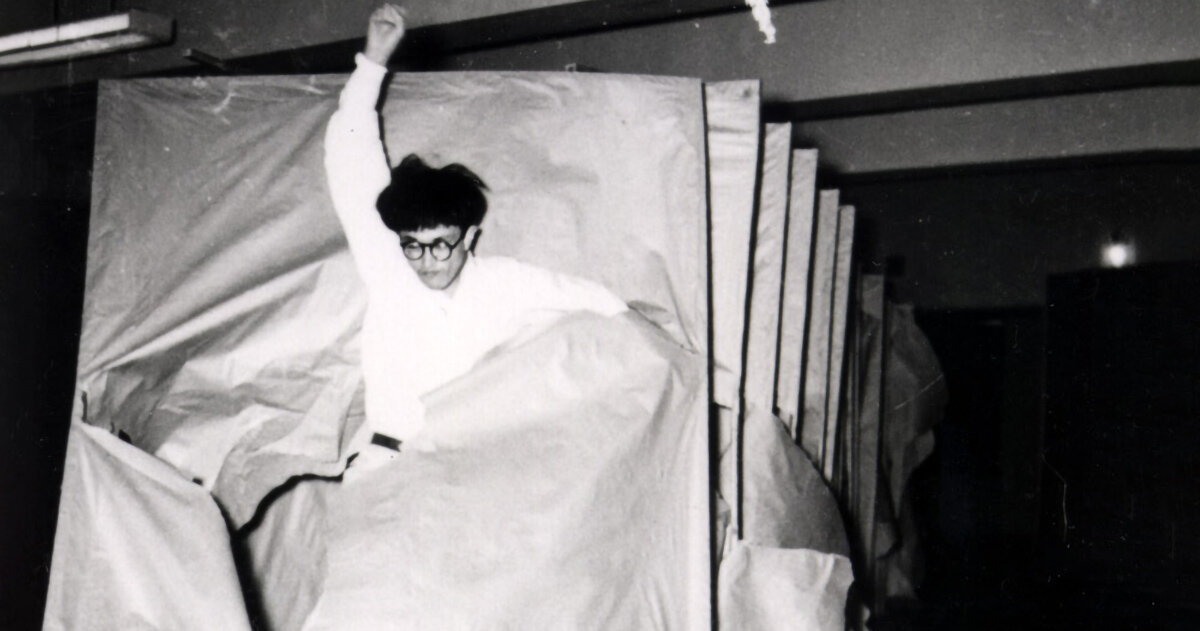
In a series of grainy photographs from 1956, Saburō Murakami drives his fists and shoulders through a row of paper screens. The sheets split around him, their clean surfaces turning into jagged openings within seconds. His passage leaves behind a painting made through force and contact. The image feels immediate even now because the action is so easy to understand. A body meets an obstacle, which then gives way and leaves art to appear among the torn edges.
Gutai is a Japanese avant-garde group founded in 1954 by Jirō Yoshihara. Its name can be translated as concreteness or embodiment, which is a clue to the artists’ interest in direct encounters with the physical world. They poured paint from cans, suspended colored water between trees, wired bells across galleries, and invited visitors to draw on their work. Each experiment changed the basic terms of artmaking. A painting could become an event, or an exhibition could behave like a playground.
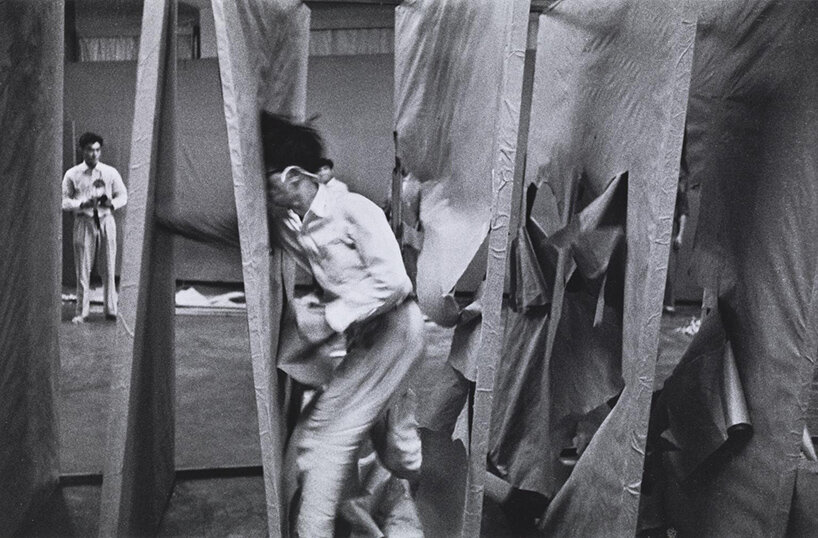
Murakami Saburo, Passing Through, 2nd Gutai Art exhibition 1956, printed 2012, Kiyoji Otsuji | image courtesy Tate Modern
a movement formed after the war
Gutai began in Ashiya, near Osaka, in 1954, as Japan rebuilt after its defeat in World War II. The movement emerged within a society reckoning with the destruction of the war, the collapse of its imperial project, and years of authoritarian rule that had restricted artistic expression at home. Yoshihara gathered a younger generation around a direct instruction: ‘Do what has never been done before.‘ It felt like a dare. It also gave the group a method. Every work had to find its own way forward.
The idea of ‘play’ carried more weight within that context. Gutai treated experimentation as a way to exercise independent thought after a period shaped by militarism and enforced conformity. Members taught art, contributed to a children’s poetry magazine Kirin, and developed projects that encouraged young people to make images without inherited ideas of beauty pressing in. Creative freedom became something that could be practiced with the hands.
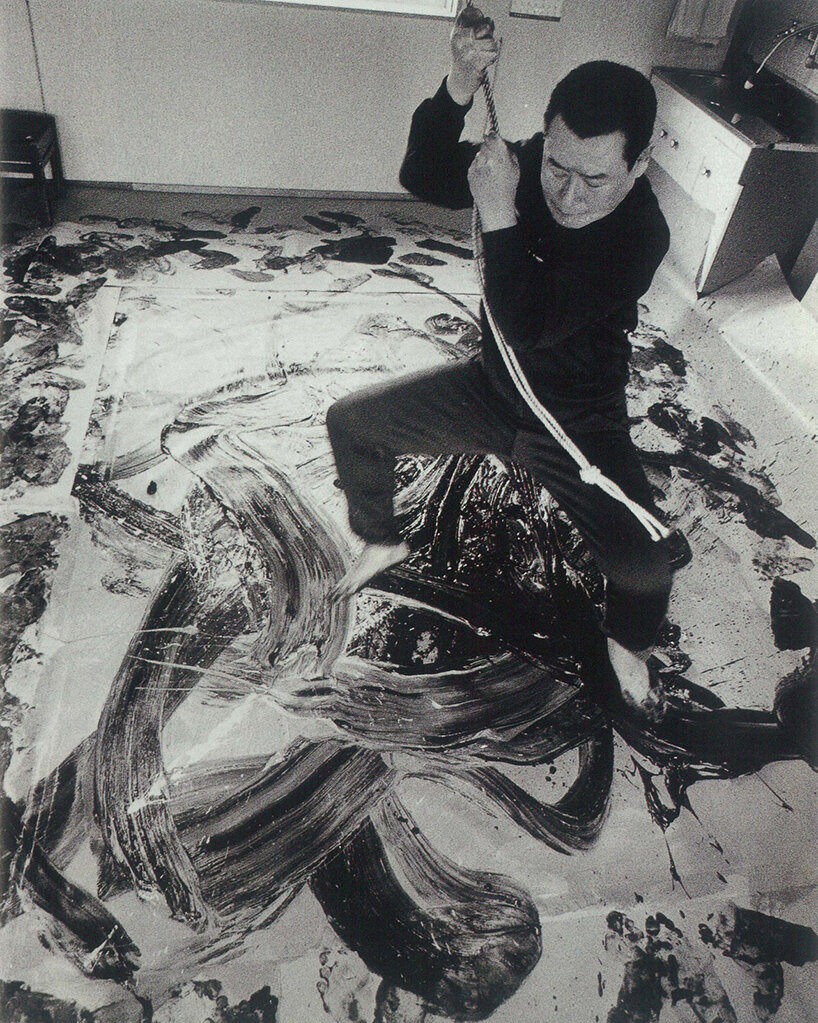
Foot, Kazuo Shiraga | image courtesy Whitestone Gallery
painting leaves the easel
Artist Kazuo Shiraga pushed that freedom through his whole body. For Challenging Mud in 1955, he entered a mound of wet clay and fought against its weight, dragging and pressing the substance as it resisted him. He later hung from a rope above canvases spread across the floor, using his bare feet to pull paint into broad arcs. Balance shaped each mark as a slip or sudden change of direction became an artifact on the finished surface.
Other Gutai artists built their own systems for giving up portions of control. Shōzō Shimamoto smashed bottles filled with paint and fired pigment from a handmade cannon. Yasuo Sumi worked with an abacus and a vibrating device. Akira Kanayama sent an automatic toy car across the surface. These methods introduced impact and mechanical motion, with chance shaping the marks that followed. The artist initiated an action and then worked with its consequences.
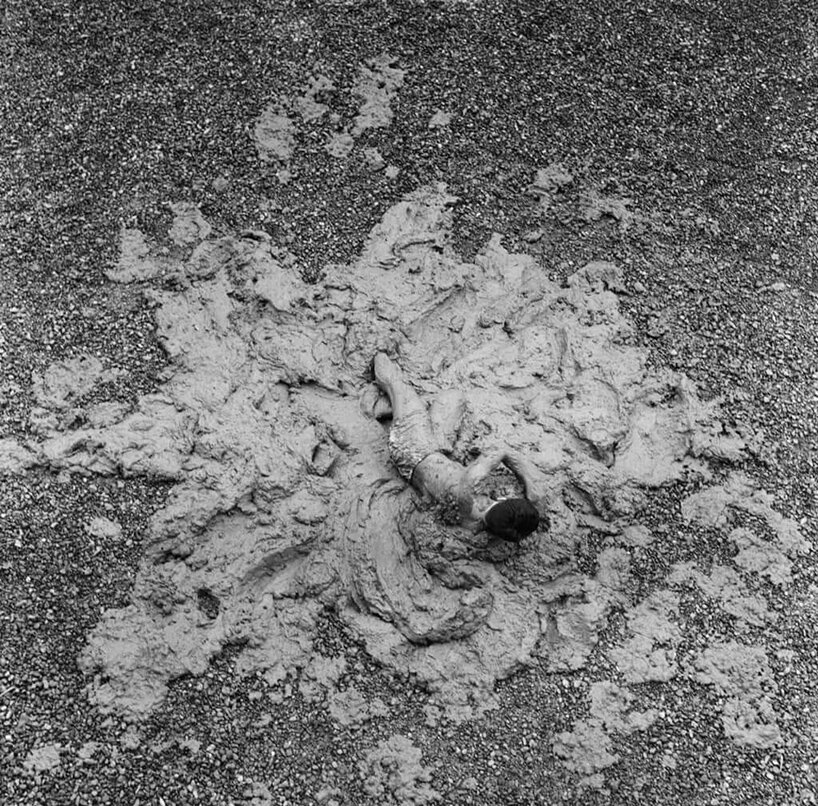
Shiraga Kazuo, Challenging Mud (Doro ni idomu), 1955 (2nd execution) © Shiraga Fujiko and Hisao and the former members of the Gutai Art Association
materials make their own moves
The group’s 1956 manifesto described the human spirit and physical material as meeting while ‘keeping their distance.’ Yoshihara wanted artists to work with the character of a medium instead of forcing it to imitate something else. Paper could tear, mud could drag against skin, and paint could splash outside the lines.
Sadamasa Motonaga’s Work (Water) brought that thinking into Ashiya Park during the 1956 Outdoor Gutai Art Exhibition. Long transparent tubes filled with tinted water hung between pine trees, forming loose curves above the ground. Sunlight passed through the liquid as air shifted the suspended forms. The installation changed with its surroundings, turning color and gravity into active parts of the composition.
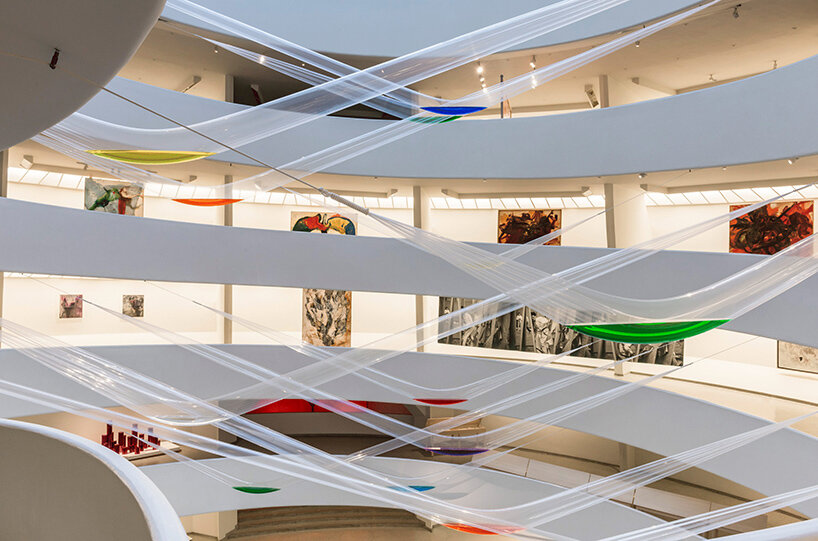
installation view: Gutai: Splendid Playground, Solomon R. Guggenheim Museum, New York, February 15th — May 8th, 2013 | image © David Heald
the audience enters the work
Jirō Yoshihara’s Please Draw Freely made the invitation explicit. A broad wooden panel stood in the park with markers available for anyone who approached. Children and adults added their own lines until the surface became a shared drawing, built from overlapping decisions. The artist supplied the space and the prompt. Visitors supplied the image.
Atsuko Tanaka explored another form of participation through Work (Bell), an installation of electric alarm bells connected across a gallery. A viewer activated the first bell, beginning a sequence of sound that moved through the room. Her Electric Dress placed the body inside a dense network of painted bulbs and exposed wiring to turn light into a wearable, flickering circuit.
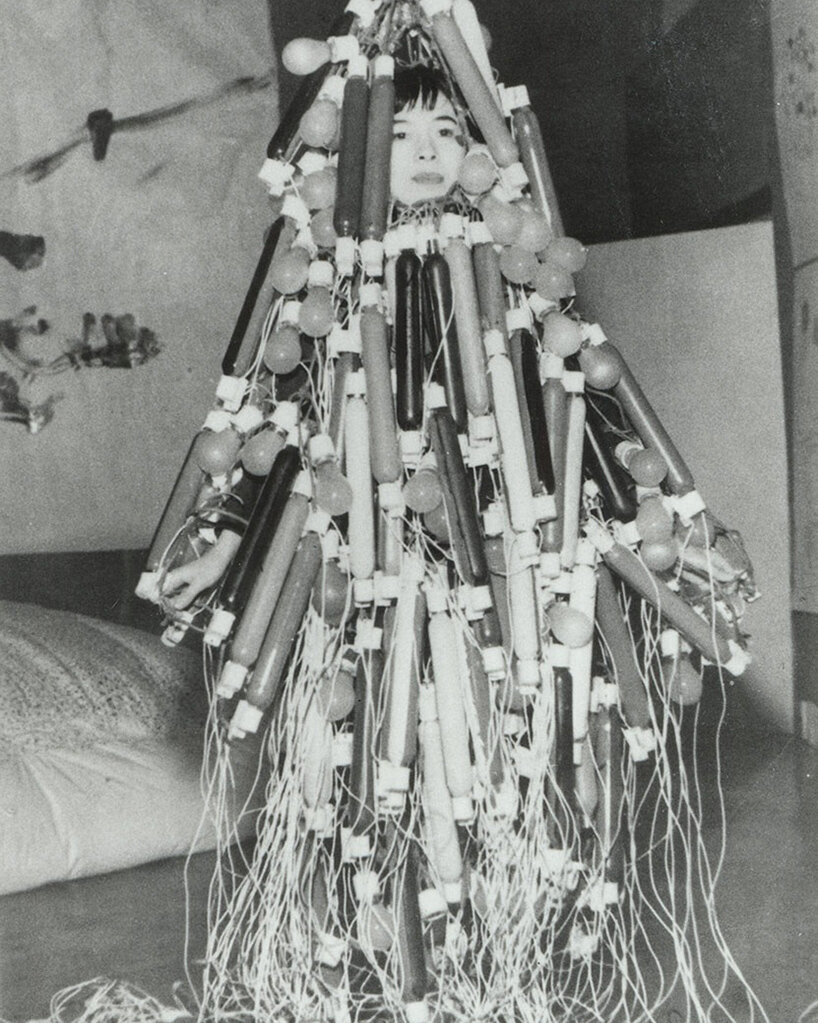
Tanaka Atsuko wearing Electric Dress (1956) at 2nd Gutai Art Exhibition, Ohara Kaikan, Tokyo, ca. October 1956. Photo: Ōtsuji Seiko Collection, Musashino Art University Museum & Library, Tokyo. © Itō Ryōji and the former members of the Gutai Art Association, courtesy Solomon R. Guggenheim Museum
play as a practice of freedom
Seen through photographs, Gutai can resemble a chain of wild gestures: a man in mud and another bursting through paper, followed by a woman surrounded by live electrical wiring. The group’s deeper logic sits inside the rules each artist invented. Their games required commitment. Once the action began, the artist had to work with resistance, speed, accident, and the presence of other people. Freedom appeared through contact with limits.
That approach keeps Gutai vivid decades later. The group expanded painting by letting bodies enter it and materials answer back, while spaces loosened and audiences altered what they encountered. Returning to Murakami’s torn screens, the opening is both damage and invitation. He passes through, leaving space for the next person to imagine another move. For Gutai, play began where familiar behavior ended and a new possibility became physical.