
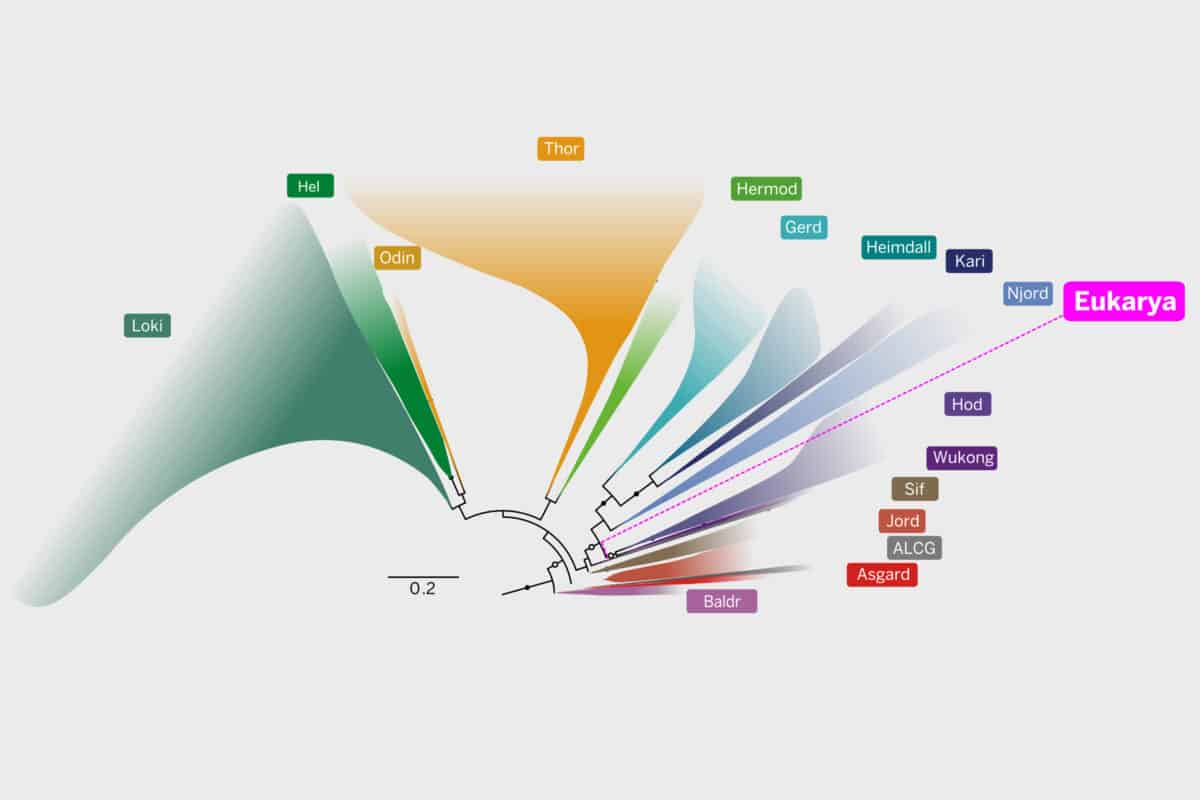
 Credit: The University of Texas at Austin.
In Norse mythology, Asgard is one of the Nine Worlds, that is inhabited by the Aesir gods, goddesses, and all sorts of mythical creatures. But according to exciting new research, dogs, eagles, starfish, worms, daisies, humans, and virtually all complex life forms are, in a sense, Asgardians. Move over, Thor!
Led by Thijs Ettema of Wageningen University in the Netherlands, the researchers analyzed the genomes of hundreds of archaea microbes. By winding back the molecular clock, the researchers found that all eukaryotes — meaning any organism with a clearly defined nucleus, including all mammals, birds, plants, and so on — can trace their lineage to a common Asgard archaean ancestor.
Update: Since this article was first published in 2023, much larger genomic studies have strengthened the connection between eukaryotes and Asgard archaea while reopening the question of exactly where our branch fits inside the Asgard family tree.
We are all Asgardians
Asgard archaea, also known as Asgard superphylum, are a diverse group of microorganisms whose discovery transformed ideas about the origin of eukaryotic cells. Their importance comes from genetics: among known prokaryotes, they carry some of the clearest evolutionary links to the archaeal lineage from which eukaryotes emerged.
In 2010, researchers analyzed sediment samples from a gravity core extracted in the Arctic Ocean’s Knipovich ridge, close to the Loki’s Castle hydrothermal vent site. Certain sediment layers, previously identified for their high abundance of novel archaeal lineages, underwent metagenomic analysis.
In 2015, researchers at Uppsala University performed metagenome analysis on sediment layers, discovering new phylum known as Lokiarchaeota. The phylum was named after the shape-shifting Norse god Loki, alluding to the hydrothermal vent complex where the initial genome sample originated.
In 2016, researchers from the University of Texas discovered another group of archaea called Thorarchaeota, derived from samples obtained from North Carolina’s White Oak River. This naming convention was inspired by the Norse god Thor.
Subsequent sampling efforts in various locations, such as Loki’s Castle, Yellowstone National Park, Aarhus Bay, the Colorado River aquifer, New Zealand’s Radiata Pool, and hydrothermal vents near Taketomi Island in Japan, revealed the existence of additional groups named Odinarchaeota (after Odin) and Heimdallarchaeota (after Heimdallr).
×
Thank you! One more thing…
Please check your inbox and confirm your subscription.
To encompass these diverse microbial groups, scientists coined the term “Asgard” for the superphylum.
Decoding ancient genomes
 Credit: The University of Texas at Austin.
Scientists have encountered these enigmatic organisms in deep-sea sediment and hot springs across the globe, but only a handful of Asgard strains have been brought into laboratory cultures. Cultivation remains extraordinarily difficult because many grow slowly and depend metabolically on partner microorganisms.
Nevertheless, a handful of researchers believe it’s still worth working with these stubborn microbes.
The early fossil record of eukaryotes is sparse and difficult to interpret, but the case for Asgard ancestry doesn’t rest on fossils alone. It comes mainly from phylogenetic comparisons of conserved genes, together with comparisons of metabolism and cellular machinery.
To gain insight into their genetic blueprints, Thijs’s team extracted genetic material from the environment and meticulously assembled their genomes. This data was then compared and contrasted with genomic data from similar microbes that can be grown without difficulty in the lab.
This way, they could infer the metabolism and other features of the Asgards. It’s a lot like a time machine that scientists can use to reconstruct the past of some of the earliest life forms ever.
Within the vast realm of Asgard archaea, scientists have uncovered the closest microbial relative to all complex life forms — a newly described order called the Hodarchaeales, or Hods for short.
The picture became less tidy in May 2025. With much broader sampling, Jiawei Zhang and colleagues instead found eukaryotes branching beside Heimdallarchaeia as a whole. They also reconstructed the common Asgard–eukaryote ancestor as an anaerobic, hydrogen-dependent acetogen that probably lived before the Great Oxidation Event over 2 billion years ago. So it’s not merely another Norse name on the tree; it changes where scientists place the ancestral branch and what kind of metabolism they think it had.
We’re all Asgardians
The disagreement is still open. In February 2026, the authors of the original 2023 study published a correction after discovering that three markers in an important 57-protein dataset were partially redundant. They removed the offending markers and reran the analysis. Their corrected 54-marker dataset still supported the original Hodarchaeales–eukaryote grouping under their preferred methods, although with some changes in statistical support.
And another large 2026 analysis of eukaryotic genes found a dominant Asgard contribution across numerous functional systems.
So we’re all Asgardians, but with an asterisk. The Asgard connection has grown stronger since 2023, but evolution has declined to provide us with a tidy Norse genealogy. Either way, the road to dogs, daisies and humans still runs remarkably close to Asgard.
The findings of the original study appeared in the journal Nature.
This article was originally published in 2023 and has been updated to reflect a correction by the authors and additional information.