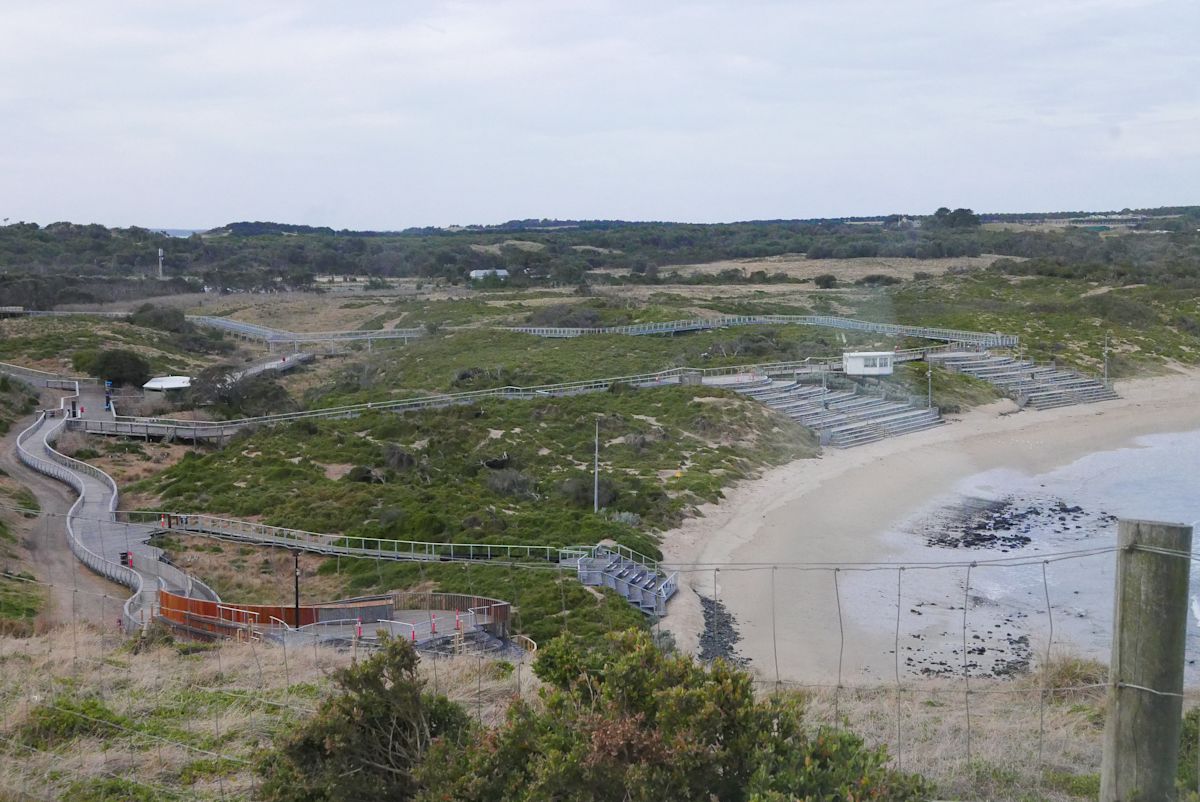
Upwards of 700,000 people watch Phillip Island’s famous little penguin parade each year, but the attraction’s future is facing uncertainty due to the spread of deadly H5 bird flu.
On August 12, the Victorian state government announced plans to vaccinate up to 5,000 little penguins.
Sadly, by August 15, one Phillip Island penguin had already been confirmed dead from the virus.
There are fears it could be too late to prevent mass mortalities. The program will begin on August 17, and the method requires two shots three to four weeks apart to be effective, with 10 weeks to reach peak antibody levels.
Report warned up to 16,000 penguins could die
A 2025 report by the state environment department’s (DEECA) research arm, the Arthur Rylah Institute, estimated mortalities could be between 20 and 40 per cent, or around 8,000 to 16,000 penguins across the Summerland Peninsula on the western tip of Phillip Island.
The report Assessing the risks of endemic and exotic diseases to Victorian terrestrial wildlife concluded, “To ensure that adequate coverage is achieved, any vaccination program would need to be administered prior to the arrival of H5N1”.
“Modelling revealed that waiting until the arrival and discovery of H5N1 to start administering vaccinations would most likely be too late, because significant mortality is likely to occur before adequate vaccine coverage is achieved,” the report continued.

Up to 16,000 little penguins could die on Phillip Island’s Summerland Peninsula.
(Getty)New Zealand began vaccinations before H5 arrival
H5 was confirmed to have arrived in Australia on June 19 this year.
This prompted New Zealand to begin vaccinating its birds on July 6, even though the virus did not reach its shores until July 15.
Australia’s federal agriculture department (DAFF) confirmed the vaccines were delivered to Victoria for its little penguins on August 10.
“Once the Australian government received a request for release of bird flu vaccines from the Government of Victoria, we provided immediate authorisation of a shipment,” a DAFF spokesperson told Yahoo News.
Penguins, raptors, owls included in vaccine trial
Both countries had conducted trials and pilot studies of bird flu vaccinations on native species.
“As part of strengthening Australia’s preparedness for H5 bird flu, scientists have undertaken trials of bird flu vaccines in various Australian captive wild bird species,” a DAFF spokesperson said.
“This has been backed by $2 million of investment by the Australian government.
“States and territories are responsible for identifying which native bird species to prioritise for vaccine rollouts in their jurisdiction.”

At night, thousands of penguins exit the ocean and return to their burrows.
(Getty)
Locally, between 2025 and 2026, the CSIRO Australian Centre for Disease Preparedness was commissioned to generate safety data and determine appropriate dose rates for small native bird species.
Tests were conducted on a small number of birds representing a range of non-poultry bird groups, including penguins, ratites, raptors, owls, shorebirds, parrots and cockatoos, passerines, ducks and other waterbirds.
“Results to date have been encouraging and have informed regulatory assessments and emergency use arrangements for the vaccine,” a DAFF spokesperson said.
Victoria makes little penguin protection a ‘priority’
Overseas, H5 has resulted in the deaths of tens of millions of birds and mammals, with waterbirds, seabirds, sea lions, and seals among the worst affected.
Decisions about which birds to vaccinate are made by the states, based on the likelihood and potential consequences of H5 exposure, and whether it can be delivered safely and effectively.
Victoria’s environment department (DEECA) is understood to have selected little penguins at Phillip Island and St Kilda, because they can be easily identified and managed for repeat doses in the wild, as they return to the same nesting sites each evening.
RELATED:
Tests conducted in Victoria showed no long-term adverse impacts from the vaccine and encouraging immune responses.
“We understand this detection will be concerning for the many Victorians who care deeply about our wildlife,” a DEECA spokesperson said.
“Little penguins are an iconic Victorian species, and protecting these colonies is a priority.”
Overseas, vaccinations for wild birds have not been widely used, and Australia believes its program is likely the world’s largest.
However, vaccines have not been developed for marsupials, and all doses for birds need to be imported from overseas.
Urgent call for more H5 funding as birds die
Vaccinations are just one small part of Australia’s response to the virus.
To date, the federal government has allocated $47 million to mitigate its environmental impact.
But the majority of that funding was allocated in October 2024, and so the impacts of that spend are largely unknown.
Conservation groups, including the Biodiversity Council and Invasive Species Council, have called on environment minister Murray Watt and agriculture minister Julie Collins to immediately boost investment in wildlife protection by $200 million.
You can also follow us on Facebook, Instagram, TikTok, X and YouTube.