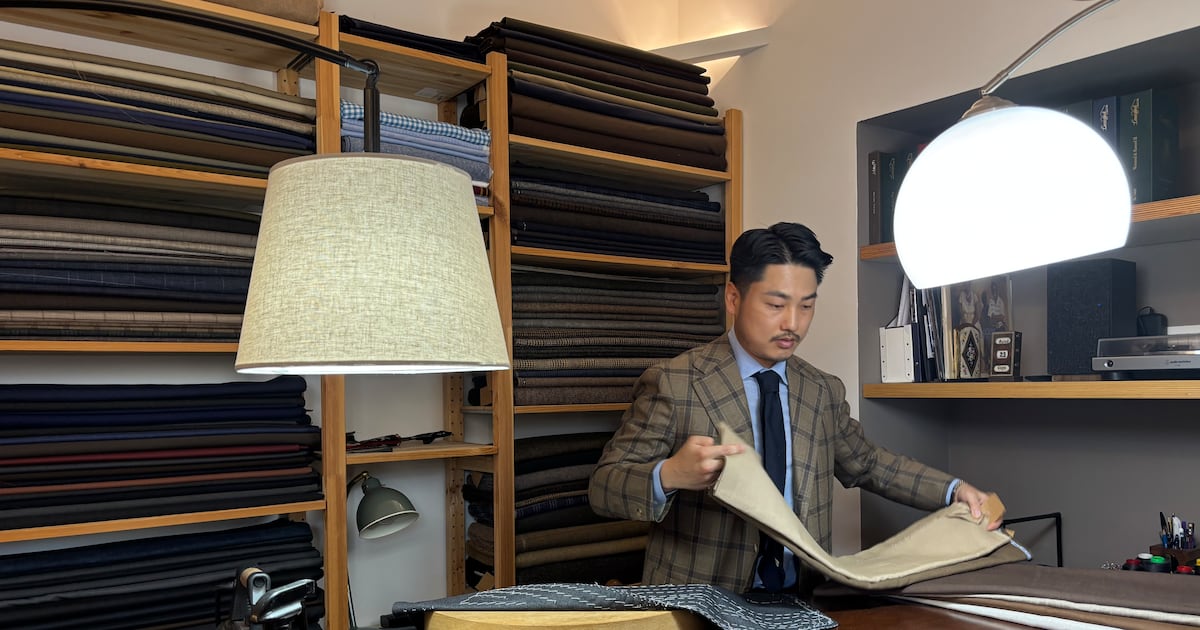
Sunghyun Yoo’s journey from South Korea to becoming one of the only outsiders ever to become a master tailor of Naples began the day he first saw a Neapolitan tailored jacket.
Fascinated with dress from an early age in his native city of Gyeongju, Yoo had long been making his own clothes when he couldn’t find what he wanted to wear.
He had spent eight years working as a fashion designer in Seoul but felt restless, unsatisfied with the lack of “craft” in the system, in which designers would draw patterns and manufacturers would create the clothes mechanically elsewhere.
[ A touch of Savile Row opens up on Dublin’s Pearse StreetOpens in new window ]
Then he happened upon the jacket: a hand-sewn piece of Neapolitan tailoring that a South Korean traveller had brought back home from Italy. It changed everything for Yoo.
“It was soft – in the sleeves too, in the shoulder,” Yoo recalls, in the small tailoring house in the old town of Naples, Sartoria del Signore, where he now makes suits by hand as an officially recognised Italian artisan.
The jacket had the classic “spalla camicia” or shirt shoulder, the slightly rippling seam where the upper sleeve meets the shoulder that is a traditional feature of classic Neapolitan tailoring and makes the suit move with the body rather than bunching up.
Yoo’s decision was immediate.
“We had been married a year, and he told me: ‘I want to go to Italy. To Naples. No other city. If that’s where this came from, I want to go there’,” remembers Minjae Song, his assistant and partner.
Friends were baffled. “He had never even been to Italy,” says Song. Back then, she was working as a graphic designer in a Seoul publishing house. “I’m a bit of a strange wife,” she says. “I saw him as an artist, as a dreamer, and I wanted to support him.”
They both quit their jobs and arrived at Naples airport with four suitcases in November 2017. They threw themselves into Italian lessons and began working up a letter to introduce Yoo to the master tailors of the city.
 Yoo founded Sartoria del Signore in 2022. Photograph: Naomi O’Leary
Naples has a centuries-old tradition of top bespoke men’s wear tailoring, and is still thought to have the highest concentration of master tailors in the world. But the tradition is fading.
“It’s a closed world,” says Song, as Yoo (39) arranges bolts of material on his sewing table, half-finished suits hanging around him.
“The masters are getting old. They all want to pass their skills on to their children, and not to other tailors. They want it to stay in the family. But often the children don’t want to take it on. It’s not easy work,” she continues.
“It’s already dying out.”
The couple went around the city’s famous tailoring houses and tried to explain that Yoo wanted to become an apprentice. These were small family businesses. The tailors spoke Neapolitan dialect – famously challenging even for Italians to master.
“They were very welcoming because they thought we were clients; they have a lot of Asian clients. It was difficult to communicate,” Song recalls.
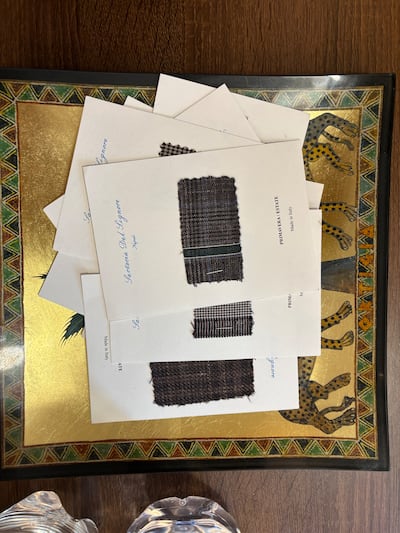 Yoo has travelled to Donegal to source tweed. His clients are international and some travel to Naples for fittings. Photograph: Naomi O’Leary
One day they called at the tailoring house of Nunzio Pirozzi, a famous master tailor who began working in the industry in the 1950s. He had a severe reputation, but the two found him smiling and relaxed.
Pirozzi listened as Yoo read out the letter he had prepared, explaining that he was looking for someone who could train him in Neapolitan tailoring.
“The master realised this wasn’t an ordinary young person; he had a special passion,” Song remembers. “He said, ‘come here. I accept you’.”
Yoo’s training had begun. He would spend two years studying under the Pirozzi family before moving to father-and-son business Sartoria Solito, learning first to make suit trousers, then jackets, and then coats.
Finally, he was taken on as an apprentice by Raffaele D’Alisa, a legendary Naples tailor.
“He was an old master with glasses,” Song remembers. “He didn’t have any children. He had run his own tailoring house for 50 years.” D’Alise adopted Yoo as a protege.
 Each commission takes at least three months to complete. Photograph: Naomi O’Leary
Standing at his sewing table, Yoo explains the tools of the trade he learned to use: the wooden “half moon” that helps to sew suit jackets with a slight curve to allow for the rise of the chest; the heavy metal iron that presses the material into the shape of the body.
“This is five kilos,” Yoo says, lifting the iron. D’Alisa, the master tailor, used a 7kg iron until his death last year at the age of 86.
Feeling he was finally ready, Yoo founded Sartoria del Signore in 2022.
On the wall hangs an official certificate: a recognition of artisan status by the Naples guild, awarded only to small businesses that create products by hand.
Each commission takes at least three months to complete. Production is limited. Yoo hand-sews every piece – trousers, jackets, coats – with nothing done by machine or contracted out.
Clients are international. Some travel to Naples for fittings; Yoo and Song also visit New York and Seoul frequently for trunk shows. Each suit is priced at €4,000, irrespective of the fabric used.
Yoo travelled to Ireland to source tweed.
“This material comes from Donegal,” he says, as he raises a grey woollen jacket. Other suits are made with Irish linen.
“I made these trousers with Irish material. Irish linen is quite special. It’s heavier. It falls well on the body,” the tailor explains.
He lifts up a summer suit, showing how the material is almost transparent against the light.
“I don’t put a lining in for a summer jacket like this.” The shoulder has a “spalla camicia”.