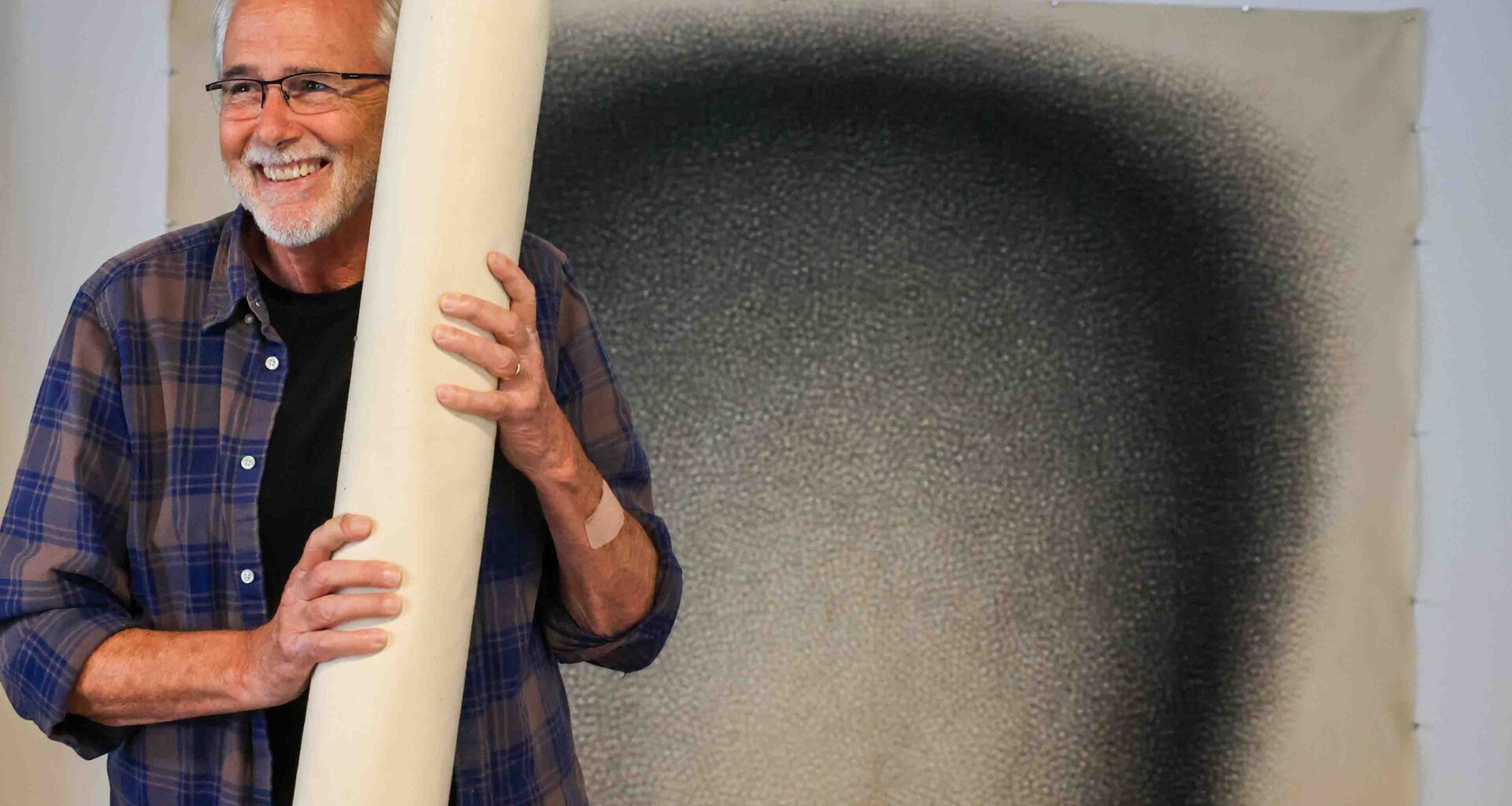
Jack Scott pinned the top edge of “Locust’s” 17-foot canvas across the studio wall with the help of two assistants. As the drawing’s charcoal marks were slowly revealed, Scott cocked his head and refocused. The abstract image looked like a flock of swallows.
“That’s right. … That’s right. … Oh, this is amazingly black,” said Scott, the 73-year-old Marin County native. “I haven’t visited it in 50 years. I really forgot what this one looked like – I thought I knew. It’s just lost in the blur of history.”
Scott and his agent Michele Hembree have revealed 10 of the artist’s most treasured works for the first time in decades at the Mark Serr Photography Studio in Alameda. The exhibit runs through Friday, Aug. 21, as Scott attempts a late-career revival of his “art about nothing.”
Scott’s artwork hung in premier art museums in California in the 1970s: the Los Angeles Institute of Contemporary Art, the William Sawyer Art Gallery in San Francisco and the Nelson Gallery at the University of California, Davis. Contemporary art critics like Thomas Albright praised the “disembodied, transparent quality” of his monumental charcoal pieces, adding they “seem to detach themselves from the acres of blank canvas around them and hang, like free-floating mirages, in some ambiguous space.”
But as Scott pivoted toward an even more overt style of nothingness with the “Study for a Black Drawing” series in the 1980s, his earlier works fell out of vogue and became more difficult to place in exhibits.
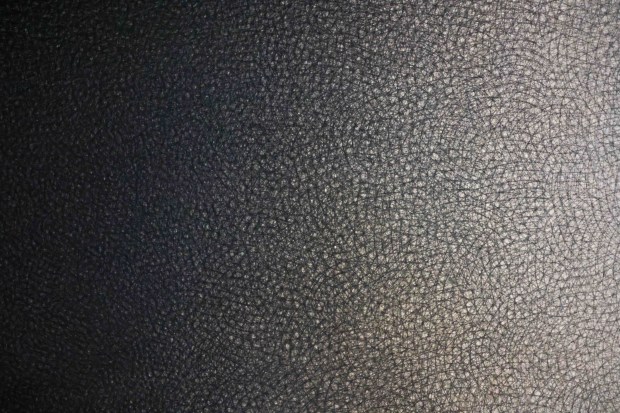 A detail of “Locust,” an 8.5-by-17-foot charcoal-on-canvas artwork made by Bay Area artist Jack Scott, shows how he contrasted black and white. The image was captured during a photo shoot at Mark Serr Photo Studio in Alameda on Tuesday, Aug. 18, 2026. (Ray Chavez/Bay Area News Group)
Style comes from simplicity in Scott’s work. Employing a reductive approach, his artwork focuses on the drama that occurs between light and dark, the balance between the pallid white canvas and the blackness of charcoal, he said. It’s his attempt to create an “ideal void” as a physical manifestation, to confront death not as an ominous force but an old friend.
“Scott’s web of soft, undulating arcs subverts the large-scale coolness of the primary form. In this sense the artist’s works remind one of Rothko, whose monumental forms were also conceived through a diffused or soft-edge development,” the late San Francisco art critic Hal Fischer wrote in a review of Scott’s exhibit at the William Sawyer Gallery for the November 1978 edition of Artforum magazine. “Scott’s web of soft, undulating arcs subverts the large-scale coolness of the primary form.”
Scott grew up in Novato, a town of 5,000 people, where the Highway 101 exit was only a stop sign until 1971. It was a nice life, he said, but there was “nothing much to do in Novato.” He had developed a skill for hyperrealistic drawing in his youth, but it was when he began taking art classes at the College of Marin that he began to experiment with abstract art.
The Bay Area’s art community was still drawing heavily from the Beat Generation, as its key literary figures, like Allen Ginsberg and Jack Kerouac, championed boundary-pushing, spontaneous creation and raw, authentic lived experiences. Scott paid close attention to artist Mark Rothko’s shift toward abstraction, and he specifically noted artist Morris Louis’ “veil shapes” that influenced his own atmospheric forms.
But it was the Sonoma coast, with its obscuring fog and luminous sun rays, that impacted how he viewed shadow and light. So it was as an art student in his 20s that he became curious: What if he took away all the color and forms, leaving everything except the bare essentials?
“It was sort of like this silly, absurd attempt to create the ideal void,” Scott said. “It’s humorous on one level to try to find the perfect proportions and density of marks and dark to light or whatever, to make this ideal drawing of nothing.”

Bay Area artist Jack Scott installs one of his artworks, “Locust,” an 8.5-by-17-foot charcoal on canvas, during a photo shoot at Mark Serr Photo Studio in Alameda on Tuesday, Aug. 18, 2026. (Ray Chavez/Bay Area News Group)


Show Caption
1 of 17
Bay Area artist Jack Scott installs one of his artworks, “Locust,” an 8.5-by-17-foot charcoal on canvas, during a photo shoot at Mark Serr Photo Studio in Alameda on Tuesday, Aug. 18, 2026. (Ray Chavez/Bay Area News Group)
Nothing took shape on Tuesday, when Scott unrolled “Locust,” a 1976-77 artwork that he had spent some two months drawing. Three people were required to place the canvas on the art studio wall, meticulously spreading each inch of canvas to remove any wrinkles.
Fully unrolled, the canvas was the size of the cargo container, looking like a dust storm descending over a desert town. The sheer scale of Scott’s art is one of his primary modes to engage an audience, like creating an environment that envelops a room.
As he stood before the drawings once more, examining his work, a sanguine smile crept across Scott’s face. It was less like reviewing an archive and more like stepping through a portal to shake hands with his younger self – one he hadn’t seen in 50 years, he said.
At the time Scott created “Locust,” he was in graduate school, painting houses for money while immersing himself in his passion for abstract art. When asked how he evaluated the work of his younger self, he said that time was the ultimate judge.
“This was my innocent attempt to dive into the idea of mystery and the void. When you’re right in the moment, you don’t know whether the piece is going to live or last,” Scott said. “And then over time, it proves you wrong or right.”