
Reggie has always been a bit mad. My standout memory of him from school is as a certified messer. Must be something about the walls of Dundalk Grammar School that produced both frontmen in The Mary Wallopers – one of Ireland’s wildest trad bands – and, now, a rapper many can’t get out of their heads.
Reggie’s big break came last year when Fred Again, the British producer widely considered music royalty, remixed Talk of the Town, one of Reggie’s catchiest songs. It’s a self-glorifying track about the artist being “the talk of the Town” – the Town being a common nickname for Dundalk, of course. I didn’t see him much after leaving school, and we weren’t very close. But my curiosity was piqued last year when a friend mentioned that one of my peers had collaborated with Fred.
“It feels like Dundalk’s on top of the world right now,” Reggie tells me, boisterous as ever. “The centre of the universe.”
I’m meeting him at Relief, a barber shop in Dundalk owned by a long-time friend, Kelly Okabi. “Finally, recognition for such great talent,” Okabi is quick to tell me. “He’s been doing this for years now. It was about time.”
I notice a tattoo on Reggie’s arm that reads “Reggie B” – a rap moniker from a previous life. The “B”, stands for “babe”. “I used to be a charmer back in the day,” he says, “so I thought I’d throw a B in there, just to make it a little bit saucy.”
He’s also keen to display his Risky Business medalliont, a nod to another nickname. “I just feel like music in itself is a risk,” he says. “I took bets on myself from [an early age]. It’s just taking chances on things and aiming big. So it ended up becoming a slogan of mine.”
Reggie was born in Nigeria and moved to Ireland when he was seven. I ask him about his relationship with his family, who are spread across Ireland, Britain, Canada, Nigeria and mainland Europe. “Everyone’s grown now and living their own life,” he says. “I’ve got a lot of siblings – I think it’s six. Sometimes I lose count. I don’t see a couple of them in the UK or Canada.”
After school ended, Reggie went on to study quantity surveying at what was then Athlone Institute of Technology. “I was skipping class with the boys,” he admits now, “hitting the studio and getting up to all sorts of madness.”
[ 50 people to watch in 2026: From film and music to arts, activism, sport and moreOpens in new window ]
The madness included soccer. “Before I found music I wanted to be a footballer,” he says. This takes me back to the dread you’d feel on our school pitch when Reggie closed in for a tackle. He was one of those lads you could see going all the way – and later in his teenage years Reggie played for Newry City FC, making money for every goal scored. His ticket to college was on the back of a sports scholarship.
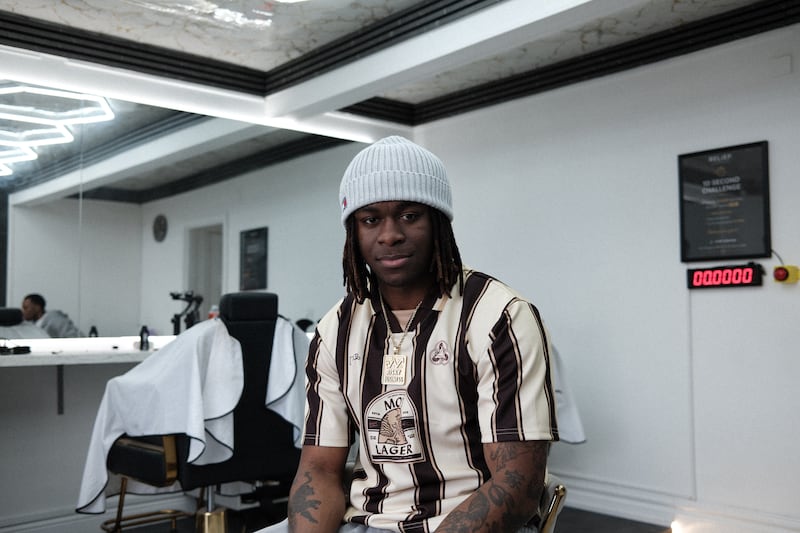 Reggie at Relief Barber shop, Dundalk, wearing his ‘Risky Business’ medallion. Photograph: Conor Capplis
  Reggie B, the performer’s longtime rapper name – the ‘B’ was lost somewhere along the way. Photograph: Conor Capplis
“I feel like I could have went on to play First Division Irish football, but then I started rapping and was living a kind of Hannah Montana lifestyle. I would have a football match in the morning and in the evening I would have a show, so it was getting a bit hectic. I ended up saying, ‘Whichever makes me the most money, I’m gonna go for that one.’”
After a year at college Reggie dropped out to focus on music. His parents weren’t too happy. “The rest of my siblings are engineers and doctors and stuff like that, so I had to show them it was worth pursuing,” he says. During this period, Reggie says, he topped up his music income with “basic factory work – nothing major, just to stay afloat”. He eventually left that, too, to focus entirely on his craft.
His early music was, in Reggie’s words, “more aggressive”. The drill rap he was emulating had a particular aesthetic: fast cars, wads of cash, (prop) firearms, bully dogs and no shortage of scantily-clad women.
“A lot of that music doesn’t get on the radio and you wouldn’t really get a lot of festival bookings,” he says. “Some people would deem it as violent. The inspiration came from UK drill, and obviously that’s related to gang violence and stuff like that. I just knew the artistry that I wanted to do, I wanted it to be for all audiences – more commercial. That’s why I started making less drill and more rap. I slowly drifted from the hard-core stuff and started making feelgood music.”
Reggie released The Talk of the Town at the height of this era, in 2022. In many ways he had moved on from the track when, last year, Fred Again sampled it during a livestream in Greece.
Fred “suggested collaborating when he came to Dublin in November. I was, like, ‘Bro, I’m free. For you, anytime.’”
 Reggie’s latest music video was partially shot at Oriel Park, the home ground of Dundalk FC. Photograph: Conor Capplis
Reggie performed the song at a blowout gig with Fred Again last November. Only a few days’ notice was given, and tickets were like gold dust. This was Reggie’s shot.
“The RDS went crazy,” he says. “It was insane. You had to be there.” RTÉ called it the gig of the year, Hot Press called Reggie’s performance an “absolute firestorm of a track in top form live”, and he made sure to represent the Town by wearing a Dundalk FC jersey.
[ The hottest ticket in town: the Fred Again show in the RDSOpens in new window ]
Two days after the RDS concert Fred’s Talk of the Town remix was released to the masses, and for a while it felt inescapable. He was finally getting radio play, doors were opening up in the music industry and, in a full-circle moment, Dundalk FC asked him to model its new kit.
The song is now one of Fred’s most popular tracks; it has been streamed more than 75 million times on Spotify. It’s a high bar to match going forward.
“At the beginning there was a lot of pressure, to be fair,” he says. “That’s the music industry, though: you can never really tell which one’s gonna go off. I just had to come to terms with the fact that it’s a unicorn song … Speaking to Fred, and taking advice from someone who is as prolific as he is, he said just focus on the music and don’t care about the numbers. As long as the music’s good and it’s timeless, you’re always gonna catch a unicorn. That’s what I’m gonna do.”
I ask, with some trepidation, if there’s any truth to the song’s catchiest lyric, “I’ve got girls in every county” – the woman he’s dating is sitting two metres away. He blushes. “There are some counties I haven’t been to, but the ones I have been to, I mean, I know some people there.”
His voice trails off. I sense that’s the last he’d like to say about his love life, present company accounted for.
We leave the barber shop for a change of scenery. “Growing up here, all my friends were in this estate,” he says as we walk through Muirhevnamore – “Muco” to locals.
“There’s quite a big Traveller community around here as well, we were quite close. It’s a very diverse area and there’s a lot of character-building around here. Muco can get a bad stigma sometimes – you get the good and the bad – but, growing up in Muco, you don’t look at it as a bad place.”
We stroll into a nearby park, complete with football pitches, a playground, a boxing gym and a new running track under construction. “When I used to train for football, I would come in here and do laps of this place.” The odd rap battle would materialise too, he says. “For some reason I was always kind of witty with the lyrics. You can see from my early days there was something there, it just had to be worked on.”
Walking around Muirhevnamore, most young people seem to know him. One child, no older than 10, holds his hand out for a high-five as he whizzes by on a scooter. Others, closer in age, greet Reggie like an old friend.
 Outside Clann Naofa Boxing Academy in Dundalk where Reggie trains. Photograph: Conor Capplis
Along the way I catch Mac Ubezonu for a chat. He’s one of Reggie’s closest friends and acts as a sort of manager too. In 2024 the pair collaborated on B & M, a song that encapsulates Reggie’s style before gaining celebrity status. “I come with the bitches and marijuana,” goes the chorus. “I got them tricking like Maradona.”
“There’s a Reggie that people don’t see,” Ubezonu says of the man he’s known for more than a decade. “People don’t see the caring, the hardworking side of him. He wouldn’t really call us friends – he’d call us family, and he takes care of us. I document as much as I can, but people don’t see the amount of hard work he puts in, and how specific he is about his craft and the image he wants to portray.”
Reggie is certainly specific about his image. If this afternoon is an accurate reflection of a day in his life, Reggie takes a lot of photographs. In the few hours we spend together he is quick to offer up shots for his social media, and there’s a sense that he’s deeply aware of his brand and keen to share his day-to-day life online.
This spring Reggie released a follow-up to Fred Again’s Talk of the Town. The pressure was on. El Paso (365) – a common nickname for Dundalk, as a once-fractured Border town – kicks off with a trademark confidence: “Took a long time, but I knew I’d be great.”
It’s a reimagining of the David Keenan song of the same name that’s regularly sung at Dundalk FC games. Reggie sampled the troubadour’s anthem and stepped up his budget for a music video shot around Dundalk. No sign of fast cars and prop guns this time around.
Since then Reggie has collaborated with Belters Only, Dublin’s darlings of dance music, and last month he released Eimear, a catchy, Talk of the Town pastiche, alongside a music video that saw a return to the wads of cash and passive women of his earlier music. On Eimear, he raps, “Will this one go bigger than Fred’s? I don’t care, I got bread.”
None of these songs is a unicorn, sure, but each is a milestone for an artist rebranding as something a little more mainstream, even as he sticks to his roots.