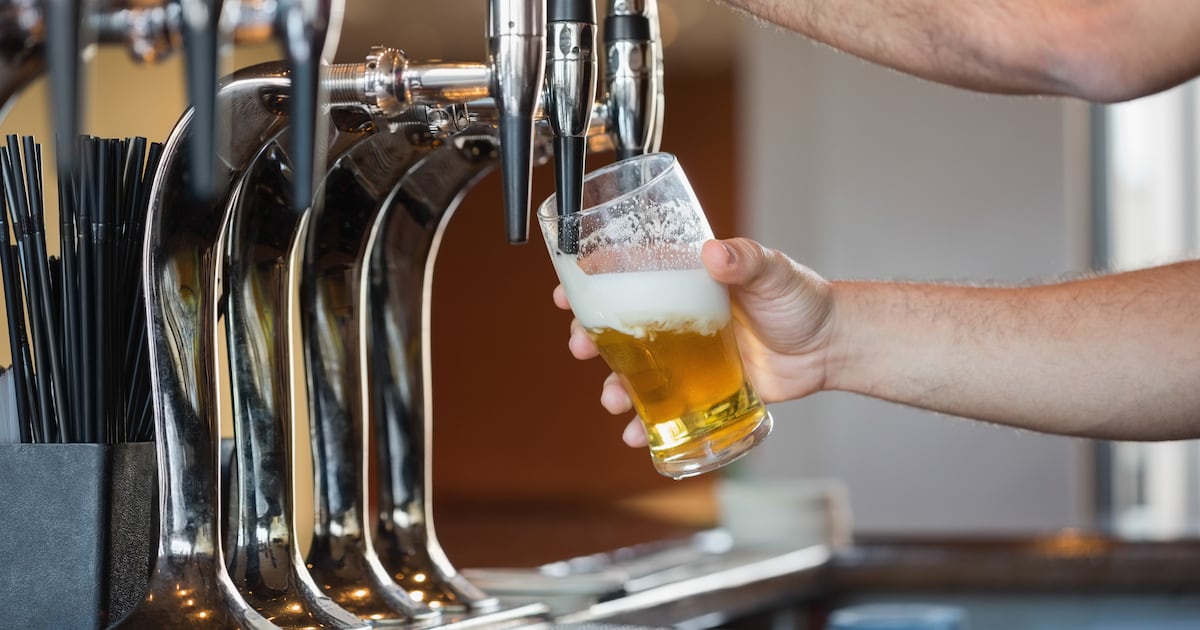
Irish consumers pay 11 times more duty on a pint of beer than people in Spain and Germany, according to research published on Friday.
The research, carried out by DCU economist Anthony Foley and commissioned by the Drinks Industry Group of Ireland (Digi), suggests that consumers here pay more duty on beer, wine and spirits than people in every country in Europe apart from Finland.
The report highlights how excise tax on wine in Ireland is the second highest across the EU and UK combined, while excise on beer and spirits is the third highest.
A pint of beer purchased in a pub here attracts excise of 55 cent compared to just five cent in Spain and Germany.
And while whiskey is produced in Ireland, a 70cl bottle of the spirit is levied with €11.92 excise here, representing more than half the price customers pay, compared to a far lower rate of €2.69 excise in Spain and €3.65 in Germany.
The research shows a similar trend across wine products, with excise making up €3.19 of the €11 cost of a standard bottle of wine purchased in an off-licence in Ireland.
When VAT of €2.06 is included, this means 48 per cent or €5.25 of the overall purchase price goes directly to the Government.
The rate of tax charged on an €8.50 glass of wine in a bar or restaurant is somewhat lower. However, it still makes up €2.39 of the purchase price when excise of €0.80 and VAT of €1.59 are combined, the research suggests.
By contrast, 14 European countries don’t charge any excise on wine, including Spain, Portugal, Italy, Germany and Greece. France, meanwhile, charges just one cent on a standard glass of wine.
“The main aim of this report is to objectively assess what the rate of excise in Ireland is compared to other countries across Europe,” said Foley. “The results show, without doubt, that Ireland has a very high level of alcohol excise tax in 2026 when compared with the large majority of other countries.”
Digi has argued that the high rate of excise is one of the main factors behind the significant rate of pub closures in Ireland in recent years. It said this is “something which the Government must begin to take responsibility for”.
It wants 10 per cent reduction in excise in the upcoming Budget to improve the viability of Irish pubs and ensure they can continue to make a valuable contribution to their communities.
“Today’s report confirms that the level of tax levied on alcohol on Ireland is far above most of our European neighbours,” said Digi spokesman Donall O’Keeffe.
“While there may have been some argument for this when Irish alcohol consumption was among the highest in Europe, consumption has dropped to average European levels in recent years. As a result, the main impact such high taxes are having now is simply to make our pubs too expensive for locals and tourists alike and to push them out of business.”
O’Keeffe said the Government “needs to wake up to the reality that super-high taxes on alcohol are killing our pub industry”.
“Irish pubs are celebrated around the world and are often the only community hub in isolated communities, yet the Government seems to be content to tax them out of existence,” he added.
Alcohol Action Ireland does not share the view that taxes should be cut. Earlier this month, it called on the Government to increase excise on alcohol by at least 15 per cent.
It said it served a “dual purpose” of raising money and “influencing price-sensitive behaviours such as consumption”.
Its chief executive, Dr Sheila Gilheany, pointed out that excise duties on alcohol have not increased since 2014. She said their “public health benefit has been eroded by inflation and is now at least 15 per cent lower in real terms”.
Gilheany said alcohol harm costs the State as much as 2.5 per cent of gross domestic product, amounting to €14 billion.