
- South Africa’s first generic semaglutide injection launched in August – and the South African Health Products Regulatory Authority is considering 13 more applications.
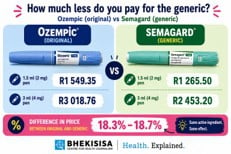
- The first generic is only about 18.5% cheaper than Ozempic, even though researchers estimate semaglutide could eventually be made for roughly R100 to R200 a month.
- High prices have helped fuel a black market in unregistered weight loss drugs, where buyers may have no way of knowing what is actually in the injection.
- For more financial news, visit News24 Business.
It was a carnivorous lizard with a forked tongue, sharp claws and beaded skin that helped rewire the appetite of millions of people around the world, making hunger something you can switch off with a few clicks and a jab.
In the 1990s, an American scientist named John Eng identified an interesting molecule in the venom of the Gila monster, which spends most of its life underground in North American deserts.
The reptile has an interesting approach to food. It emerges from the darkness just a handful of times each year to feast, and is able to maintain its blood sugar for long stretches between meals. The molecule Eng found in the reptile acts a bit like the naturally occurring human hormone glucagon-like peptide-1, or GLP-1. It’s what slows digestion, makes us feel full and steadies our blood sugar, keeping our energy steady. Eng thought it might somehow help people with diabetes.
He was right, and paved the way for the blockbuster drug Ozempic, which launched in 2017 in the US as a treatment for diabetes, but was soon used off-label as a weight-loss drug to an insatiable public.
Financial services firms like Morgan Stanley expect the GLP-1 market to reach $190 billion (R3 trillion) by 2035, more than double what it was worth in 2025.
GLP-1s have become shorthand for brand names like Ozempic, Wegovy, Mounjaro, Zepbound, Trulicity and a slew of others, with more coming as fast as pharmaceutical companies can get them into pens that deliver them in once-a-week jabs and, more recently, in tablet form. But they don’t come cheap.
At between R3 000 and R10 000 a month, Bhekisisa’s TV programme, Health Beat, reported in July that, depending on the type and amount of weight loss medication a patient needs, even those pulling R1 million annual salaries struggle to pay for it.
Those prices will start coming down now.
In March, patents on semaglutide, the ingredient that makes Ozempic and Wegovy work, expired in several countries, opening up the generics market to millions. Earlier this month, Sun Pharma launched the first generic semaglutide injection for type 2 diabetes in South Africa via its local subsidiary, Ranbaxy. And the South African Health Products Regulatory Authority (Sahpra) says it is considering 13 more applications from companies ready to sell generics in the country.
The question is, will generics bring down the price low enough to take down an illegal market that has mushroomed in the price gap and get the medication to the people who need them the most?
‘This is not a vitamin’
A former professional athlete who spoke with Health Beat under the condition of anonymity said she bought into the GLP-1 black market trade in 2023 after gaining 30kg and becoming pre-diabetic following a trauma that had her on antidepressants, a common side effect of which is weight gain.
The 38-year-old tried everything she could to shave off the extra kilos: eating healthy, limiting her food intake, exercising and drinking all kinds of protein shakes in an attempt to stave off hunger. Despite all of that, she says, her weight wouldn’t budge.
Ozempic had landed on the South African market by then, and her doctor gave her a script. But when she went to the pharmacy to pick it up, they were out. At the time, there was a global shortage of the medication driven by massive demand and, in South Africa, people could wait weeks to fill their prescriptions.
She found a compounding pharmacy that was willing to sell it to her with the script from her doctor. The semaglutide cost R2 500 a month, slightly less than she would have paid for the real thing.
Within days of taking it, the noise stopped. She eventually lost 10kg and started boxing again. “It was so amazing not to be starving for the first time in years,” she says.
Then she heard about another type of GLP-1, retatrutide, and went back to the doctor. Word had it that she could lose even more – up to 30% of her body weight.
Retatrutide studies have indeed shown those kinds of impressive numbers. The drug targets three hormones instead of the one semaglutide hones in on, or the two hormones tirzepatide, which is marketed as Mounjaro or Zepbound, are directed at. The thing is, retatrutide is still in its trial phase. It has not been approved for use anywhere in the world, other than an allowance made early in August by its maker, Eli Lilly, to treat obesity in a select number of patients, with special permission, in the US.
The former athlete’s doctor had her sign a waiver to get the medication.
“The moment I signed this disclaimer, I thought, this is not a vitamin, this is an experimental drug,” she says. She paid the doctor R3 000 for a month’s supply and he administered it in his office, saying he had it tested to make sure the compound actually had retatrutide in it. “That is why I wanted the tested one, even though I would pay more for it.“
That testing, says Francois Venter, the head of Ezintsha, the health research unit at the University of the Witwatersrand, would require your very own biochemist to test the stuff before it goes into your body, which wouldn’t make it any more legal – or safe – to supply an unregistered medicine.
“I get the impatience,” Venter told Health Beat. “I think this is a testament to how medicine has failed in terms of getting these drugs to people at an affordable price.”
Advocates are hoping the wave of generics will help drive prices down. Medical aids don’t have to cover GLP-1s for weight loss because obesity is not a prescribed minimum benefit condition, and only in select cases will they cover Type 2 diabetes.
What activists are banking on is that lower costs of generics will help convince government to approve the medications as an option for the 84% of South Africans who depend on public healthcare.
Whack-a-mole
The eye-popping price tag is a major factor driving the black market trade. Like the former athlete, many people are getting their hands on GLP-1 medications through compound pharmacies, which are prohibited from large-scale manufacturing, advertising or distribution of unregistered medicines.
According to Sahpra CEO Boitumelo Semete-Makokotlela, the agency’s whistleblowing platform gets two or three complaints a week about unregistered GLP-1s advertised on WhatsApp, Facebook and X.
“When there’s a complaint, we send inspectors to investigate and inspect the product. If non-compliant, we confiscate the products. Where there’s an e-commerce platform, we bring down the site. That’s a tough one to do,” she says of this whack-a-mole strategy. “You close down one site today and another one emerges [tomorrow].”
The retatrutide formulations are even more of a risk.
“Even if a medicine has shown potential … you still have to complete all the clinical trials so that you can ensure that the product is [effective] and safe for patients to take,” says Semete-Makokotlela.
She adds that a legal product is easy to spot: it carries a Sahpra registration number and a patient information leaflet listing warnings and/or side effects. In an effort to combat the illegal GLP-1 market, the agency has embarked on an awareness campaign, including public-facing information to help consumers know what to look out for.
Where obesity meets HIV
Even if people all around the world are doing whatever it takes to get their hands on all kinds of weight loss medication, it still can’t keep pace with the global obesity epidemic.
A study in the journal Nature in May, which drew on more than 4 000 studies of 232 million people, found that obesity has plateaued or even edged down in most wealthy countries. But it is climbing in the developing world.
“Our obesity problem is actually worse than the US, and we haven’t peaked yet,” Venter says. According to a 2025 study published in the South African Medical Journal, obesity rates in the country have risen substantially between 1998 and 2017. The numbers are particularly high among women, where rates shot up from about 30% to 43%.
Obesity is classified as a chronic disease by the World Health Organisation (WHO). It can lead to heart disease, diabetes, different types of cancers, and even brain disorders. The WHO has added GLP-1s for the treatment of obesity to its essential medicines list and issued guidelines on their use in obesity treatment, alongside healthy diets and exercise, a signal that the drugs are no longer seen as a luxury.
In addition to weight loss and controlling diabetes, studies are consistently showing other remarkable benefits. Among other things, researchers have found that GLP-1s can reduce heart attacks and strokes; heart, kidney and liver diseases; sleep apnoea, a condition that causes breathing to stop and start during sleep; and may even help ease drug and alcohol addictions. Side effects like nausea, diarrhoea, vomiting and constipation are the most common, but some researchers have raised concerns about gallbladder disease. And, as the weight peels off, so does muscle mass and bone density, making weight-bearing exercises crucial, which is even more important for older patients.
Still, Venter says the drugs are nothing short of revolutionary. Particularly for South Africa’s other epidemic: HIV. He says weight gain is currently the biggest challenge in HIV care. A Johannesburg-based study he led showed that patients on the latest antiretrovirals (ARVs) gained weight, sometimes dramatically.
In a recent op-ed for Bhekisisa, Venter and his colleagues describe a woman at a Johannesburg clinic who gained weight she couldn’t lose after starting ARV treatment. She kept buying bigger and bigger clothes and blaming herself. But the story that weight loss comes down to discipline is just not true, he says.
“They’re told it’s simply a moral failure, that you just eat badly and don’t exercise enough, and if you suck it up and do the right thing you can [lose the weight] through sheer will,” he says.
“That is absolute nonsense. There’s a tiny percentage of people who can lose weight that way, and they’re the ones who go on television and write bestsellers and sit around the dinner table and shame everybody else. But for the vast majority of us, our weight just steadily goes up.“
Taking GLP-1s means a lifetime commitment – it’s not a quick-fix weight-loss strategy. Those who go on the medication and then will gain a significant amount of the weight back. It’s a continual investment that makes the high cost even more painful.
The coming wave
But Venter says it shouldn’t be that way.
In July, he co-authored a study published in the journal Obesity, which cost the production of semaglutide. Venter says generics could be manufactured at around R100 to R200 for a month’s supply.
Nicolaou says generic pricing usually starts at between around 25% to 30% below the brand cost, and prices normally continue to drop as more players enter the market. But when Bhekisisa phoned a national pharmacy chain for the price of Ranbaxy’s generic product, we found the generic, Semagard, is only around 18.5% cheaper than Ozempic.
But there is a good sign for those who want to see the price drop quickly – Sahpra is considering 13 more applications for semaglutide and 18 others for an earlier GLP-1 drug, liraglutide, with at least one of those already on the market.
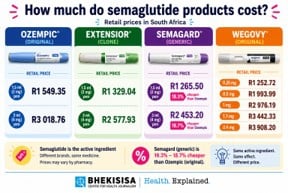
Meanwhile, Novo Nordisk recently brought out Extensior, a cheaper version of Ozempic, which costs about 15% less. Earlier this year, the company dropped prices for Wegovy, its version of semaglutide specifically for weight loss. While that might be good news for those who are already buying it, the medication still costs a stratospheric amount for most.
“They are simply unaffordable, and they are not expensive to make,” says Venter. “It’s pharma greed and government just sitting on its hands. We have incredibly good people in government who could be pushing this forward, who did an amazing job with ARVs for HIV treatment. I don’t understand why we’re not pushing harder on this.“
Some of the reporting on this story is from Bhekisisa’s television programme, Health Beat.
This story was produced by the Bhekisisa Centre for Health Journalism. Sign up for the newsletter.
