
A team of physicists at the Harvard John A. Paulson School of Engineering and Applied Sciences has found that a steady stream of sound waves can shield a fragile quantum bit from its own noisy surroundings, nearly tripling how long it holds information. The breakthrough paves a path toward sound-based quantum networks on chips as well as hybrid quantum systems that combine many different types of qubits.
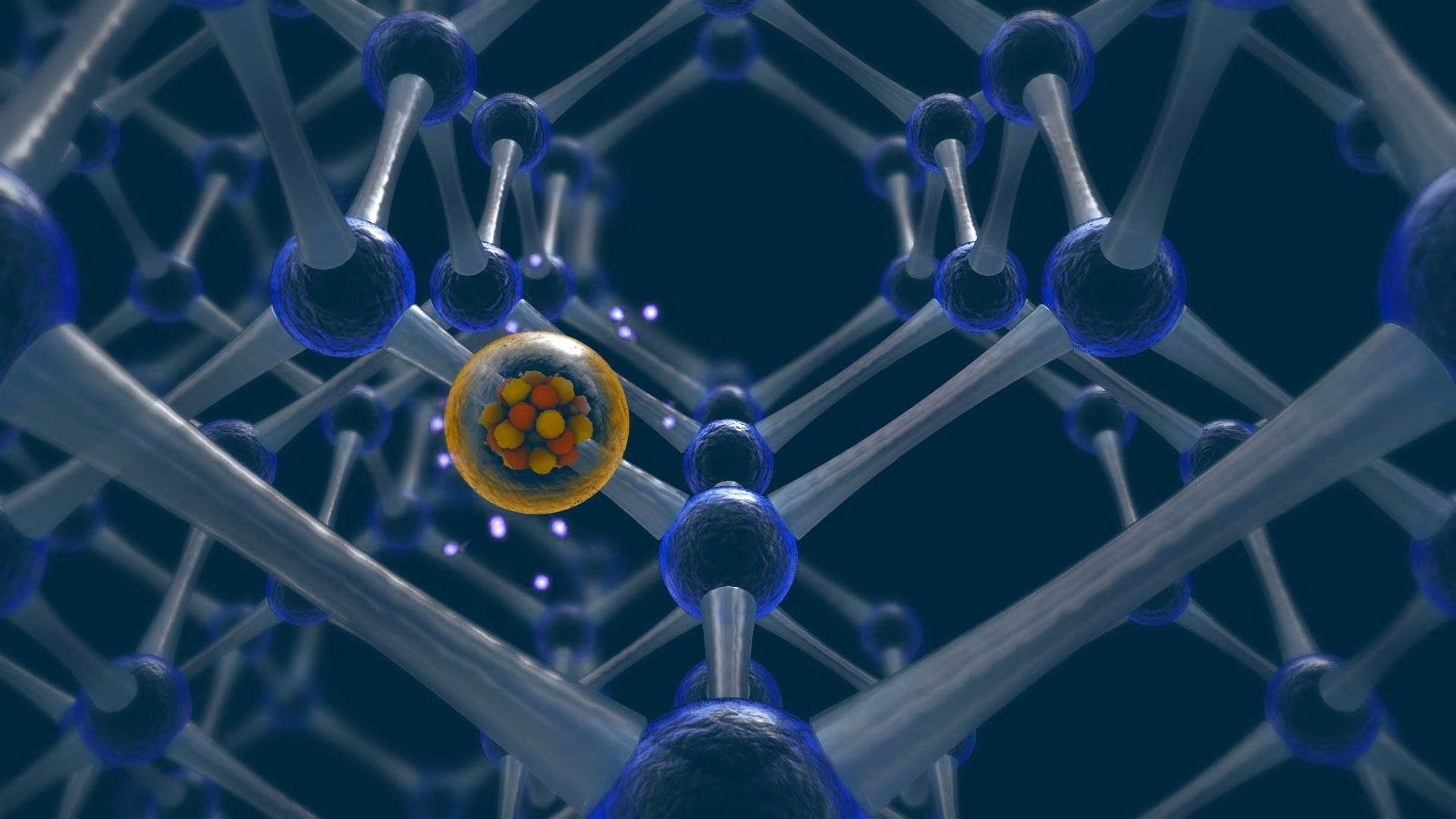
Cornell et al. demonstrate all-mechanical coherence protection of a silicon-vacancy spin in diamond. Image credit: Cornell et al., doi: 10.1038/s41567-026-03369-2.
“One emerging type of quantum network uses the spin of an electron, associated with impurity in diamond, as quantum memory; and sound particles called phonons as information carriers between qubit nodes,” said Harvard researcher Eliza Cornell and her colleagues.
“Phonons offer several advantages over more traditional approaches to quantum networking that use light as information carriers at the chip scale.”
“First, phonon wavelengths at a given frequency are much shorter than light wavelengths, enabling devices with far smaller footprints and tighter integration.”
“Second, phonons couple easily both to solid‑state spins and to electromagnetic fields, making them attractive components in hybrid quantum systems that employ more than one type of qubit.”
“But working with phonons has unique challenges, mainly related to memory.”
“Quantum memories need to be protected from their environment in order to extend their coherence, or their ability to retain memory for a sufficiently long time.”
“But existing approaches that rely on microwave pulses to de-couple memories from their environment do not work well on qubits housed in phononic cavities.”
Dr. Cornell and co-authors solved this bottleneck by demonstrating a unique ‘all-mechanical coherence protection’ of a silicon-vacancy spin in diamond.
Rather than traditional microwave pulses, they applied a continuous mechanical driving field made of phonons to change the qubit into a different state, called a ‘dressed’ qubit.
Called ‘dressed,’ these states are less sensitive to the low‑frequency noise in the environment.
Because spin coherence is protected here by a continuous mechanical field that is compatible with phononic cavities, the approach is designed to work within the same structures that would eventually be used to connect stationary nodes in a quantum network.
Phonons would carry out two jobs in this type of network: transmitting quantum information and also protecting it.
“We are solving two problems. We want the spin to have strong interaction with phonons, and we want the spin to have a long coherence time,” Dr. Cornell said.
“Our paper demonstrates a method of extending the coherence time that is compatible with the silicon-vacancy center being in a cavity.”
The team’s paper was published on July 15 in the journal Nature Physics.
_____
E. Cornell et al. All-mechanical coherence protection and fast control of a spin qubit. Nat. Phys, published online July 15, 2026; doi: 10.1038/s41567-026-03369-2