

Every few years, a blockbuster tries to digitally age or de-age one of its biggest stars, and every few years, the audience argues about whether it worked. It has become one of the most scrutinized tools in modern filmmaking, capable of putting a 70-year-old actor’s face on a 30-year-old body, frame by frame, decades after they actually looked that way. When it’s done well, viewers either don’t notice or they celebrate it. When it isn’t, it tends to feel wrong in one very specific, unsettling way. So, what actually goes into digitally aging or de-aging someone on screen, and why do some results fall into the uncanny trap?
You’ve probably seen this Instagram meme that’s been making the rounds lately:
 Source: Instagram
There is no real evidence yet as to whether Alejandro G. Iñárritu’s new work “Digger” does portray a 65-year-old character. There is no certainty that this exaggerated look on Tom Cruise isn’t part of the film’s comedic aesthetic. Yet what I like about this meme is the word “make-up.” Prosthetics, not pixels. Before we get to the digital side of this story, it’s worth remembering that aging an actor used to be an entirely physical, hands-on craft. Let’s start there, shall we?
How filmmakers used to age and de-age actors
Long before anyone had a dedicated VFX department, aging an actor was a job for the make-up chair. For decades, the gold standard was Dick Smith’s work on Dustin Hoffman in Arthur Penn’s “Little Big Man” from 1970. In it, a 33-year-old Hoffman spent hours a day under latex prosthetics to play his character Jack Crabb at 121 years old, as he narrated the story from a nursing home bed.
Here is a short excerpt of how this amazing result came together:
 A still from “Little Big Man” by Arthur Penn, 1970
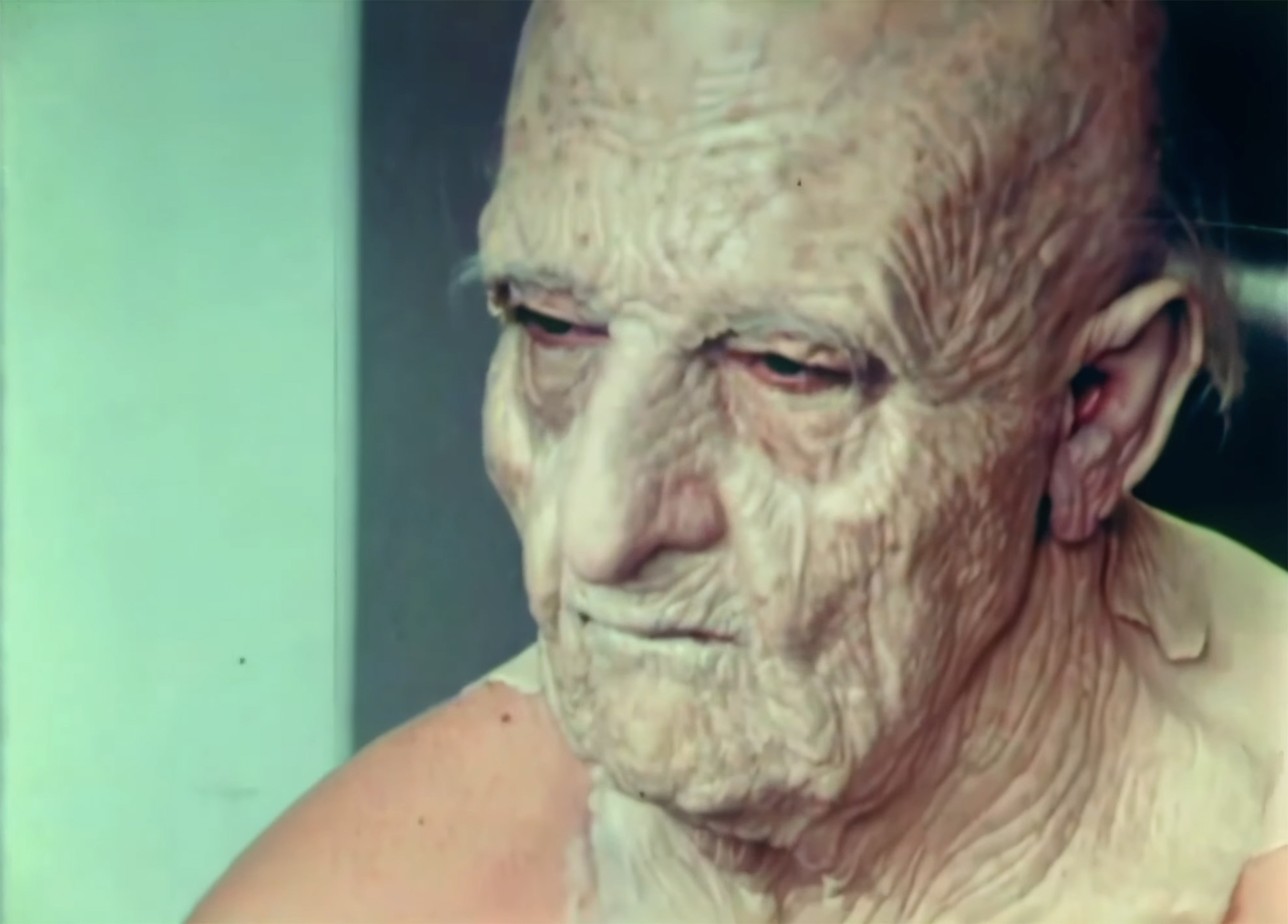 Source: a short film about the director Arthur Penn linked above
It’s a genuinely convincing transformation, isn’t it? But why does it work so well? My answer is: because it is all physical, tangible, and crafted to look “real” in-camera. Thus, it also feels authentic, both for the actor and for us. Imagine wearing all those layers of latex and paint on your face for hours. They inevitably affect the way you talk and move, because you can physically feel the “age.” Performance is a crucial element in selling the transformation, and we will touch on it later in a bit more detail. Here, no doubt, Dustin Hoffman did a super convincing acting job!
Digital Domain’s quiet breakthrough
Now I don’t say that “practical” aging and de-aging have died out. No, and the meme with Tom Cruise speaks for itself. (By the way, if you are interested in the modern world of prosthetics, head over here.)
However, over the past two decades, technology has advanced. With it have come new ways of doing the old craft. One of the first and most impressive examples of digital aging is “The Curious Case of Benjamin Button.” According to the film’s plot, Brad Pitt’s character ages in reverse, from an old man into a young one. For the sequences featuring the elderly Benjamin, VFX studio Digital Domain built fully CG heads driven by Pitt’s own facial performance, and composited them onto the bodies of three different performance doubles for more than 325 shots, totaling about 52 minutes of screen time.
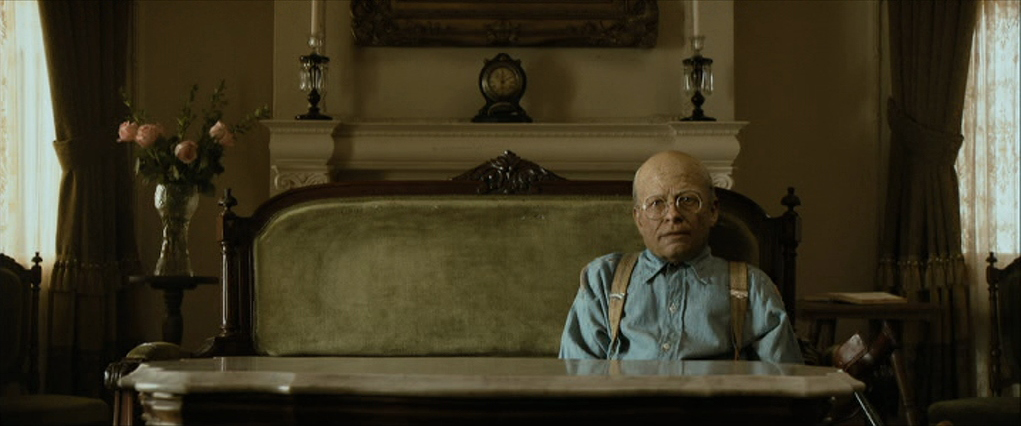 A film still from “The Curious Case of Benjamin Button” by David Fincher, 2008
The VFX company experts won the film an Academy Award for visual effects, and deservedly so. At the time, nobody had carried a photorealistic digital face convincingly through that much screen time. (There were films before “Benjamin Button” that played with digital de-aging, but only for a few flashback moments.) See for yourself:
In a sense, this film is a technological ancestor of every digital de-aging or aging effect since then. At least they revolve around the core idea that Digital Domain implemented: track a real performance, then build or borrow a digital face to put on top of it.
Tarkin’s uncanny comeback
But not only for aging or de-aging actors. One of the Star Wars movies, “Rogue One” (2016), used a similar approach for something stranger. The creators built a CG head for an actor who’d been dead for over twenty years. English actor Guy Henry performed Grand Moff Tarkin on set, in costume, and ILM then replaced his face, shot by shot, with a digitally rebuilt version of Peter Cushing’s. To ensure an accurate likeness, the studio used footage from his performances in the original “Star Wars” trilogy. Let’s rewatch the actor’s digital resurrection together:
How does this clip make you feel? Something is completely off, isn’t it? A stiffness around Tarkin’s eyes; the skin that behaves like a mask, an off-beat between his expressions and his words… I can’t quite put my finger on what is wrong here, but Tarkin looks more like a character from an older visual game than an actual human. Remarkably, even when the film came out (2016), and even if viewers didn’t know the original actor had died in 1994, they shared the same creepy feeling. And this feeling has a name.
The uncanny valley
Yes, it is called the “uncanny valley.” The term comes from Masahiro Mori, a Japanese robotics professor who proposed the idea in 1970. Initially, it wasn’t about movies or visual effects at all. Mori’s theory describes a fascinating psychological phenomenon. We can describe it like this: the more human something looks, the more we generally like it. However, this remains true only until something looks almost perfectly human, but not quite. At that point, our affection doesn’t plateau; it drops off a cliff. That exact dip is what’s called the uncanny valley, and Mori illustrated it with things like prosthetic hands and humanoid robots. They are close enough to human to invite real scrutiny, and just far enough off to fail it.
 The uncanny valley graph. Source: the original essay by Masahiro Mori, IEEE Robotics & Automation Magazine
Nobody fully agrees on why our brains react this way, but one common theory is that a near-perfect human likeness triggers a kind of threat-detection instinct. The same one that might have helped us notice illness, or something dead, in a person who otherwise looks fine. A humanoid robot with an expressive silicone face is often the fastest way to feel this for yourself (hello Sophia!)
Ouch, creepy! Back to our topic: Digital aging and de-aging land in the uncanny valley more often than filmmakers would like. One reason is that a digitally reconstructed face, however carefully modeled, is competing against a lifetime of human perception. We spend our whole lives watching and interpreting real faces, so we’re remarkably sensitive to small errors in movement, expression, texture, and timing.
The Irishman’s expensive lesson in de-aging
A further curious example of digital de-aging is Netflix’s “The Irishman” from 2019. It is interesting from various standpoints. First, it was the moment technology was tested at feature length, across three lead actors (de-aged to represent different periods in their lives), and for nearly three and a half hours.
 A film still from “The Irishman” by Martin Scorsese, 2019
Second, ILM (another leading VFX company) approached the task differently than in the case with Tarkin, which we discussed above. The creators built a custom rig: a camera array mounted beside the main camera, using infrared light to capture facial detail. That way, they didn’t need to put tracking helmets or markers on actors’ faces. They also didn’t need to interfere with the lighting setup or the director’s choices. Robert De Niro, Al Pacino, and Joe Pesci could perform without additional equipment on their faces, while the system used the captured data to drive their digital models frame by frame. (If you need an in-depth technical explanation, head over to this breakdown.)
 The rig with dual additional infrared cameras. Source: FX Guide
The results, however, split audiences. First, it was expensive technology, raising the question of whether it was worth it (compared to a traditional way of “recasting” younger actors for different ages). The bigger complaint, though, had nothing to do with money. Lots of critics pointed out that de-aged faces didn’t fit on top of 76-year-old bodies. Because the actors still moved like men in their 70s, a digitally “young” De Niro could look unconvincing in physically demanding scenes, such as a fistfight. (Which is a problem that we already touched on in the beginning: if the acting doesn’t help sell the illusion, the overall effect is bound to feel false and artificial.)
And now, to the most unexpected twist. Not long after the film came out, one visual effects artist decided to try it himself, alone, on a home computer. Working under the name “Shamook”, he posted his own De Niro redo using simple-enough deepfake software. The result? Gone wild! At the time, various sources reported this experiment as more convincing than the studio’s own multi-million-dollar version. I’ll let you draw your own conclusions. Here is the artist’s side-by-side comparison:
Deepfake – a proper modern solution for digital de-aging?
The story doesn’t stop there. A year later, the season 2 finale of “The Mandalorian” brought back a young Luke Skywalker to save the day, again with the help of ILM. The VFX house used a combination of a body double, archival footage of Mark Hamill, and a CG face. The result fell into much the same uncanny valley as Tarkin had years earlier. This time, though, audiences already knew what the older Hamill looked like, making the digital recreation especially apparent – even though Luke’s CG face appears for only a few seconds.
Weeks later, the very same Shamook posted his own version, which again turned out to be uncomfortably better than the studio’s work:
 Comparison from the video. Source: Shamook’s YouTube channel
Luckily, this time, ILM and Lucasfilm didn’t just take the hint; they hired the artist. How cool is that! And it worked! When Luke reappeared a year later in “The Book of Boba Fett“, ILM built the shot around a deepfake stage from the start, testing footage across different lighting setups with Shamook’s guidance. I don’t know about you, but I remember watching the scene with Grogu and thinking to myself: “Wow, that feels so much better now!” Lots of fans and critics agreed that it was a real improvement over the Mandalorian version, even if it still wasn’t quite perfect.
So where does that leave us?
What conclusions can we draw so far? We seem to be very good at recognizing what feels physically real, which is one reason Dick Smith’s foam-latex work has aged so well. At the other extreme, a face built largely in CG without being closely grounded in a real human performance is much more likely to fall into the uncanny valley.
At the same time, whenever we age or de-age someone digitally, we’re actually asking the audience to believe a lie they’re evolutionarily wired to catch. It becomes especially unnerving because of the rapid development of general AI image and video tools. Take a look at filmmaker Drew Geraci’s recent tests in his MZed course “Directing the Future: Ethical AI Video for Filmmakers.” Too realistic, and too simple to create. Telling a “real” face from a generated one is only getting harder, whether in de-aged blockbusters or in your own social feed. It’s something worth keeping in mind.
What about you? Has a de-aged performance ever pulled you out of a film, or fooled you completely? How do you feel about deepfakes? Where do you think the technology is heading next? Let us know in the comments below!
Feature image: a side-by-side stills comparison from “The Irishman” by Martin Scorsese (2019) and Shamook’s deepfake test from his YouTube video.
Full disclosure: MZed is owned by CineD.