
Identifying distinctive types of conditions like diabetes is helpful in two ways.
It means treatments can be personalized more precisely to individuals, and gives researchers a better idea of how to make those treatments more effective going forward.
When it comes to type 1 diabetes, there are two genetic patterns called HLA-DR3 and HLA-DR4 that are associated with a higher risk of the disease. However, while the end result is the same (type 1 diabetes), the early signs differ between the two patterns.
To investigate further, researchers from the US and UK ran the first-ever genome-wide association study (GWAS) separating type 1 diabetes patients by these two genetic signatures (technically known as haplotypes).
The purpose of a GWAS is to find areas of DNA potentially linked to a disease, and there were enough genetic differences between HLA-DR3 and HLA-DR4 participants in a sample of 9,091 people with type 1 diabetes and 14,157 controls to suggest we may be looking at two distinct subtypes.
The results have been published in Diabetologia.
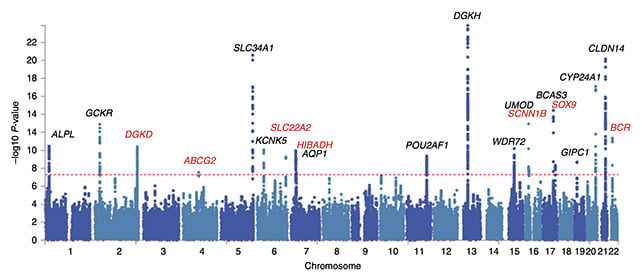 A GWAS (like this for kidney stone disease) associates specific genes with specific diseases. (Howles et al., Nat. Commun., 2019/CC BY 4.0)
“Type 1 diabetes is a complex disease characterized by autoimmune destruction of beta cells, but the underlying etiology is not well understood,” write the researchers in their published paper.
“The timing of progression to clinical diabetes varies widely across individuals, ranging from very early in childhood to adult onset.”
While the HLA-DR3 and HLA-DR4 genetic profiles and early signs had hinted at two types of type 1 diabetes, the new findings point to different biological machinery and mechanisms being involved as well.
 frameborder=”0″ allow=”accelerometer; autoplay; clipboard-write; encrypted-media; gyroscope; picture-in-picture; web-share” referrerpolicy=”strict-origin-when-cross-origin” allowfullscreen>
The HLA-DR3 results pointed towards immune cells called mast cells, linked to allergies and inflammation, which keep watch for potential infection and foreign invasion.
With the HLA-DR4 genetic pattern, the body’s T cells were more strongly implicated. These immune cells directly attack other cells when ordered to, and in the case of type 1 diabetes, are known to destroy the beta cells in the pancreas.
“This reveals that type 1 diabetes in a DR3 and DR4 background may represent heterogeneous sub-forms of type 1 diabetes at the genetic level,” write the researchers.

To add some perspective, the researchers say the genes driving type 1 diabetes in HLA-DR3 cases compared to HLA-DR4 cases are as distinct and separate as they are when comparing schizophrenia and bipolar disorder.
And that brings us back to what we mentioned at the start: if type 1 diabetes can develop through different biological pathways, then separating treatments and treatment targets might be a more effective approach.
“Given heterogeneity in genetic risk and disease mechanisms in non-DR3/DR4 type 1 diabetes, effective prevention of type 1 diabetes may require distinct therapies in this group as well,” write the researchers.
These results now need to be tested further, to see if type 1 diabetes needs classifying in more detail as a disease that can be caused by several overlapping sets of triggers rather than one single route.
Knowing someone’s genetic background could help in figuring out the best treatment for them.
Now that researchers know there might be a possible distinction in the build-up to type 1 diabetes, it can be taken into account in future studies. The results of clinical trials of diabetes drugs, for example, could be separated by HLA-DR3 and HLA-DR4 patients.
Another possibility for future research is to follow type 1 diabetes patients more closely over time, to see how the condition develops based on genetic profile and other factors, such as autoantibody development and environmental exposures.
Related: This 70-Year-Old Diabetes Pill Might Also Slow Down Aging
“The results of our study should have wide application to the design of future studies,” write the researchers.
“DR3 and DR4 status could be considered in continued genetic association studies and risk prediction models of type 1 diabetes, for example, to understand risk variant interactions with HLA background.”
The research has been published in Diabetologia.
This article was fact-checked by Peter Dockrill and edited by Peter Dockrill. While we pride ourselves on our process, we are only human. If you spot a mistake, please let us know.