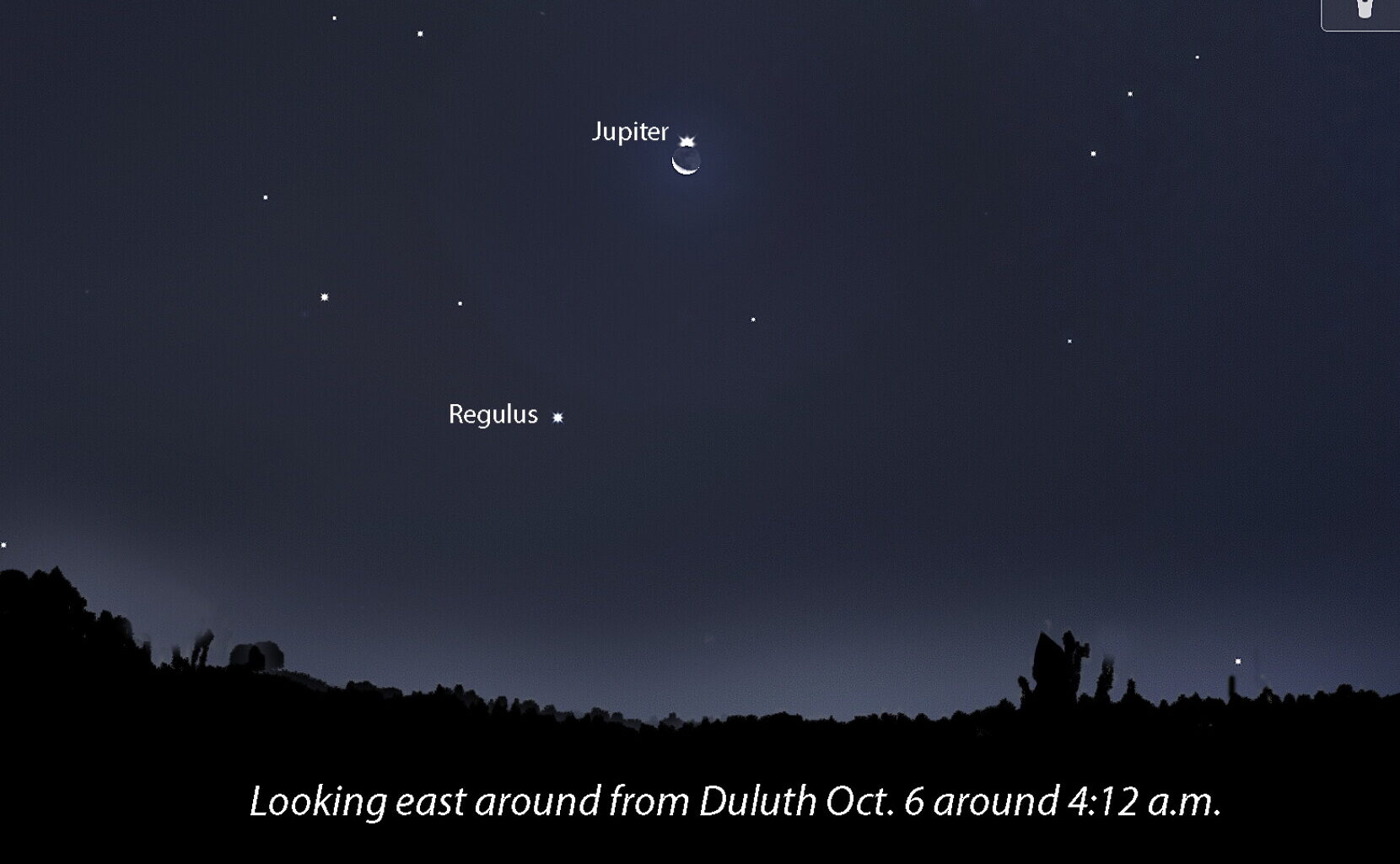
Like a magician, the moon will make Jupiter disappear on the morning of Oct. 6, then “pull it out of a hat” less than hour later. The rare event, called an occultation, will be visible from the Duluth region and much of eastern North America Tuesday morning before dawn, low in the eastern sky. I wish it were happening at a more convenient time, but nature has a habit of not consulting with humans.
Times vary depending on your location, but for the Duluth region, the bright edge of the lunar crescent first “touches” the planet at 3:31 a.m. A little more than a minute later, Jupiter is out of sight. I love an underdog and get a quiet thrill seeing a small body like the moon, just 2,160 miles across, effortlessly cover a planet 11 times wider than Earth.
We should be able to follow Jupiter almost to the bright crescent’s edge by eye alone, but if lunar glare interferes, use binoculars. Once covered, the gas giant will be tucked behind the moon for some 40 minutes. Starting at 4:12 a.m., it blazes back into view along the dark edge. Watching Jupiter slowly materialize from darkness and swell to full brilliance should be an amazing sight.
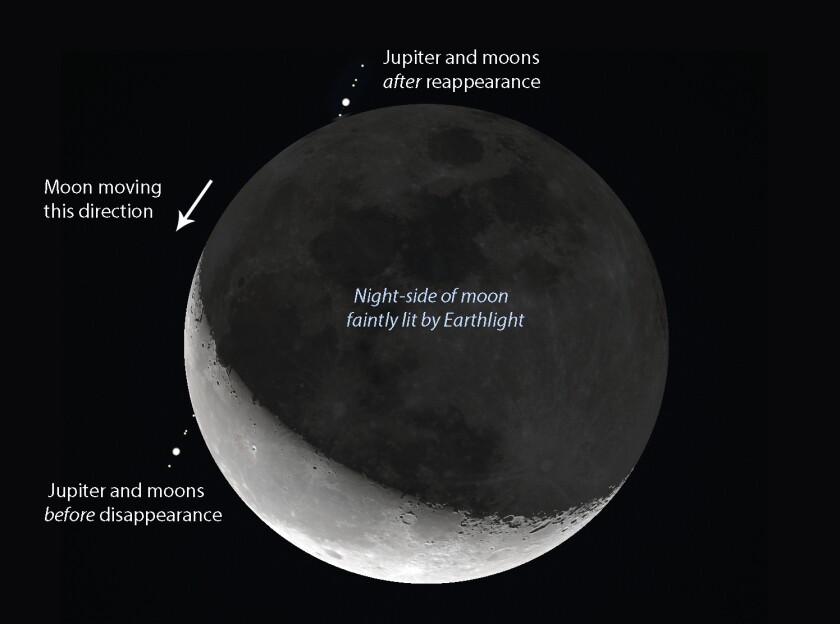
As the moon moves east — down and to the left — in its orbit around the Earth, it covers and then uncovers Jupiter and its four bright Galilean moons on the morning of Oct. 6. You’ll need a small telescope to see the moons. Jupiter’s path behind the moon is shown for the Duluth region.
Contributed / Stellarium with additions by Bob King
Jupiter takes nearly 90 seconds to extricate itself, after which it shines triumphantly atop the lunar crescent. Thereafter, the moon and planet remain close companions through dawn. To find out disappearance and reappearance times for your location, go to
http://www.lunar-occultations.com/iota/bstar/1006jupiter.htm
and look up the largest city nearest you. Note that time is UT or Universal Time. Subtract 4 hours to convert to Eastern Daylight (EDT), 5 hours for CDT, 6 hours for MDT and 7 hours for PDT.
Going into the event, give yourself at least 15 minutes lead time to get oriented. Since the moon will be only about a fist high when Jupiter fades out, be sure you observe from a spot with an unobstructed view of the east-northeast sky.
Small telescope owners will see the crescent gobble up and release both Jupiter and its four brightest moons — Io, Europa, Ganymede and Callisto. Bright light from the moon will make it difficult to see their disappearances, but give it a try. Europa vanishes first at 3:27 a.m., followed 2 minutes later by Callisto and Io (3:29 a.m.), then Jupiter (3:31 a.m.) and finally Ganymede at 3:34 a.m.
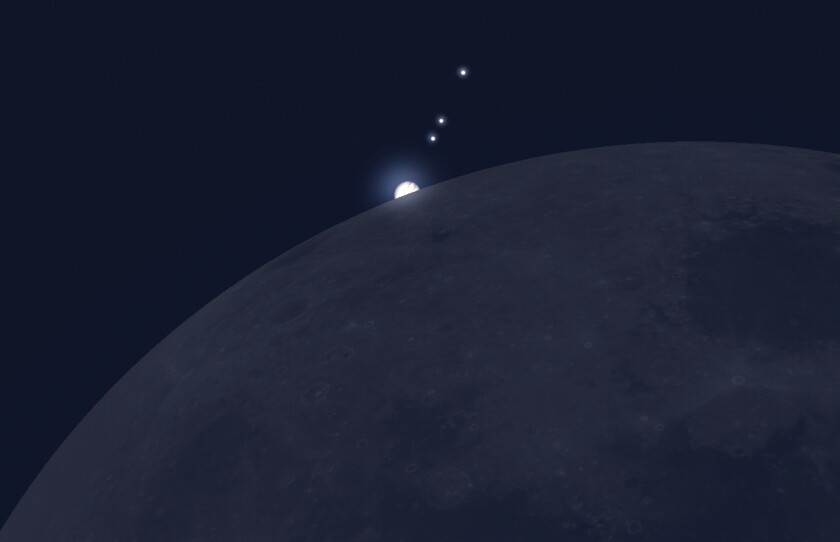
The most dramatic part of the occultation will be Jupiter’s reappearance at the moon’s dark limb where the dim moon and brilliant planet make a striking contrast. A small telescope will easily show all four of Jupiter’s Galilean satellites, three of which are shown here. From top: Europa, Callisto, Io and Jupiter.
Contributed / Stellarium
Reappearances at the moon’s dark edge are dramatic. Europa leads the gang at 4:07 a.m., followed by Callisto (4:09 a.m.), Io (4:10 a.m.), Jupiter (4:12 a.m.) and Ganymede (4:14 a.m.). If you think about it, this isn’t a single occultation. It’s five!
According to meteorologist and amateur astronomer Joe Rao, easily visible Jupiter occultations happen only about once every 13 years for a particular location. Let’s hope the weather cooperates for what will likely be a once-in-a-lifetime sight for many.

“Astro” Bob King is a freelance writer and retired photographer for the Duluth News Tribune. You can reach him at nightsky55@gmail.com.