
ⓘ NASA – Unsplash
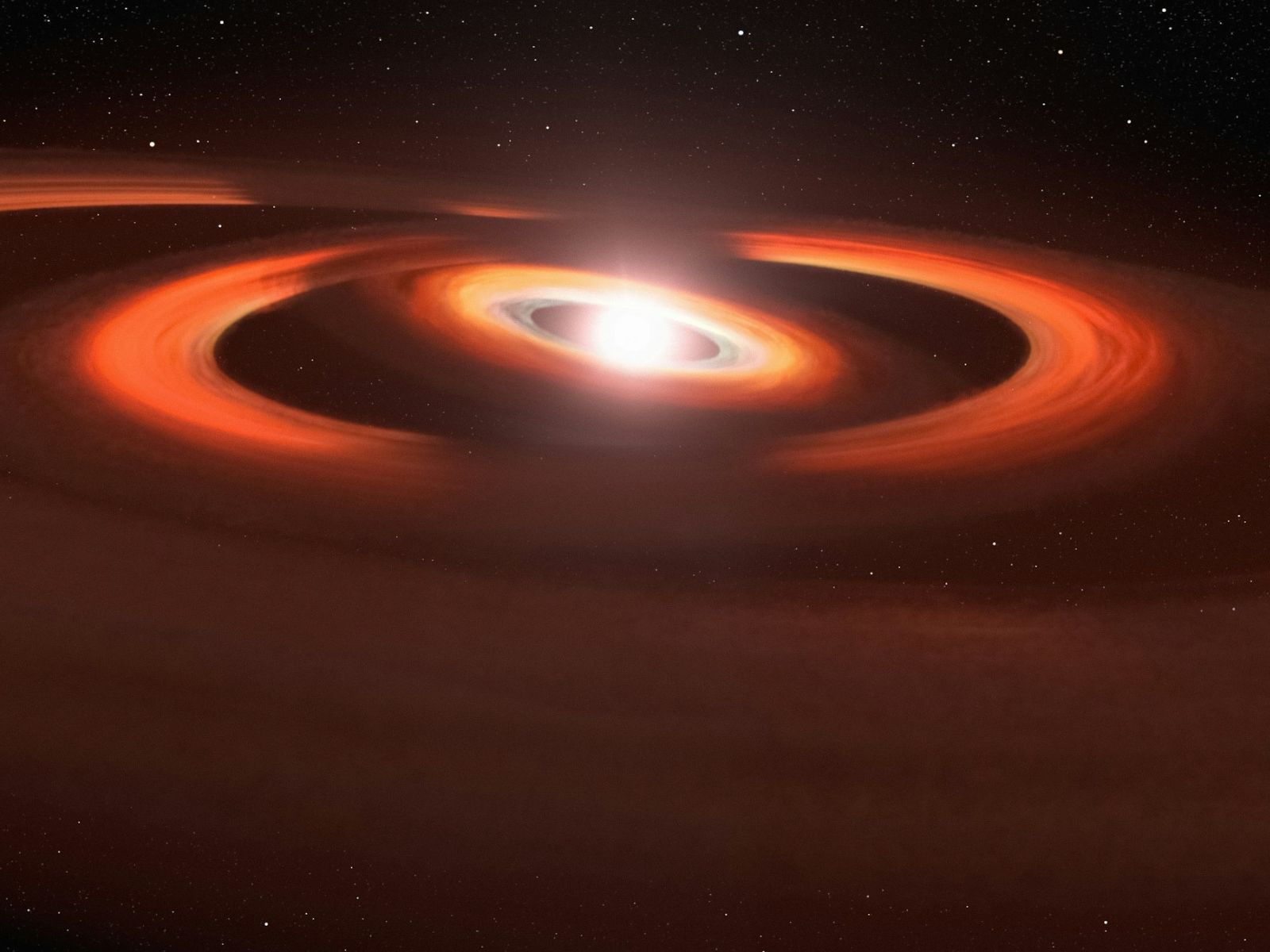
An artist’s illustration showing a quasar and a black hole.
The previous record was set by J1729+6410, but that’s now ancient history. Indeed, astronomers have detected a quasar in the early universe that has broken that record. And by analyzing it, they have also determined the mass of its black hole.
Observing the universe, particularly the early universe, allows astronomers to break certain records. This was recently the case with the quasar J1504+6252, which is the oldest and most distant quasar discovered to date.
This announcement was made by an international team of researchers led by Julien Wolf. To detect it, they analyzed more than a million observations made by the Euclid telescope, which was launched in 2023 to better understand dark energy and dark matter. However, additional observations were conducted with the James Webb Space Telescope and the Hubble Space Telescope to determine the black hole’s mass.
Thus, this quasar is observed as it was 13.1 billion years ago, when the universe was less than 5% of its current age. The mass of the black hole at the center of this quasar is estimated to be 360 million times that of the Sun. However, astronomers do not know how this black hole could have reached such a mass in just 630 million years, as Julien Wolf points out:
“About 630 million years after the Big Bang, its black hole had already grown to about 360 million times the mass of the sun. But how?”
ⓘ ESA
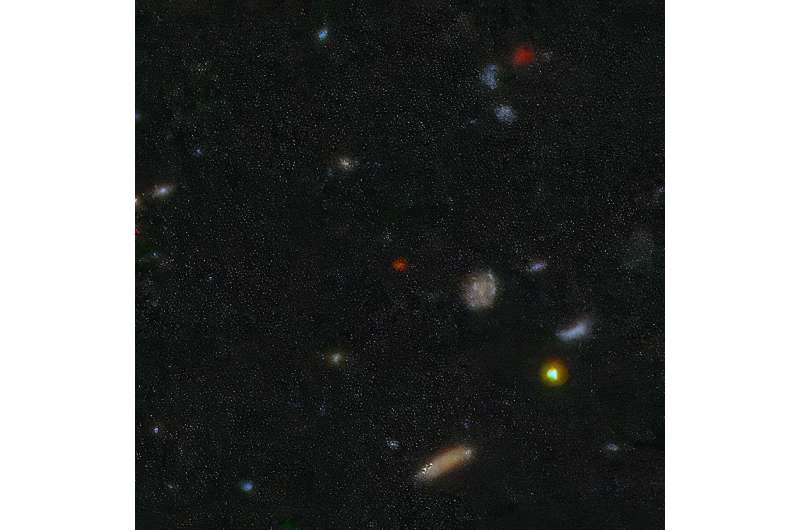
An image showing the quasar J1504+6252 (in red at the center).
Therefore, while J1504+6252, also known as Dún Aonghasa, has marked a major scientific breakthrough, it remains very mysterious. In addition, these records could also be broken in the coming months, particularly thanks to Euclid.
 Alexis Stegmann – Tech Writer – 868 articles published on Notebookcheck since 2025
I’ve been working in the field of web writing for several years, and I’m passionate about keeping readers up to date with the latest news on astronomy, technology, the world of video games and other exciting subjects. In particular, I’ve had the opportunity to work on a number of websites, which has enabled me to cover a wide range of subjects. In my personal life, I’m passionate about a wide range of subjects, including astronomy, video games, history and science. I’m also drawn to psychology, which is a subject that deserves greater documentation and recognition.