
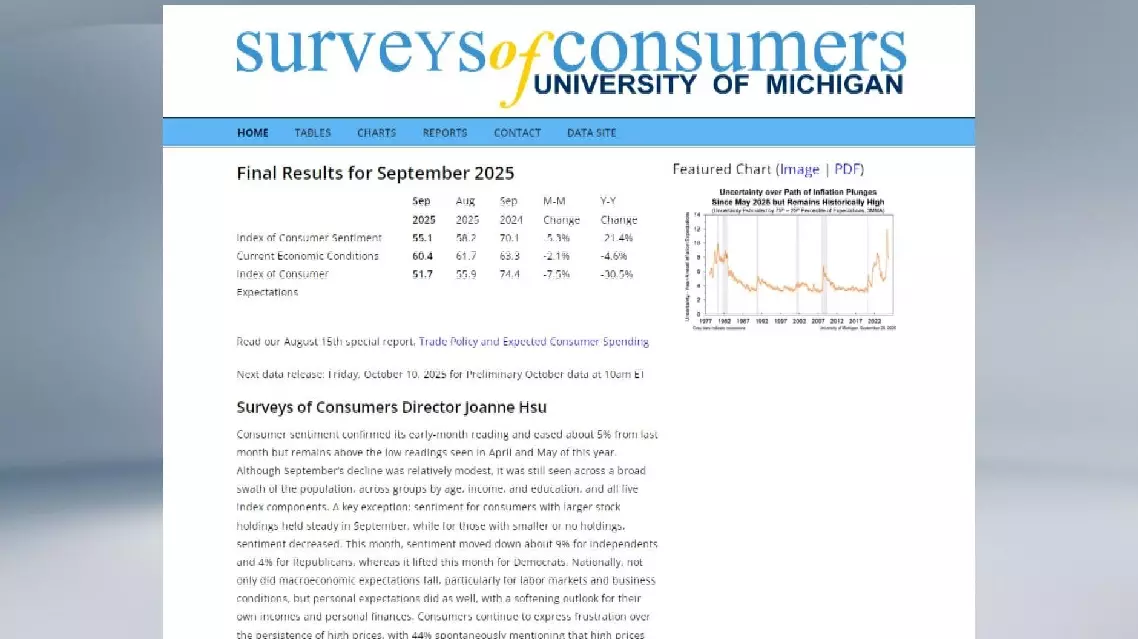
The U.S. Consumer Sentiment Index released Friday by the University of Michigan Surveys of Consumers fell to 55.1 in the September 2025 survey, down from 58.2 in August and below last September’s 70.3.
The Current Economic Conditions Index fell to 60.4, down from 61.7 in August and below last September’s 63.8. The Index of Consumer Expectations fell to 51.7, down from 55.9 in August and below last September’s 74.5.
Consumers continue to express frustration over the persistence of high prices, as 44 percent of consumers mentioned that high prices are eroding their personal finances, the highest reading since November 2024, the survey showed.
Tariffs are still highly relevant to consumers. About 60 percent of consumers provided comments about tariffs, compared with 65 percent in May and 28 percent in January. Nearly 70 percent of consumers expect inflation to exceed any income gains in the year ahead, up from less than 60 percent in September 2024.
About 65 percent of consumers expect unemployment to rise in the year ahead, up from 57 percent in July and 35 percent a year ago. Consumers’ expected probability of personal job loss ticked up in September to its highest reading since March, suggesting that consumers are indeed concerned that they may be personally affected by any negative developments in labor markets.
The U.S. Federal Reserve’s preferred inflation gauge rose in August from a year earlier, while consumer spending increased slightly more than expected, the Bureau of Economic Analysis (BEA) of the Commerce Department said Friday.
A BEA report suggested that Americans ramped up their spending in August. Personal Consumption Expenditures (PCE) price index grew 2.7 percent year on year in August, higher than a 2.6 percent growth in July.
However, their costs of living were on the rise as food and other goods became even more expensive last month and service prices remained stubbornly high. Core PCE price index, excluding volatile food and energy prices, grew 2.9 percent year on year in August, equal to the growth in the prior month. This so-called core inflation index is still higher than the 2 percent target set by the Federal Reserve.
The BEA said that PCE increased 0.6 percent in August, following an unrevised 0.5 percent advance in July. Personal income rose 0.4 percent, with a similar gain in July.
U.S. consumer sentiment falls in September on inflation, unemployment worries
Political and academic figures from the Middle East denounced the speech given by Israeli Prime Minister Benjamin Netanyahu at the United Nations General Assembly (UNGA) on Friday, describing it as arrogant and provocative, while calling for regional unity and resistance.
Netanyahu delivered a speech during the general debate of the 80th session of the UNGA. Scores of delegates walked out of the General Assembly hall in protest when Netanyahu took the stage.
In his speech, Netanyahu accused the Palestinians of not believing in the two-state solution, and also alleged that “the persistent Palestinian rejection of a Jewish state in any boundary is what has driven this conflict for over a century.”
“The speech Netanyahu gave at the United Nations was arrogant and haughty. Such a speech can only be confronted by military force. What Yemen is doing is the best way to face this arrogance and the sense of superiority expressed by Netanyahu. From here we tell Netanyahu: we will confront you with rockets, unmanned aerial vehicles and all weapons — this arrogance and the impunity you seek to exercise against the peoples of the region with U.S. support and a U.S. green light,” said Abdulrahman Al-Ahnouni, Media Relations Official for Ansar Allah, or the Houthis group.
“What Netanyahu is saying amounts to nothing but a call for bloodshed. We say to the world, to the peoples of the world, and to the leaders of the Arab and Muslim nations: isn’t the challenge Netanyahu has launched enough? Respect yourselves, unite, respond to Netanyahu, and save the Palestinian people — especially in Gaza — from the indiscriminate assaults Netanyahu proclaims against women, children, even trees and stones,” said Dirham Abu Al-Rijal, President of the Yemeni Supreme Council of Civil Society Organizations.
In his address, Netanyahu criticized the countries that have announced their recognition of the State of Palestine over the past few days.
France, Britain, Portugal, Australia and Canada are among Western nations that have recently recognized the State of Palestine in support of the two-state solution over the past few days. So far, more than 150 UN member states have recognized Palestine.
“Benjamin Netanyahu, shocked by the international recognition of Palestine, stood at the podium of the United Nations, repeating previous threats, which are not based on any facts or realities on the ground. It was striking in his speech that he demanded the disarmament of the Palestinians and the disarmament of the resistance in Lebanon, while the Israelis are increasingly arming themselves, and the U.S. administration is providing them with all kinds of weapons,” said Hamza Al-Bishtawi, a Palestinian journalist and political author in Lebanon.

Middle East voices slam Netanyahu’s UN speech

Middle East voices slam Netanyahu’s UN speech