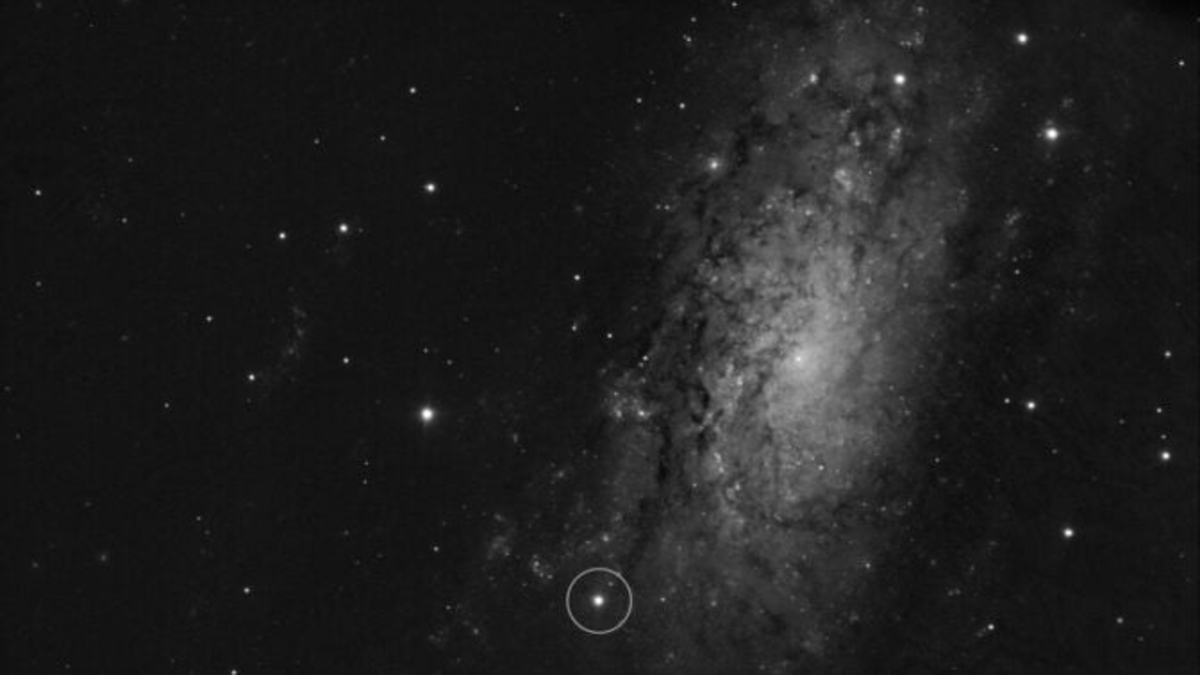
Astronomers have captured a supernova in its early stages, just 26 hours after it was first detected in April 2024, using the European Southern Observatory (ESO). The supernova that was captured using the observatory’s Very Large Telescope (VLT) is SN 2024ggi, located in the NGC 3621 galaxy.
A Rare Sighting Of A Supernova In Its Earliest Stage
The sighting of this supernova at its early phase is the first time we have the opportunity to see its shape in the earliest phase. This is very important for researchers and the astronomy field, as it can provide insight into the nature of supernovae.
Yi Yang, an assistant professor at Tsinghua University in Beijing, China, was the lead author on the study that led to this sighting. Speaking on this sighting, Yang says, “The geometry of a supernova explosion provides fundamental information on stellar evolution and the physical processes leading to these cosmic fireworks.”
The method used to observe this supernova is known as spectropolarimetry, which provides information about its geometry, unlike any other type of observation. By polarising the light emitted by SN 2024ggi after its explosion, researchers were able to reveal hidden clues about its geometry.
Using the data gathered with this observation method, the team of astronomers discovered that the supernova was shaped like an olive. As the explosion expanded, the shape flattened out; however, the axis of symmetry of the ejecta remained the same.
Yang says, “These findings suggest a common physical mechanism that drives the explosion of many massive stars, which manifests a well-defined axial symmetry and acts on large scales.” This discovery is now changing astronomers’ understanding of supernovae.
What Is A Supernova?
As a massive star reaches the end of its life, it explodes into what is called a supernova. The supernova considered in this article was created by the death of a red supergiant star, which was almost 15 times heavier than our Sun.
As it ran out of its last source of fuel, its core collapsed, its gravitational force contracted, and the pressure of its nuclear energy expanded. This resulted in the explosion, which was captured in its early stage by the European Southern Observatory (ESO).