DANIEL FIENBERG Bringing eyeballs back to broadcast in a major way, the best television show of the fall was a seven-part anthology series that sparked debate about the limitations of star power and whether budget and quality are inextricably intertwined. Although seemingly reset from year-to-year, it’s technically a drama owing to key elements that recurred from last fall, including the wunderkind multi-hyphenate at the story’s center: a producer of the highest level, unbound by the medium’s traditions.
Despite efforts to put restrictions on running time, some installments made a mockery of duration, with one episode running well over six hours — unheard of outside of the realm of Stranger Things.
We laughed. We cried. We held our collective breath waiting to see whether or not the series would stick the landing, only to end up with a thrilling finale that satisfied one part of the fandom and left the rest of the audience fixated on the smallest of details, the most random of choices.
Thank you to the Los Angeles Dodgers and Toronto Blue Jays for briefly saving one of the most lackluster TV autumns I can recall. Fox is certainly grateful. Heck, all of broadcast television is grateful, because otherwise we’d only mention ABC, NBC, Fox and CBS in the context of questions like, “Boy, Nashville sure has some wacky emergencies!” or “Boy, the cast of DMV is better than the TV show they’re currently in.”
It was a fall where people were constantly coming up to me begging for TV recommendations and for a while, I was forced to recommend favorites from the first half of the year, urging people, for the hundredth time, to check out Netflix’s North of North or Adult Swim’s Common Side Effects.
But as we transition from fall to winter, it becomes clear that there were absolutely some treasures, with or without the unparalleled brilliance of Shohei Ohtani.
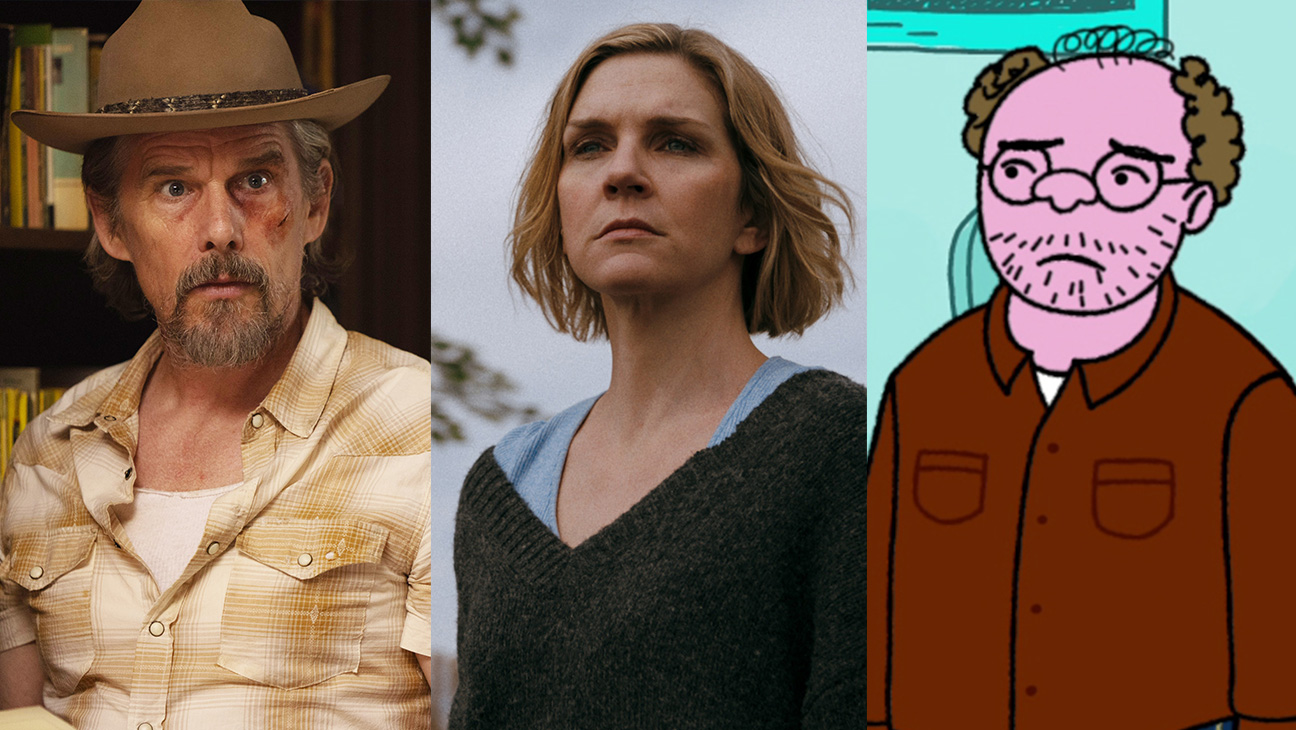
My two most anticipated shows of the fall withstood the weight of expectations and turned out to be exceptional and distinctive star vehicles. Vince Gilligan moved to Apple and returned to his X-Files roots for the sci-fi horror dramatic comedy Pluribus, which used its ultra-mysterious and yet ultra-familiar genre trappings for a droll meditation on the eternal clash between collective joy and individual grouchiness. The latter was embodied flawlessly by Rhea Seehorn, seemingly emerging as far more than every TV critic’s favorite unrecognized actor. Meanwhile, over on FX, Ethan Hawke took a beating across the nine episodes of Sterlin Harjo’s The Lowdown, a celebration of pulp mystery, white guilt and the glorious melting pot of Oklahoma.
Actually, a LOT of the fall TV that I had the highest hopes for delivered, which is far from a common occurrence. There have been several times that I’ve started one of these seasonal conversations by saying, “The big shows stunk, but we found some good stuff under the radar!” This fall, the radar … umm … did whatever radars do. It worked, is what I’m saying.
Angie, how was your radar working this fall? No, literally: How do radars work?
ANGIE HAN I didn’t go into TV criticism because I’m good at knowing and explaining science-y things like “how radars work.” But to your actual point: So much of fall TV this year has been the equivalent of the Los Angeles Dodgers, the super-talented, super-rich, super-famous top dogs already heavily favored to win the World Series winning the World Series. Is anyone surprised that the latest shows from heavy-hitting talents like Vince Gilligan and Sterlin Harjo are great? No. Was it nevertheless immensely satisfying when Pluribus and The Lowdown turned out to be as good as we’d hoped? Oh, yes.
The same could be said of several other highlights from the past few months. What keeps things interesting, though, is that despite hailing from familiar pedigrees, none of these shows just feels like more of the same.
Long Story Short, from Bojack Horseman’s Raphael Bob-Waksberg, was a bittersweet reflection on time, familial love and Jewishness as explored through one normal human family; it shared some of Bojack’s gift for combining laugh-out-loud humor with profound melancholy, but tilted more toward the latter and featured nary a Bojack-ian anthropomorphized animal in sight.
Alien: Earth, the offspring of Fargo’s Noah Hawley and Fox’s unkillable sci-fi franchise, devoted one of its middle chapters to what is essentially a recreation of 1979’s Alien, sure — but it spent the rest of its time expanding the series’ ongoing preoccupations with robots, monsters, capitalism and hubris in new directions, with new flavors of all of the above.
I didn’t love everything about HBO’s I Love LA, from Shiva Baby and Bottoms breakout Rachel Sennott, but I appreciated its ambitious and honest attempts to grapple with a specifically Zillennial take on fame, friendship and hustle culture, from her distinctly Zillennial perspective.
HBO’s The Chair Company … actually, no, that one does feel like a prestige-series-length expansion of an I Think You Should Leave sketch. But that’s not a bad thing when the extra time allows Robinson and Kanin to push their signature “weird guy doubles down on inane thing to the point of self-destruction” storyline farther than ever before, and to take you down the rabbit hole with them.
So, yeah, maybe our faves weren’t necessarily out-of-nowhere shocks to the system, but they managed to surprise me nonetheless. Just like how anyone could have predicted the Dodgers would win, but no one would have foreseen that getting there would involve an 18-inning game, a ball getting wedged under a wall, a benches-clearing almost-brawl, etc.
FIENBERG Sigh. Long Story Short was so very good and so effectively Jewish that it made me resent how repetitive and generally toothless the second season of Nobody Wants This was and (how heavily and aggressively Netflix promoted one and not the other). Long Story Short found a way to combat popular culture’s stereotypical-Jewish-mother problem with nuance and evolving storytelling, while Nobody Wants This attempted to do the same by mostly writing the Jewish mother out of the show. Oh well.
It isn’t surprising that HBO continues to push hard at the boundaries of cringe comedy — this is the home of Girls and Curb Your Enthusiasm — but it may be achieving peak cringe this year. After the spring triumph of the second season of Nathan Fielder’s The Rehearsal, HBO is raising the bar with The Chair Company, which has an uncomfortable tone that feels unsustainable until it just keeps going. The blend of conspiratorial thriller drama and absurdist humor is hard to get right (Netflix’s The Vince Staples Show does it fairly well in its second season), but Tim Robinson and company are getting it right so far.
A lot of the shows from familiar auspices have delivered familiar and satisfying results this fall, including Down Cemetery Road, which shares literary origins with Slow Horses and offers the pleasure of watching Emma Thompson play her own version of Gary Oldman’s Jackson Lamb — only more stylish and less flatulent.
That does not, however, mean that every TV auteur and beloved star has delivered up to their high standards.
Ryan Murphy’s one-two punch of Monster: The Ed Gein Story and All’s Fair were met with critical hostility — the first is a thematically repetitive and exploitative condemnation of true crime and the audience who loves it, the second a bizarrely overqualified ensemble of acting titans playing second fiddle to Kim Kardashian. Glen Powell generates few, if any, laughs in the sour sports satire Chad Powers, while Andy Muschietti made so much money with his two It movies that he decided to basically remake them for It: Welcome to Derry.
But All’s Fair and Monster are hits and you needn’t worry about Glen Powell or Pennywise. And some things are just polarizing. I hated Brad Ingelsby’s Mare of Easttown follow-up Task, which I found to be a hollow mixture of implausible dramatic contrivance and unearned misery. But other viewers found it emotionally devastating.
Angie, what high-profile shows let you down this fall?
HAN I was going to say something mean about the Mets, but since this is a TV column and not a baseball one, I’ll refrain and just say that you’ve already named several I’d put in that category.
I didn’t dislike Task as much as you did, but it turns out that without Mare of Easttown’s touches of warmth and humor, Pennsylvania is just an unrelenting pit of gloom. Chad Powers made me wonder if I disliked Glen Powell, a feat I would have previously assumed to be impossible. Monster: The Ed Gein Story and All’s Fair felt like the Ryan Murphy machine testing how much contempt they could show for their audience and still keep ’em coming back for more.
Then there are the promising-on-paper shows that didn’t flop, but didn’t really take off, either. AMC’s Talamasca: The Secret Order, like It: Welcome to Derry, tried to replicate the pleasures of its parent project, but despite a few bits of charm it mostly just answered questions I wasn’t asking to begin with. The Paper was cute, but it was always going to be impossible for it to live up to the legacy of its beloved predecessor … and indeed it did not, if the general lack of buzz is any indication. I only partly blame Peacock’s head-scratching decision to drop all the episodes at once. Netflix’s House of Guinness was frothy fun — not to mention an ideal showcase for Anthony Boyle’s ability to rock an old-timey mustache — but I don’t think it’s sparking Peaky Blinders-level obsession in anyone.
But enough about these big-market, big-dollar teams. Let’s talk about the Milwaukee Brewers equivalents, the little TV shows that could. Women Wearing Shoulder Pads is maybe the ultimate underdog, a queer Spanish-language stop-motion animated series created by Undone and Tuca & Bertie writer Gonzalo Cordova and aired by Adult Swim. Puppet sex, telenovela twists and surreal flourishes braid together in the saga of 1980s Ecuadorian businesswomen battling for the future of the guinea pig — and somehow, it’s even stranger than that description makes it sound. In a TV landscape currently dominated by familiar names and franchises, it’s a treat to see something so delightfully out of left field.
FIENBERG Well, the Brewers didn’t provide much of a challenge for the Dodgers, but they provided an important service in depicting Wisconsin as something other than a haven for ghoulish serial killers (and that one season of Top Chef, though I can’t say for certain that there weren’t any serial killers in that cast).
We’ve both trashed Monster: The Ed Gein Story sufficiently, so I want to say something positive about it. Watching eight episodes of Monster: The Ed Gein Story in one sitting on premiere day — Ryan Murphy doesn’t believe in screeners for critics anymore — really made me appreciate Devil in Disguise: John Wayne Gacy when I watched it the next day. Patrick Macmanus’ over-stuffed eight-parter about the prolific serial killer operating down the road in Chicagoland was subtle, somber, respectful and restrained, all attributes that will never be mentioned in a Monster review. Michael Chernus is great as the clown-loving killer whose love for clowns is barely addressed, but the series is generally an ensemble about Gacy, the law enforcement figures who pursued him, his victims and the societal conditions that allowed him to operate unchecked for years. It isn’t flawless, but it’s substantive.
Good call on the charmingly odd Women Wearing Shoulder Pads, which I recommended in my weekly Now See This newsletter, but hadn’t heard anybody discuss in the wild. I felt like Common Side Effects had a bit of a mainstream breakthrough, but Shoulder Pads was perhaps just a bit too strange.
But you never know what’s going to “work.” Mae Martin’s Netflix limited series Wayward didn’t feel like a breakout either, but it was in the Netflix Top 10 for a few weeks (even if I assume many of those viewers were left more perplexed than gratified). I still dug how the show, an extremely dark semi-satire of the troubled kid correctional industry, always felt like it was on the verge of becoming something else and, thus, kept me guessing (in contrast to Netflix’s The Beast in Me, a thriller that never kept me guessing for a second).
I don’t know if a show with Michael Shannon, Matthew Macfadyen, Nick Offerman and Betty Gilpin could count as an underdog, but Netflix’s Death by Lightning, focusing on James Garfield’s unlikely rise to the presidency and his bizarre assassination, delivered three excellent episodes before a too-rushed conclusion. The stars are all great, especially Offerman, whose drunken, easily overlooked Chester A. Arthur become one of my favorite TV characters of the year.
And speaking of unlikely TV favorites? Benito Mussolini! Chances are good that unless you’re a Mubi subscriber, you haven’t even heard of Mussolini: Son of the Century, starring the spectacular Luca Marinelli as the fascist dictator. Directed by Joe Wright, it’s one of the most artistically audacious shows you could ever hope to see. Does it all work? No, but it’s a brash and bold and operatic cautionary tale.
Let’s go back to radars, Angie. Other than the arrival of pitchers and catchers at spring training in February, what are you looking forward to over the next couple of months?
HAN Hmm … does the final season of Stranger Things count, if I’m mostly just looking forward to not ever having to think about those overgrown kids anymore?
Not to turn up my nose at With Love, Meghan: Holiday Celebration or anything — I am sincerely sure the Duchess of Sussex does amazing things with gift wrap — but aside from the usual procession of holiday specials, this winter’s looking pretty sleepy.
One possible highlight is Netflix’s The Abandons, which looks like the most Taylor Sheridan drama not actually produced by Taylor Sheridan (it’s created by Sons of Anarchy’s Kurt Sutter). If nothing else, its cast list — Gillian Anderson! Michael Greyeyes! Nick Robinson! Patton Oswalt! — is too promising to ignore. Similarly, His & Hers, also on Netflix, has sold me on its talent alone: Tessa Thompson, Jon Bernthal, Lady Macbeth director William Oldroyd. And I have no idea what exactly Adult Swim’s one-off animated special The Elephant is going to be, but after Common Side Effects and Women Wearing Shoulder Pads, I’m down to see whatever weirdness they’re cooking up.
Then there’s the usual cavalcade of returning shows and spinoffs from now ’til February: Spartacus: House of Ashur, Game of Thrones: A Knight of the Seven Kingdoms, Star Trek: Starfleet Academy, Destin Daniel Cretton’s Marvel comedy Wonder Man, a new season of Scrubs. Am I pumped for all of them? Not at all. But I’d be remiss not to mention them at the end of a long conversation about how many of this fall’s big winners have also been the buzziest and most obvious ones.
A great show can come from anywhere, and sometimes that includes hugely beloved properties you might fear had already been strip mined to death. Check back here in a few months, I guess, to see if a single one of those actually wins us over — or if we really will be forced to start saying things like “The World Baseball Classic is the best TV show of 2026 so far!” come March.