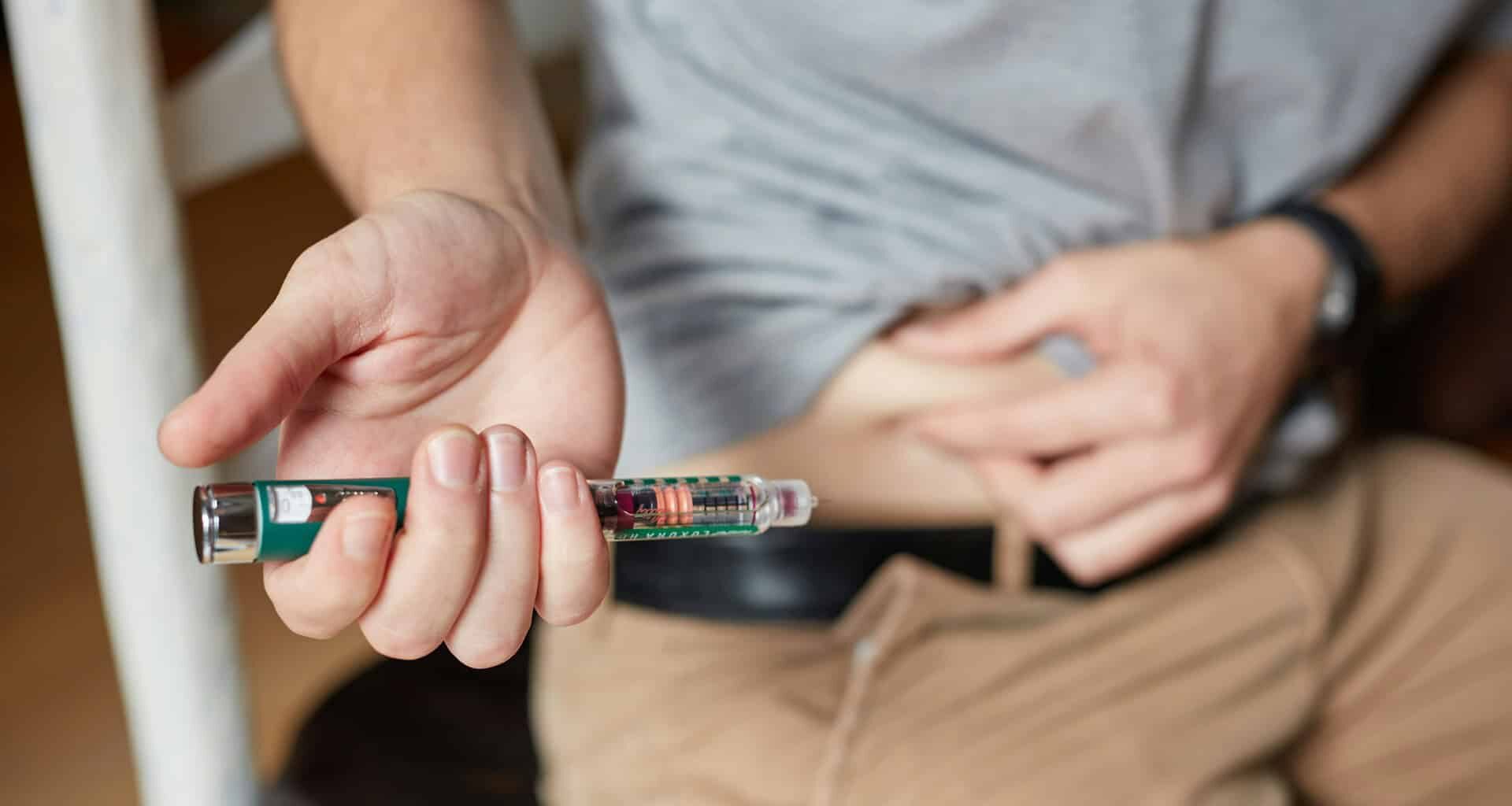
 In the future, insulin injections might become part of the past. Credit: Unsplash.
If you live with diabetes, your day is punctured by sharp little rituals: pens, syringes, infusion sets, or fingersticks. Now imagine swapping some of that hardware for medicated skin cream that never pokes your skin.
That is the vision behind a new Nature study describing a polymer that can haul insulin straight through the skin and into the bloodstream in animals, normalizing blood sugar for hours without a single needle.
Why insulin and skin don’t get along
On paper, an insulin cream or patch sounds obvious. Transdermal drugs are easy to use at home, painless, and can drip-feed a steady dose into the body over time. Nicotine and hormone patches are just two examples of this already on the market.
The problem is that human skin is built to keep things out, and insulin is almost custom-designed to be excluded.
The outermost layer, the stratum corneum, is a stack of dead skin cells glued together with fatty lipids — like a brick wall sealed with greasy mortar. Small, slightly oily molecules can sneak through. Big, water-loving ones bounce off.
Insulin is a relatively large protein with a hydrophilic exterior. In other words, it loves water and hates oil. That makes it exactly the kind of molecule the stratum corneum rejects. For decades, the dogma was simple: no needle, no insulin.
The new work doesn’t break that rule so much as sidestep it with some clever chemistry.
Instead of trying to brute-force insulin through the barrier, the team — led by researchers at Zhejiang University in China — looked at a subtler feature of skin: its pH gradient. The surface is mildly acidic, while deeper layers trend toward neutral.
They designed a polymer that changes personality as it travels along this gradient.
The star of the show is a mouthful of a molecule: poly[2-(N-oxide-N,N-dimethylamino)ethyl methacrylate] (OP), a “polyzwitterion,” a kind of charged polymer whose pH behavior can flip.
Near the acidic skin surface, OP carries a net positive charge. That lets it latch onto the negatively charged fatty lipids in the stratum corneum, embedding itself in the outer barrier. As it migrates into the more neutral environment below, OP switches to a neutral zwitterionic form. At that point, it stops clinging to the lipids and starts “hopping” along cell membranes, slipping through the viable epidermis and dermis and into the lymphatic system and blood. Insulin on its own still can’t make this journey, so the researchers chemically tied insulin to OP, creating a conjugate dubbed OP–insulin, or OP-I. The idea is simple: OP is the train, insulin is the cargo.
From petri dish to minipigs
The first tests were done using lab-grown human skin models and diabetic mice. Insulin alone barely crosses the barrier in this setup. Insulin paired with a more conventional polymer, PEG — an everyday pharmaceutical workhorse — does somewhat better, but still struggles. OP-I, though, moved much more effectively through the skin and into the underlying tissue.
Then came the part that matters to anyone counting carbs.
In mice with type 1 diabetes, a topical dose of OP-I was smeared onto the skin. Blood glucose levels fell to a normal range within about an hour — matching the effect of a standard insulin injection — and remained stable for roughly 12 hours.
Results on mice are encouraging, but still a long way from humans, so the team kicked it up a notch to diabetic minipigs, whose skin and overall physiology are closer to ours. The same basic pattern appeared: after a transdermal dose of OP-I, the pigs’ blood sugar dropped into the normal range in about two hours and stayed there for around 12 hours.
Inside the body, OP-I didn’t just float around aimlessly. The conjugate accumulated in organs that matter for glucose control — liver, fat tissue, skeletal muscle — where cells took it up and released the insulin cargo. Downstream, insulin receptors were activated and glucose uptake ramped up, just as you’d expect with injected insulin.
The difference was in the curve: instead of a sharp spike and gradual drop, the OP-I treatment produced a smoother, longer-lasting effect.
Patches, pens, or both?
Even if OP-I, or something like it, survives the clinical gauntlet, it doesn’t automatically replace every injection.
Different people manage diabetes in different ways: some rely on multiple daily injections, others on insulin pumps and continuous glucose monitors; some will want precise, rapid control around meals, while others might prefer slower, background dosing. A cream or patch that works over about 12 hours could slot in as a basal option, paired with fast-acting injected insulin at mealtimes, or as part of yet-to-be-designed regimens.
The work also falls within a broader effort to make insulin less needle-centric. Researchers are currently testing microneedle patches, long-acting depot formulations, smart insulin particles, and polymers made from natural materials that slowly release insulin in response to cues inside the body.
OP-I brings something different to the table: a way to sneak full-sized proteins across intact skin without puncturing it.