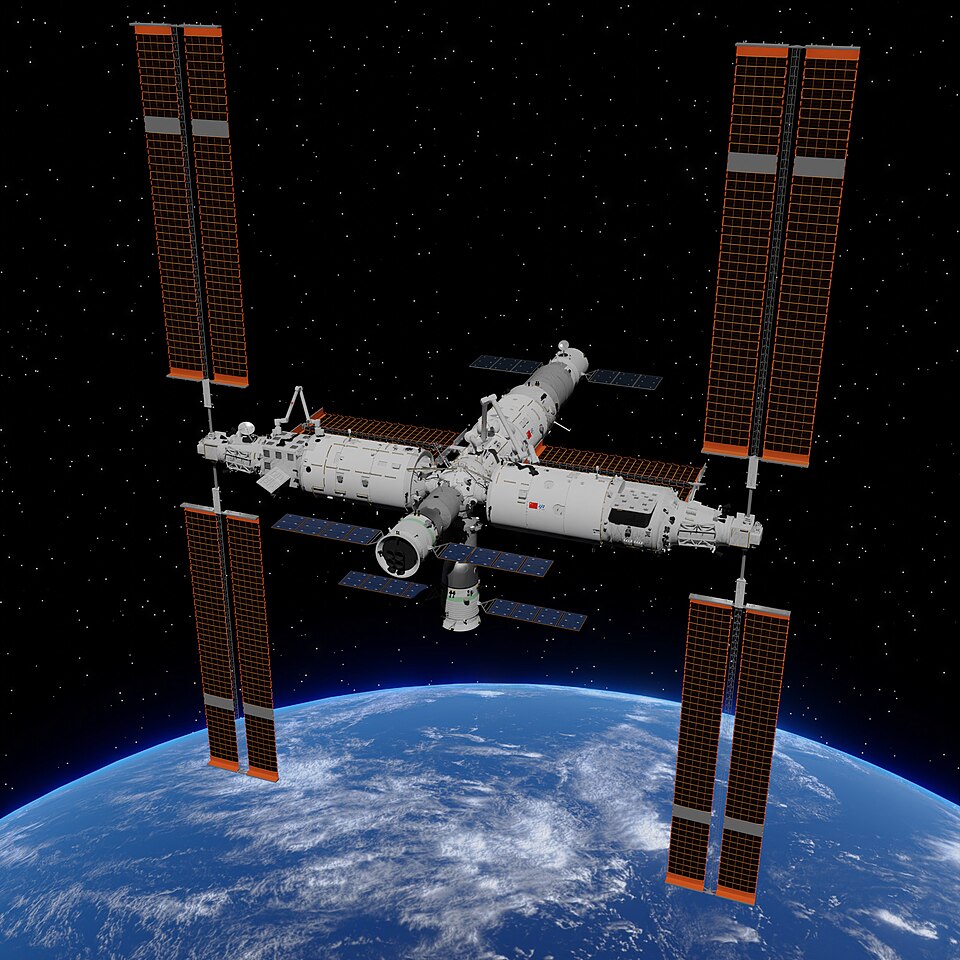
China is preparing to fire an uncrewed Shenzhou-22 capsule toward the Tiangong space station after the three astronauts of Shenzhou-21 were left without a functioning return craft. The crew, Zhang Lu, Wu Fei and Zhang Hongzhang, have been aboard the outpost since 31 October but are now effectively stranded following a chain of unexpected events.
Their original spacecraft departed without them on 14 November after the Shenzhou-20 crew used it to return to Earth. That swap only happened because the Shenzhou-20 capsule suffered a debris strike, leaving cracks in its viewport and rendering it unsafe for normal use.
Debris Strike Triggered A Domino Effect
The problem began when suspected space junk hit Shenzhou-20 shortly before its planned trip home. Engineers identified a crack in the craft’s viewing port, forcing a last-minute rethink. With no time to wait for a replacement, mission controllers ordered the Shenzhou-20 crew to ride back to Earth in the freshly arrived Shenzhou-21 capsule instead.
As a result, the Shenzhou-21 team remained on Tiangong without a viable lifeboat. Normally, the station only hosts six astronauts during brief handover periods, and China had insisted Tiangong could cope. But the damaged Shenzhou-20 still attached to the station, combined with an over-capacity crew period, raised concerns about the station’s limited resources.
Launch Preparations Already Underway
Signs point to China preparing to launch Shenzhou-22 earlier than scheduled. An airspace closure notice suggests lift-off could come around 25 November. The capsule will fly empty and carry supplies, serving primarily as a replacement return vehicle.
Space security specialist Victoria Samson told Scientific American: “I’m very glad that they (Shenzhou-20 crew) got home, but it is a bit disconcerting that the replacement crew apparently does not have a vehicle to come back to Earth.”
Once Shenzhou-22 arrives and docks, the damaged Shenzhou-20 is expected to be detached and guided to a safe deorbit over the Pacific Ocean.
Could The Damaged Capsule Still Work In An Emergency?
Although the cracked area is concerning, the Shenzhou spacecraft consists of three separate modules, and the return compartment is designed to withstand re-entry on its own. If the damage is confined to a non-return section, it might technically be usable in a last-resort escape scenario, although authorities have not confirmed this and appear keen to avoid such a risk.
A Temporary Crisis As China Eyes Future Upgrades
Despite the disruption, the Shenzhou-21 astronauts are still expected to complete their six-month mission. China also plans to introduce the new Mengzhou-1 spacecraft to Tiangong in 2026, eventually replacing the Shenzhou series, though crewed flights of the new design are not anticipated before 2027.
This latest incident echoes several cases on the International Space Station, where crews have also faced extended stays due to vehicle issues. But unlike those situations, the Shenzhou-21 team currently has no backup craft docked and ready.
With Shenzhou-22 now being rushed toward launch, China appears determined to end that gap as quickly and quietly as possible.
 Published by Kerry Harrison
Kerry’s been writing professionally for over 14 years, after graduating with a First Class Honours Degree in Multimedia Journalism from Canterbury Christ Church University. She joined Orbital Today in 2022. She covers everything from UK launch updates to how the wider space ecosystem is evolving. She enjoys digging into the detail and explaining complex topics in a way that feels straightforward. Before writing about space, Kerry spent years working with cybersecurity companies. She’s written a lot about threat intelligence, data protection, and how cyber and space are increasingly overlapping, whether that’s satellite security or national defence. With a strong background in tech writing, she’s used to making tricky, technical subjects more approachable. That mix of innovation, complexity, and real-world impact is what keeps her interested in the space sector.