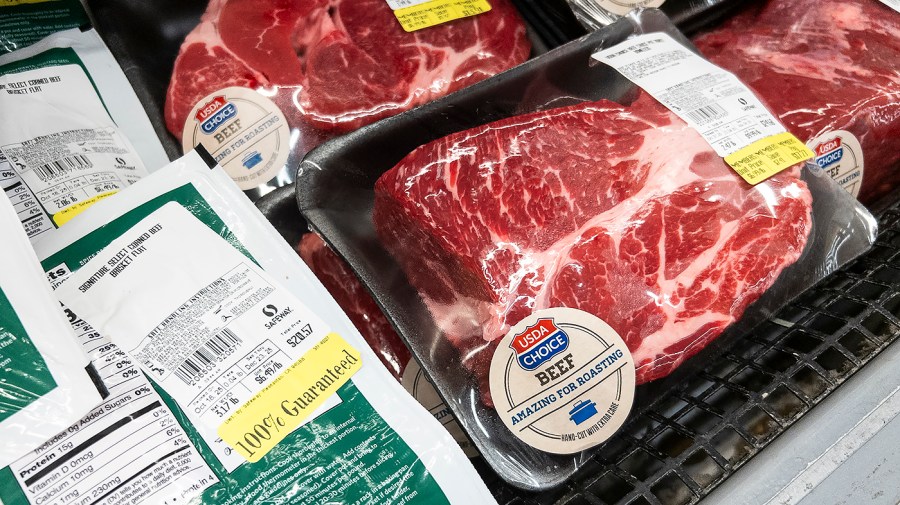
(NEXSTAR) – Beef prices are going to remain high and likely climb even higher before consumers can expect to see any relief in the coming years, experts say.
“There’s nothing anybody can do about it in the short run,” Dr. Derrell Peel, a professor of agriculture economics and the extension specialist for livestock marketing at Oklahoma State University, told Nexstar. “We don’t have enough cattle, and it takes an extended amount of time to produce more. So we’re in it for the foreseeable future.”
The high price of beef has prompted finger-pointing from politicians within the Trump administration and beyond. In separate interviews with Fox Business this past week, Agriculture Secretary Brooke Rollins and Treasury Secretary Scott Bessent blamed the Biden administration for at least some of the problems with supply.
But Democrats have argued that prices of several staple grocery items have only skyrocketed under President Trump, and that his tariffs on beef imports (which he finally said he’d scrap earlier this month) have done nothing but exacerbate the problem.
Experts who spoke with Nexstar, however, said there were other factors at play — specifically droughts that thinned the U.S. cattle supply over several years.
“Beef prices are being driven by the fundamentals I’ve talked about for months: the U.S. cattle herd is at a 70-year low, demand remains extremely strong, and it will take time for supply to rebuild,” Nate Rempe, the president and CEO of Omaha Steaks, told Nexstar. “Those factors, not politics, are what will keep upward pressure on prices into next year.”
Peel, speaking with Nexstar, said the cattle industry is inherently cyclical and usually self-correcting. (When inventory is high and prices are low, cattle producers liquidate herds; when inventory is low and prices are rising, cattle producers tend to reserve some of the female livestock for breeding to increase herd sizes.)
But Peel says the current cycle began in 2019, when herd sizes began to decline. Droughts in the following years certainly exacerbated the problem, but Peel also believes that uncertainty within the cattle industry — fueled by the Trump administration’s talk about importing beef, or open grazing land — might now be gumming up the works of the cyclical cattle production cycle.
“All of these things inject uncertainty in the market … and slows down the pace that the producers will rebuild, slows down the cattle industry,” Peel said. “It means everybody kinda hunkers down and pulls in their horns a little bit.”
Bessent, in his interview, also claimed that rising beef prices could partially be blamed on “migrants” from Mexico who allegedly brought screw worm-infected cattle over the border, forcing the U.S. to stop imports from the country. But again, Peel said Bessent “doesn’t know what … he’s talking about.” Peel explained that the U.S. only imports between 1 million and 1.2 million head of cattle from Mexico per year, which is “not insignificant,” but only makes up about 3.3 percent of total imports, and isn’t a major factor in rising prices.
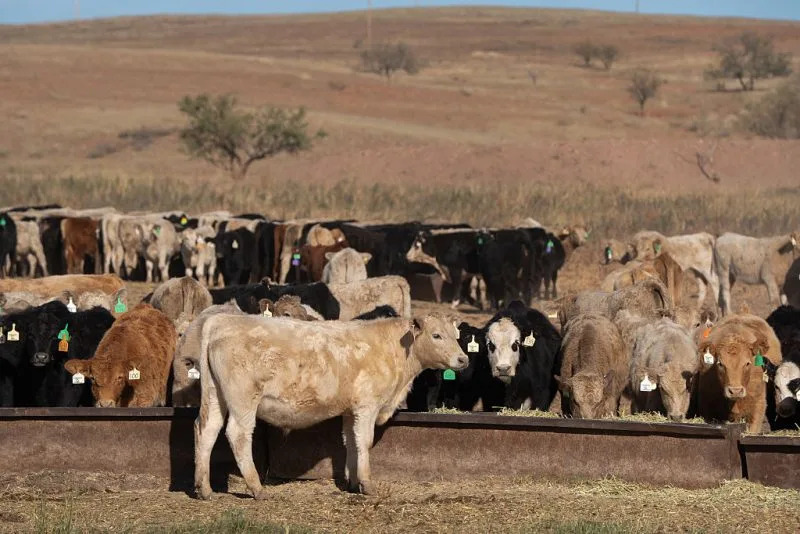
Beef cattle feed at a ranch in Sonoita, Arizona, US, on Tuesday, Nov. 11, 2025. (Rebecca Noble/Bloomberg via Getty Images)
Peel said the one thing that might bring down prices, albeit “slightly,” is a recent executive order to roll back tariffs on beef imports, but it would only affect the prices of ground beef (beef imports into the U.S. largely supplement ground beef production), and might not even be noticeable at the consumer level.
“That may have a slight moderating effect,” Peel told Nexstar, “but it’s not going to have a major impact. And I’m not sure we’re going to be able to detect it, to be honest with you.”
Rempe, speaking with Fox Business earlier this month, had predicted a “reality” in which ground beef would reach $10 per pound before the end of 2026. Peel couldn’t say for certain, but noted that prices for ground beef are already “not far off” in parts of the U.S., while the costs of other cuts have risen even faster since last year.
Both Rempe and Peel, meanwhile, say prices aren’t likely to come down for a long time, despite attempts at intervention from the Trump administration.
“America is in for a bit of a long haul here, and we won’t really see material downward movement in price until late 2027,” Rempe told Nexstar.
Peel suggested a similar time frame, adding that inventory will get even slimmer (and prices even higher) before the cycle corrects itself.
“The inevitably biology of cattle production means it’s going to get tighter before we get better, before we start retaining those females for cattle production,” he said. “Increased imports may affect a little bit of those ground beef prices, but steak prices at restaurants, or stores — there’s absolutely nothing anybody can do about it for two to four years.”
Copyright 2025 Nexstar Media, Inc. All rights reserved. This material may not be published, broadcast, rewritten, or redistributed.
For the latest news, weather, sports, and streaming video, head to The Hill.